Jacksonville Stucco Repair & Painting Resource Center
Stucco problems, cracks, moisture, repairs and painting for Northeast Florida homes.
Cracks, white deposits, rust stains, bubbling paint, loose stucco and repairs that keep failing can look like unrelated problems. Often they're connected — by movement, moisture, surface condition, or the wall assembly behind the finish. This resource center helps Jacksonville homeowners identify what they're seeing, understand what it may mean, and find the right next step before repairing or repainting.
Serving Northeast Florida since 20015,000+ residential projects completedStucco repair and exterior paintingInsured
The visible symptom is not always the underlying problem. A crack, stain, bubble, rust spot, or white deposit is a clue — the important question is why it developed.
Where Should You Start?
Pick the description closest to what you're actually looking at. Each path leads further down this page.
1. I found a crack
Hairline, diagonal, horizontal, around a window, or a crack that keeps coming back after it was repaired.
Start with what you can actually see. Appearance alone can't establish a cause — but it narrows the possibilities and tells you where to look next.
Hairline cracks
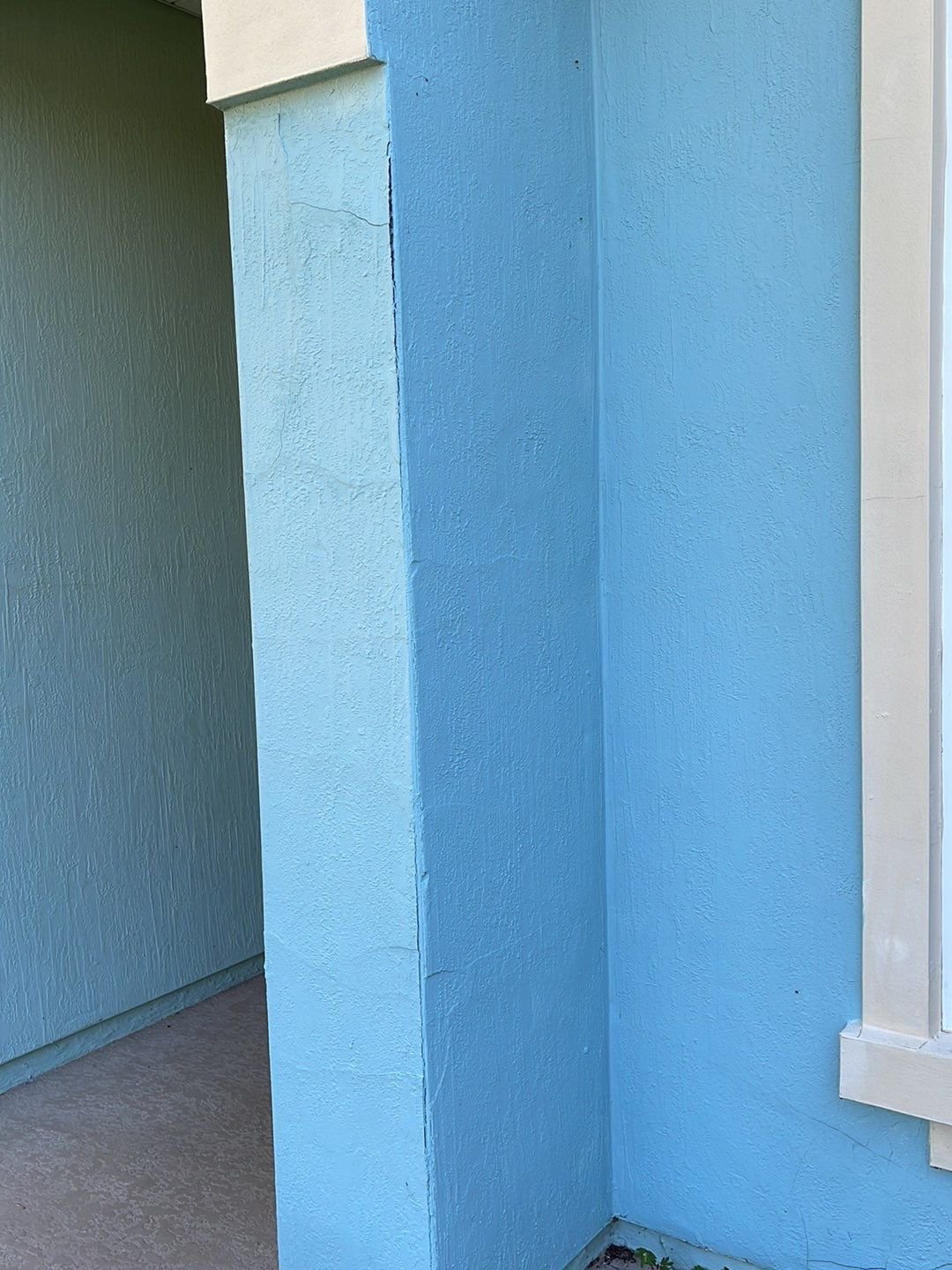
Very narrow lines, often only visible in angled light. Can be associated with shrinkage, minor movement, or ordinary aging of the finish. Deserves closer evaluation when it widens, recurs after repair, or appears with staining.
Angled lines running out from an opening corner. Openings interrupt the wall and concentrate stress at corners. More concerning when several openings show the same pattern, or when staining appears below.
A line reopening in the same place after repair. May indicate continued movement, a rigid repair in a moving location, or a moisture condition that was never addressed.
Efflorescence — mineral salts carried out of the masonry by moisture and left behind as water evaporates. Recurring deposits can indicate moisture is still moving through the wall.
Darker patches, streaks, or areas that stay damp after the rest of the wall dries. Where a stain appears may not be where water entered — it can travel behind the finish before emerging.
Can be associated with corrosion of metal behind the finish, or with an external source above the stain. The distinction matters, because a stain-blocking primer doesn't stop active corrosion.
Raised blisters in the coating film. The stucco underneath may still be sound. Often points to moisture behind the film, adhesion failure, or application over a contaminated surface.
The wall surface itself protrudes, usually across a broader area than a paint blister. Can indicate the stucco has lost bond with the substrate behind it. Paint doesn't restore adhesion.
A different sound when tapped compared with surrounding wall. A useful clue — but sound alone doesn't establish why the area is hollow or how far the condition extends.
Material that flexes under gentle pressure, separates at edges, or comes away from the wall. Unsound material needs to be addressed before any coating is applied.
Coating lifting or curling away. Can involve moisture, chalking that was painted over, contamination, incompatible coatings, or preparation shortcuts on the previous job.
Sealant that has hardened, split, shrunk, or pulled away from a window or door frame. A fresh coating over failed sealant hides the gap without correcting the joint.
Each guide below goes deep on one condition. If you're not sure where to begin, start with the crack guide — more stucco questions trace back to cracking than to any other single condition.
Why Is My Stucco Cracking? Types of Stucco Cracks
The starting point for every crack question. Distinguishes hairline, spider and map cracking, vertical, horizontal, diagonal, window and door, material-transition, and recurring cracks — and explains what makes each one more or less concerning.
Openings concentrate stress and depend on sealant and flashing details to manage water. Covers diagonal corner cracking, perimeter separation, failed sealant, and when cracking at an opening deserves closer investigation.
How moisture, soluble salts and masonry produce white deposits, why recurring efflorescence matters more than a one-time appearance, and how to tell it apart from paint chalking.
Separating a failed coating film from stucco that has lost bond with the wall. Covers hollow-sounding areas, bulging, loose material, and why paint can't reattach anything.
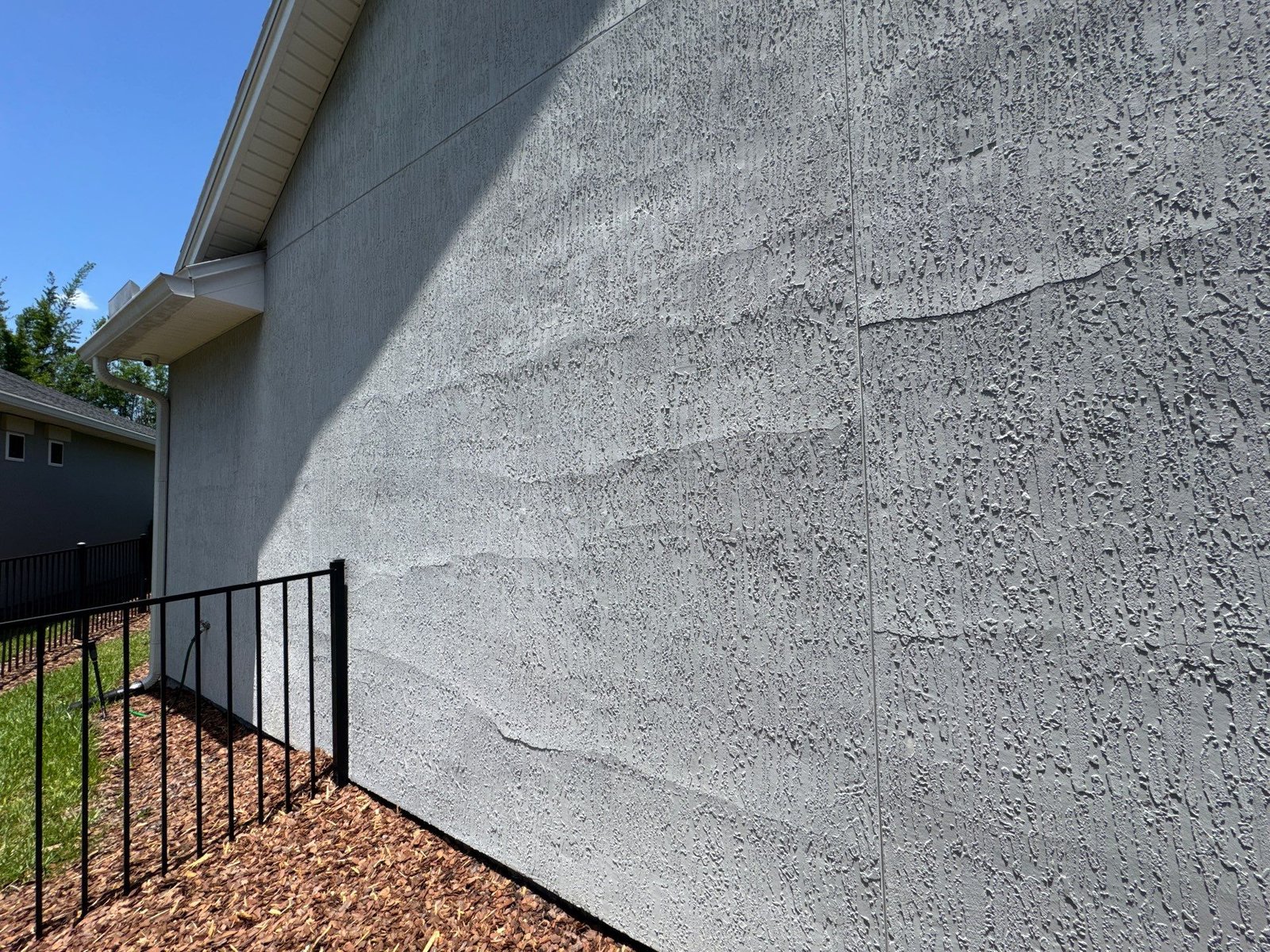
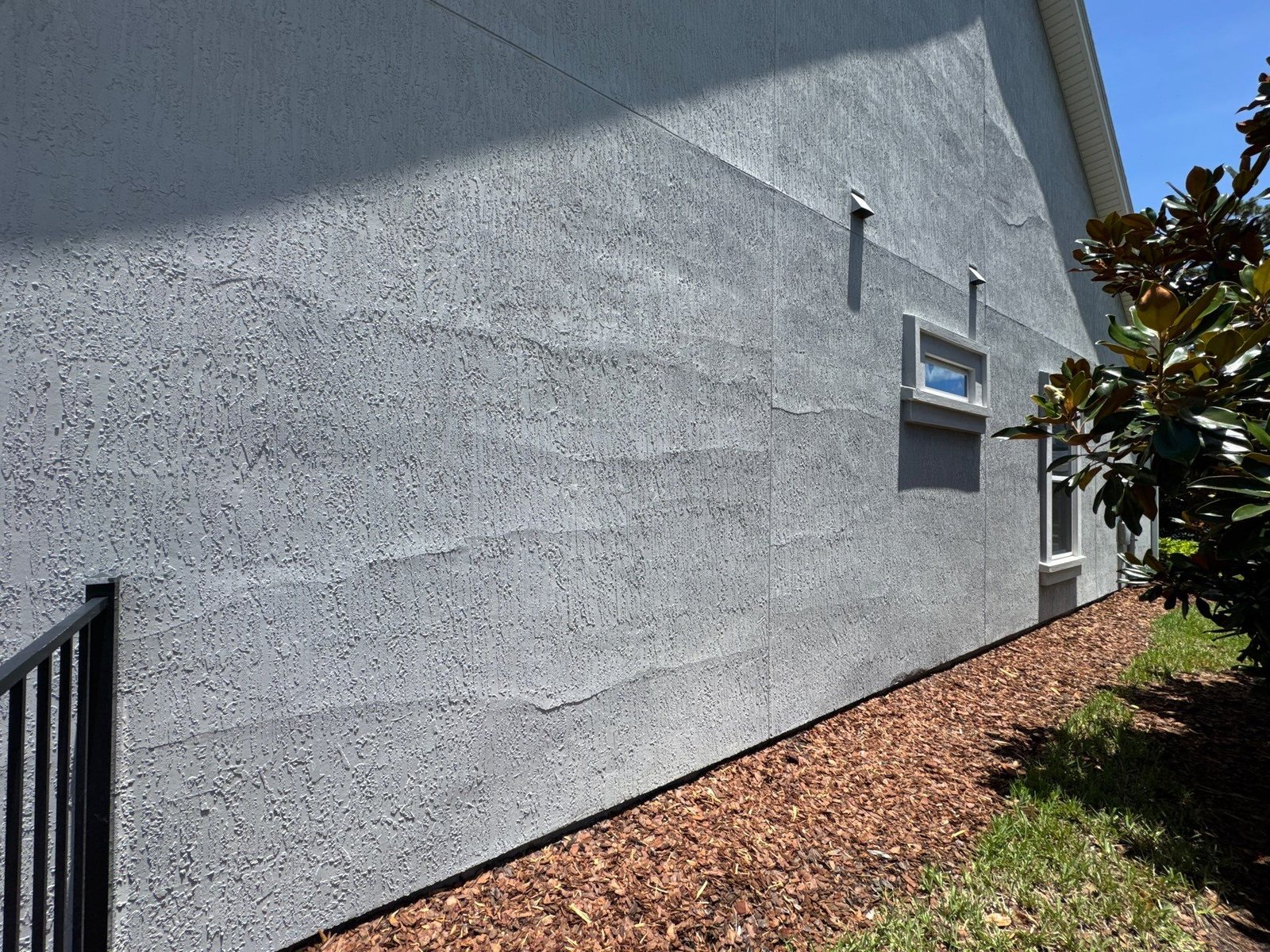
Field ExampleDelaminated stucco separating from the underlying wall before repair. The important distinction is whether the coating has failed or the stucco itself has lost bond.
Why Does Stucco Keep Cracking After Repair?
Why repeated repairs fail when movement, material transitions, moisture, substrate conditions, or the wrong repair approach remain unresolved — and how the failure pattern itself tells you which.
Water Stains on Stucco: Where Is the Moisture Coming From?
Where water appears is not necessarily where it entered. Covers staining below windows, at cracks, near rooflines and penetrations, and how to tell active staining from historical.
Stucco Repair Before Painting: What Actually Needs Fixing?
Which conditions are handled by ordinary preparation, which need real repair first, and which mean painting should wait. Includes a condition-by-condition decision guide.
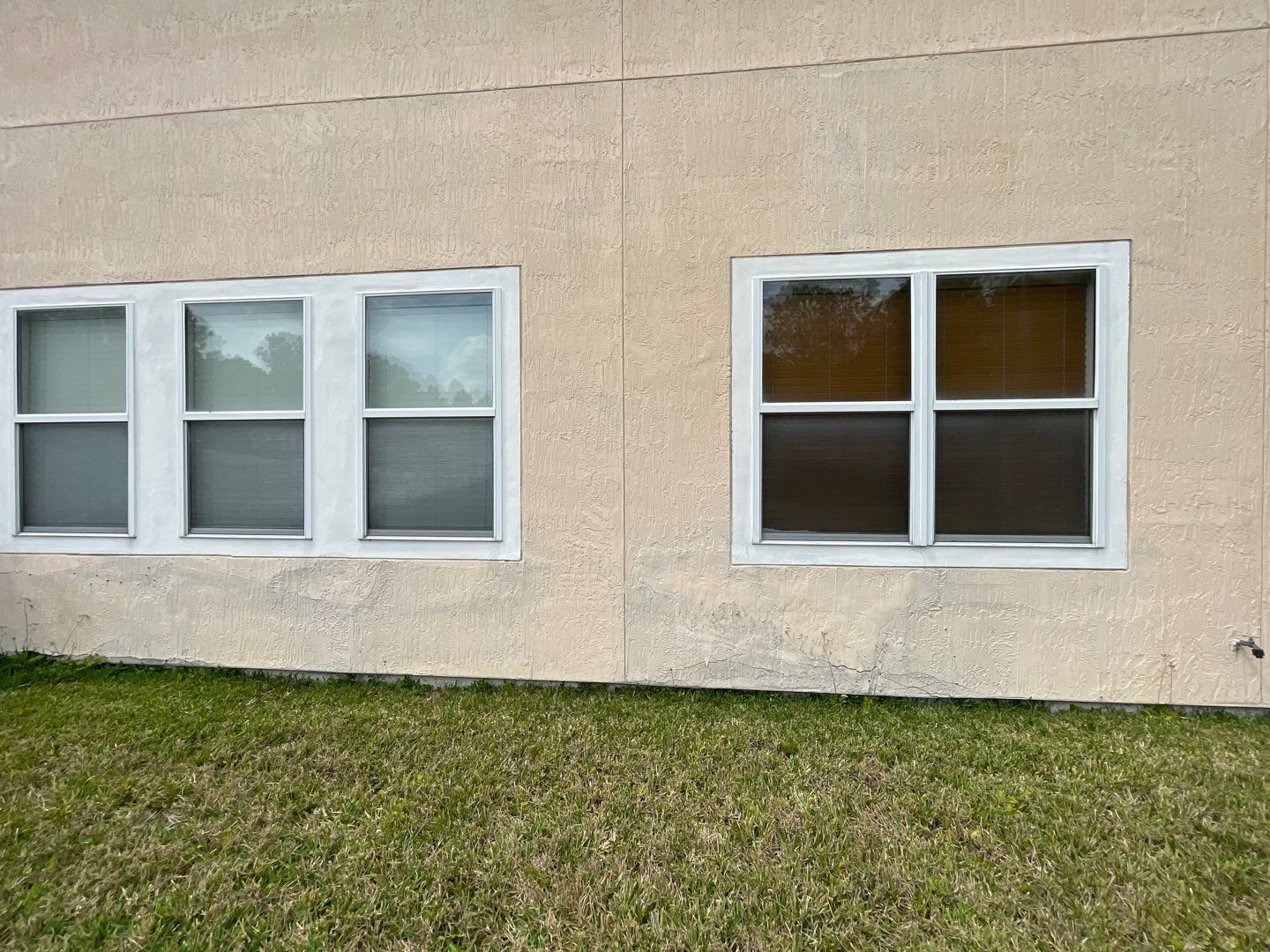
Irrigation striking a wall on a schedule is one of the more overlooked causes of lower-wall staining and deposits — and one of the simplest to check before assuming anything more complicated.
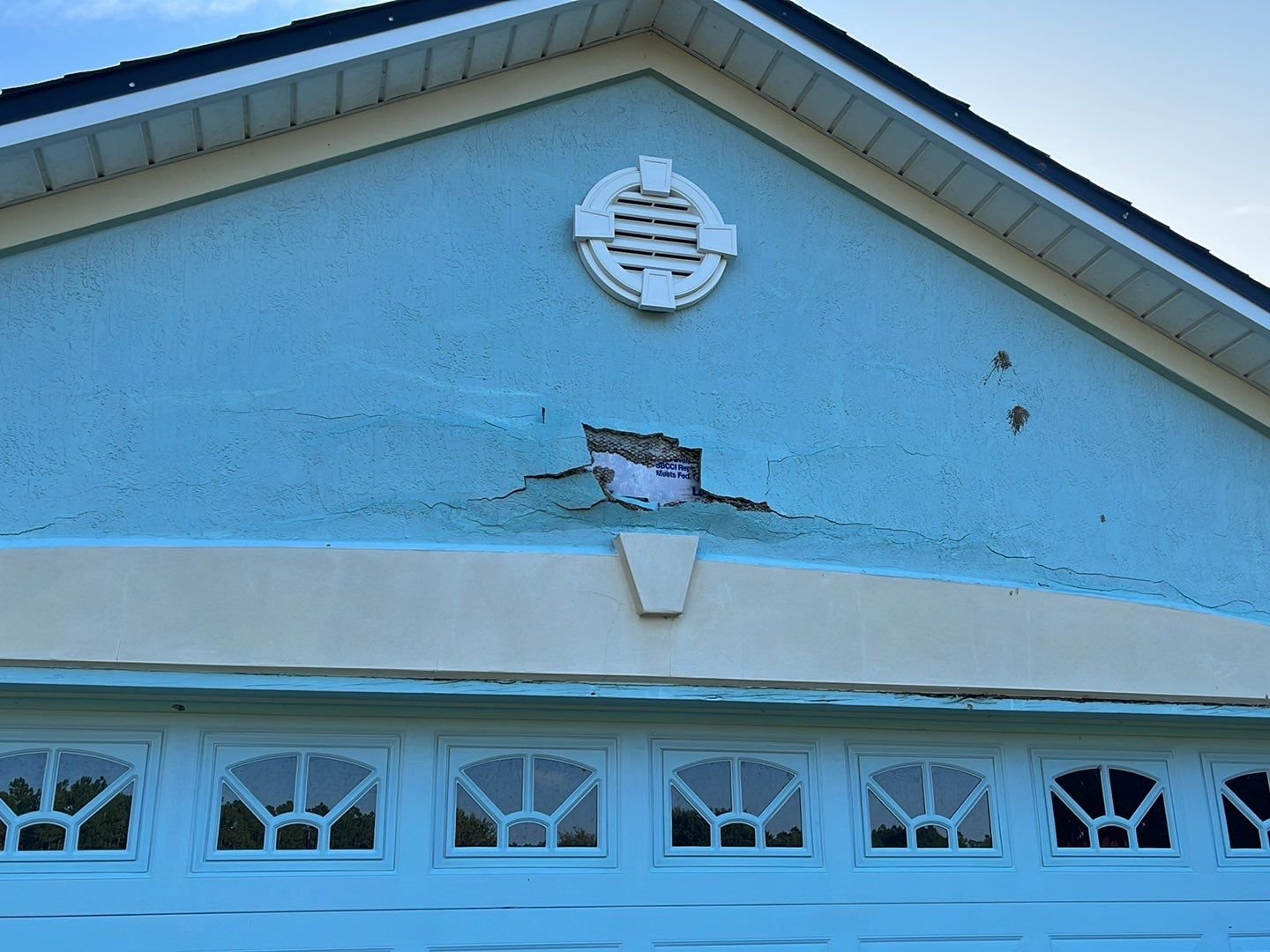
Before RepairSevere cracking documented on a Jacksonville stucco exterior before repair. Crack width, pattern, recurrence, surrounding staining, and whether the adjacent material remains sound all affect the next step.
When One Symptom Becomes More Important
A single symptom in isolation often means something ordinary. The same symptom alongside another one can mean something different. These combinations don't diagnose a wall — they're the pairings that make us look harder.
Crack + white powder
Efflorescence at a crack suggests moisture has been moving through the masonry in that area, rather than the crack being purely cosmetic.
Crack + rust staining
May indicate moisture reaching embedded metal where the assembly includes it. Corroding metal expands, which can contribute to the cracking itself.
Crack + bulging
Can point to loss of bond or movement beneath the finish. A crack in sound stucco is a different repair problem from a crack running through material that has separated.
Water stain + peeling paint
Coating failure concentrated in a stained area makes moisture an important factor to investigate before recoating.
Window crack + interior staining
Suggests the condition may involve the opening or the wall assembly rather than the finish alone, and warrants evaluation beyond a coating decision.
Repaired crack + new crack in the same line
Continued movement, an unresolved moisture condition, or a repair material that didn't suit how that location behaves.
Hollow stucco + rust bleed
Depending on the wall assembly, can suggest bond deterioration associated with corrosion — a combination worth evaluating before repair.
Field ExampleCracking through material that has also lost bond is a different repair problem from an isolated crack in otherwise sound stucco.Field ExampleBulging across the wall surface can indicate that the stucco itself has lost bond. Paint cannot reattach material that has separated from the wall.
What you’re seeing
Bulging — the wall surface protrudes beyond adjacent areas.
Delamination — stucco has separated from another layer or from the substrate.
Cracking — may exist on its own, or accompany bond failure.
Exposed sheathing — only becomes visible after failed finish material has been removed.
Monitor, Repair, Investigate, or Repaint?
Most stucco decisions land in one of four places. Knowing which one you're in is more useful than knowing what a crack is called.
Monitor
An isolated hairline that hasn't changed, no staining, no movement, no loose material, nothing recurring.
Photograph it with something for scale, date the photo, lightly mark the ends, and re-photograph in a few months and after storm season. A dated series answers the question better than memory does.
Repair
An open but stable crack, failed sealant, an isolated damaged area, an old patch that has failed for an identifiable reason, or localized cosmetic damage.
These generally fall within normal stucco repair and painting scope.
Investigate first
Cracks that keep returning, displacement across a crack, unexplained water staining, repeated efflorescence, widespread rust bleed, bulging or hollow areas, significant window-related moisture, or suspected structural movement.
Something is producing these, and coating over them doesn't address it.
Repaint
The stucco is sound, repairs are complete and cured, moisture conditions are resolved, the existing coating is aged or chalking, and the surface has been properly prepared.
Repainting belongs at the end of the diagnostic sequence, not at the beginning.
Why Jacksonville Stucco Homes Develop Different Problems
Northeast Florida puts a specific combination of conditions on an exterior wall: sustained UV through most of the year, frequent heavy rainfall, wind-driven rain that presses water against and into openings rather than simply falling on them, high humidity that extends how long surfaces stay wet, and repeated wet-and-dry cycling.
Add the things that vary house to house — irrigation striking lower walls, mature canopy shading one elevation while another takes full afternoon sun, large uninterrupted stucco elevations, and the number and detailing of window and door openings — and two homes built the same year can age very differently.
Exposure varies across the region as well. An inland Mandarin or Julington Creek home doesn't face what a Jacksonville Beach, Neptune Beach, or Ponte Vedra Beach property does in terms of coastal salt exposure. Riverfront and Intracoastal homes see more wind-driven rain on the water-facing elevation. Older masonry housing behaves differently from newer master-planned construction in Nocatee or St. Johns.
Not every Jacksonville house is built the same way. A stucco wall can involve very different assemblies — stucco applied directly to concrete block, or stucco over lath on a framed wall with a water-resistive barrier and drainage behind it. Flashing, sealant joints, and openings all play a role in how water is managed. What that means practically: advice written for one assembly doesn't automatically apply to the other, and the finish you can see is not the whole water-management system.
Understanding the Bigger Florida Stucco Picture
Two broader guides sit alongside this one. Jacksonville stucco problems covers the failure conditions that show up across homes in this market. Florida stucco problems steps back to the wider building-science context and the systemic issues behind stucco performance across the state.
Traditional Stucco and EIFS Are Not the Same Wall
This distinction matters more than most homeowners realize, because the two systems behave differently and are repaired and coated differently.
Traditional stucco is portland cement plaster — a cementitious material applied over masonry or over lath on a framed wall. Synthetic stucco systems, including EIFS and Dryvit-type assemblies, use insulation board with a thin synthetic finish over it. They look similar from the street. They are not the same construction.
Wall construction differs. Moisture behavior differs. Repair methods differ. Coating considerations differ. Treating an EIFS wall as though it were cement stucco — or specifying a coating for one that was intended for the other — can create problems rather than solve them.
Repair on a stucco exterior follows a sequence, and the order matters as much as the work itself.
1. Determine what the symptom actually isCoating failure and substrate failure can look identical in a photograph.
2. Inspect the surrounding conditionsThe wall around the symptom usually carries more information than the symptom.
3. Identify sound vs. unsound materialWhere does solid, bonded stucco begin and end?
4. Address active moisture sources where visible or knownRepairing around an unresolved water source repeats the failure.
5. Remove failed material where appropriateBack to sound substrate, so the repair has something to key into.
6. Repair cracks based on how they behaveA stable crack and a moving joint call for different materials.
7. Repair appropriate stucco defectsWithin the scope a repair and painting contractor can properly address.
8. Address failed sealantRemoved, joint prepared, and replaced with an appropriate exterior sealant.
9. Match texture as closely as practicalGood matching can be very good. Perfectly invisible isn't something to promise.
10. Allow appropriate cure and dry conditionsCompressing this to keep a schedule moving undermines everything above it.
11. Prime according to substrate and product requirementsFresh repairs absorb differently than the coated wall around them.
12. Apply the coating system suited to the wallThe last decision, not the first.
A stucco crack being repaired as part of exterior preparation before coating. Repair material and method should match the condition rather than simply covering the visible line.Stucco repair in progress on a Northeast Florida exterior before the wall is prepared for repainting.
Sometimes the right painting decision is not to paint yet.
Painting is worth delaying when active moisture remains unresolved, large areas are loose or delaminated, significant movement appears to be occurring, persistent window leakage is suspected, widespread embedded corrosion is suspected, repeated repair failures remain unexplained, or the substrate simply isn't sound.
In those situations, another professional may be the right next step — a structural engineer where movement is suspected, a building-envelope consultant, a waterproofing contractor, a specialized stucco contractor, or a window and flashing professional. We evaluate visible exterior conditions within our repair and painting scope and recommend additional evaluation when conditions suggest something beyond it. We don't perform invasive moisture testing, bond testing, or engineering analysis.
Painting Stucco After the Wall Is Ready
There's no universal best paint for stucco, and any recommendation made before someone has looked at the wall is a guess dressed up as expertise.
Selection depends on the existing coating and its condition, the substrate, the extent and behavior of any cracking, the wall's porosity, moisture conditions, exposure on that elevation, previous repairs, and whether the wall needs greater flexibility or different vapor permeance characteristics. Two stucco homes on the same street can warrant different systems.
Jacksonville Stucco Painting Guide
The main overview — process, preparation, products, and what a stucco repaint involves start to finish.
Elastomeric systems have legitimate uses. Correctly specified, they can bridge certain small stable surface cracks, provide a flexible high-build film, and improve weather resistance as part of an appropriate system.
They cannot stop active structural movement, repair delaminated stucco, reattach loose material, eliminate an active water source, repair embedded corrosion, or replace correct crack and joint repair. Equally, a quality acrylic masonry coating is not an inferior choice — on sound stucco with limited stable cracking, it may be exactly right. Product specification follows the wall.
On projects where conditions call for it, we specify a hybrid approach: a Sherwin-Williams Loxon XP masonry base with an Emerald Rain Refresh topcoat. The reasoning is straightforward — a masonry-oriented base coat doing the substrate work, with a premium finish handling color retention, weather exposure, and cleanability. That's a system we use where it fits, not a requirement for every stucco home, and it doesn't resolve structural or moisture conditions.
Painting vs. Repair: A Starting Point
Condition
Monitor
Repair before paint
Investigate further
Painting may be appropriate
Stable hairline crack
Yes
Sometimes
—
Yes, once prepared
Recurring crack
—
After cause is understood
Yes
After resolution
Diagonal window crack
If isolated and stable
Often
If widespread or displaced
After repair
Failed perimeter sealant
—
Yes
If accompanied by staining
After replacement
Efflorescence
If one-time and dry
Clean and prepare
If recurring
After moisture is addressed
Rust staining
If clearly external
Depends on source
If from embedded metal
After source is addressed
Water staining
If historical
Repair the pathway
If active or recurring
After drying and repair
Bubbling paint
—
Remove unsound coating
If moisture is suspected
After cause is understood
Hollow stucco
If small and stable
Often
If extensive
After repair
Bulging stucco
—
Yes
Yes
After repair
Delamination
—
Yes
Yes
After repair
Faded coating
Yes
—
—
Yes
Chalking paint
If light
Prepare thoroughly
—
Yes, after proper prep
Old patch
If sound
If failing or mismatched
If cracking has returned
After evaluation
EIFS concern
—
—
Yes — different assembly
With EIFS-appropriate approach
This is a starting point, not an inspection. Every row depends on what the rest of the wall is doing.
What We Look for on Northeast Florida Stucco Homes
These are conditions we encounter while evaluating stucco exteriors across Jacksonville and the surrounding area. They're observations about what turns up on inspections, not claims about how often any of them occurs.
Diagonal cracking running out from window and door corners
Older rigid repairs reopening along the same line, or around the patch perimeter
Perimeter sealant that has hardened, split, or pulled away from a frame
Irrigation heads striking lower stucco walls on a schedule nobody has watched in years
Efflorescence near cracks or along lower wall sections
Rust bleeding from accessories or embedded metal, where the assembly includes it
Coatings peeling from chalky or poorly prepared stucco
Several generations of repair showing through a single coat of paint
Cracking concentrated where stucco meets another material
Substantial differences between a sun-exposed elevation and a shaded one on the same house
Coastal salt exposure affecting exterior metal components on Beaches and Intracoastal properties
Homes where the right recommendation is repair first rather than an immediate repaint
Real Stucco Repair & Exterior Painting Projects in Northeast Florida
Stucco problems make more sense when you can see what they look like on an actual home. The projects below show conditions our crews have encountered while preparing, repairing, and painting stucco exteriors throughout Jacksonville and Northeast Florida. These are real project conditions — not stock photographs or examples created for this guide.
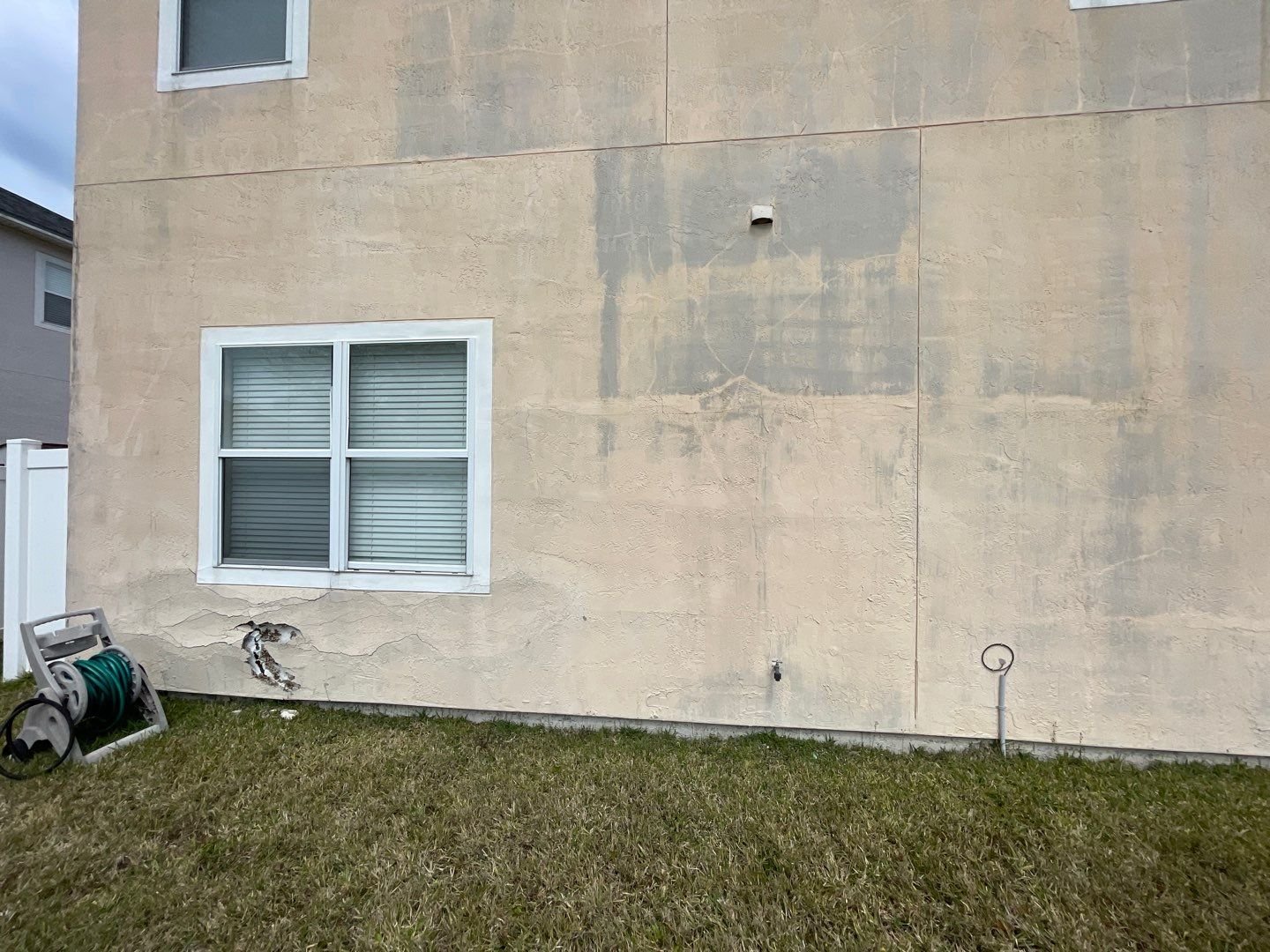
The exterior showed visible stucco delamination — areas where the stucco had lost bond rather than areas where the coating alone had failed. Bulging and loose material were present across affected sections of the wall.
Visible delamination identified during evaluation, before any repair or coating work began.
What Removal Revealed
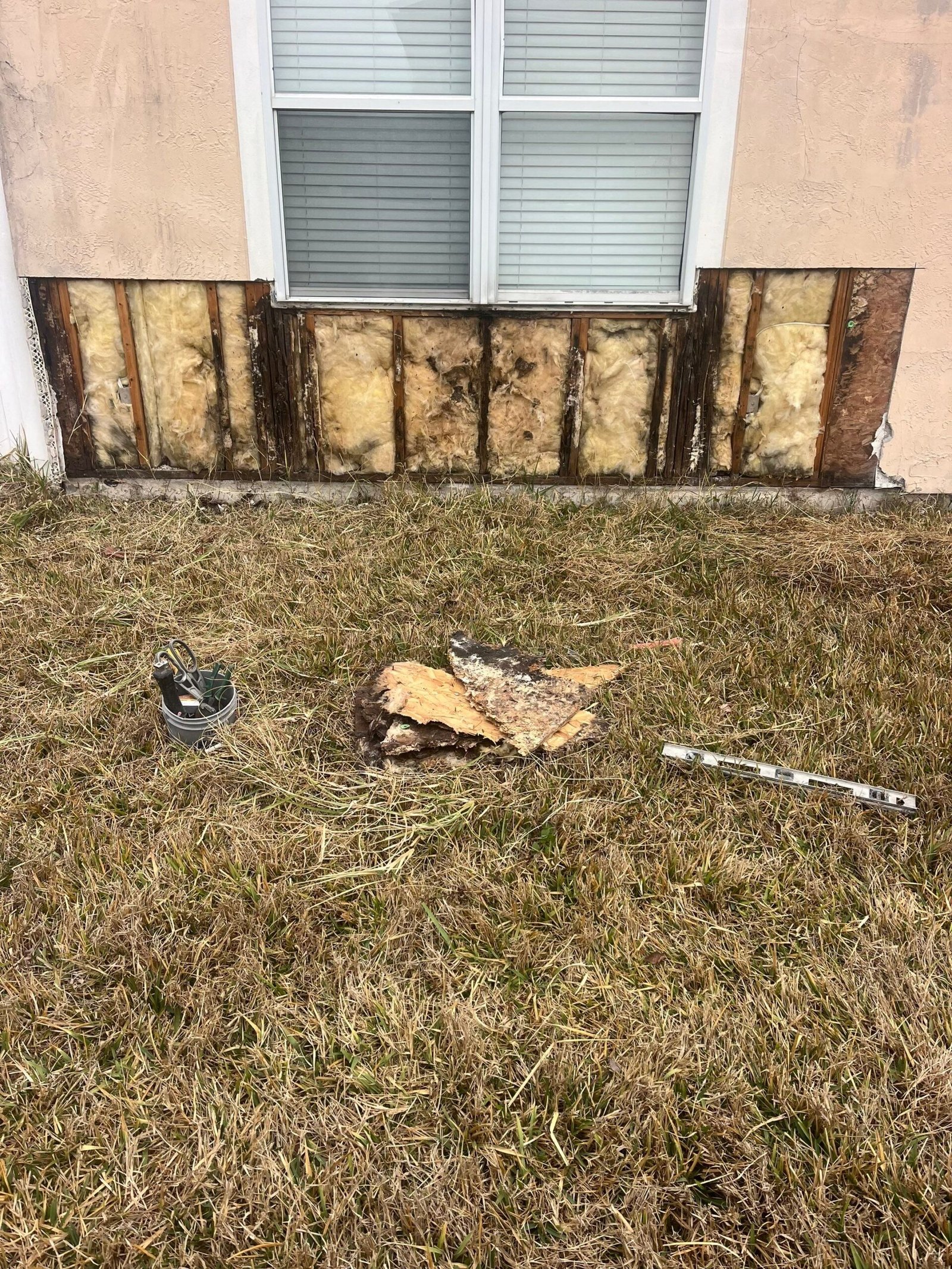
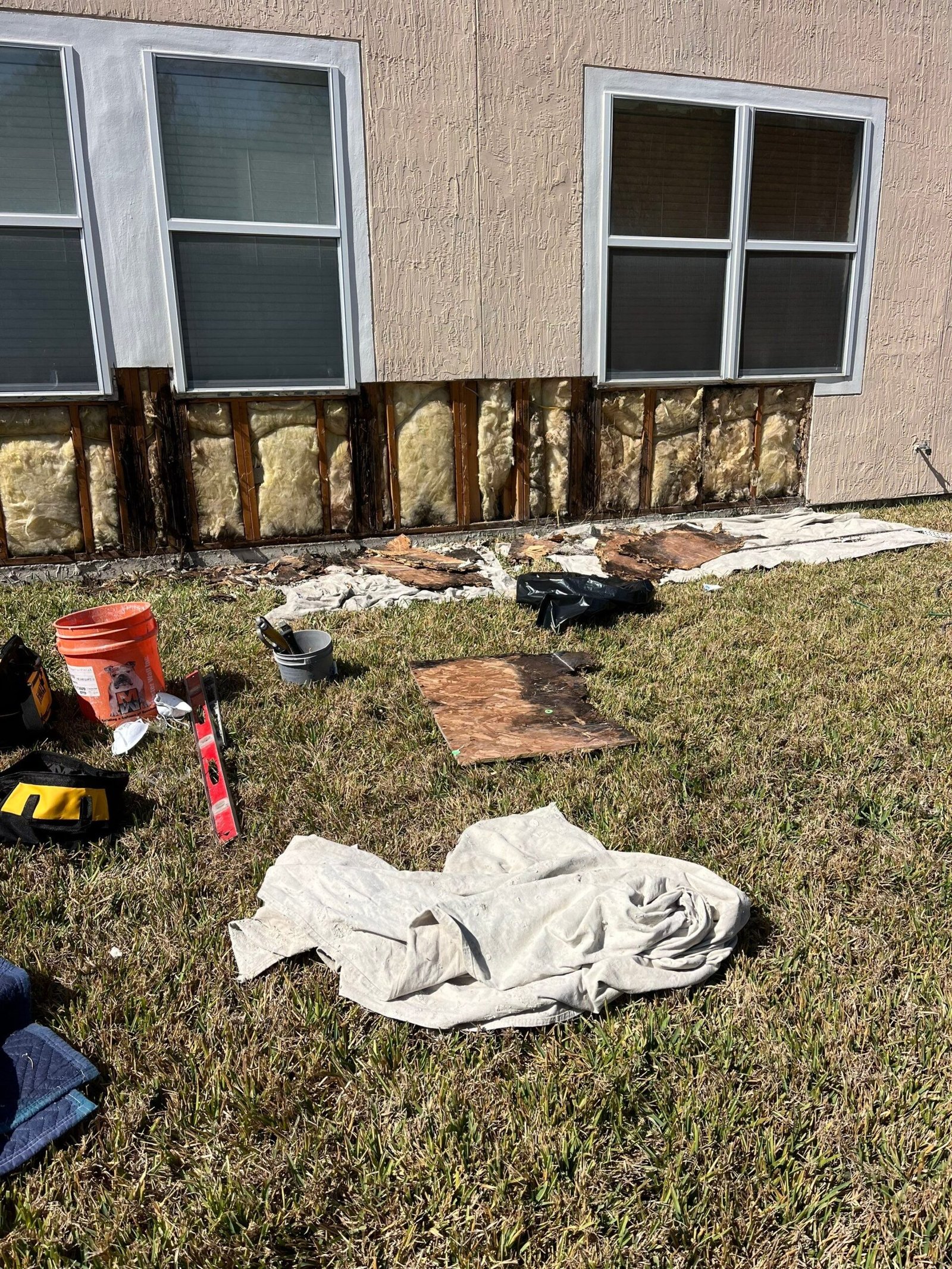
Once the unsound stucco was removed, deteriorated OSB sheathing was visible behind the failed area. That condition was not apparent from the outside — the stucco finish was concealing it.
What the wall looked like once the failed stucco came off.Another section after removal. Deterioration behind a stucco finish is only measurable once the unsound material is off the wall.
Why This Mattered
This is why visible stucco damage should be evaluated before repainting. The coating is only the outermost layer. Applying another coating over the original surface would have concealed the failed material rather than correcting it — and the deterioration behind it would have continued underneath a finish that looked complete.
The Sequence
Work on a project like this follows the order the wall requires: identify where sound stucco begins and ends, remove the unsound material, evaluate what becomes visible, repair or replace damaged substrate within appropriate scope, restore the stucco assembly, match the surrounding texture as closely as practical, and allow proper cure and dry time. Only after the repaired areas were cured, prepared and primed as required could the exterior proceed into the appropriate coating system.
These aren't separate topics that happen to share a wall. They're often stages of the same story — though not every wall follows the whole sequence, and much depends on the assembly.
A crack formsFrom shrinkage, movement, stress at an opening, or a material transition. It may stay cosmetic — or become a path.
Moisture may moveThrough the crack, or entering elsewhere and traveling behind the finish before emerging.
Moisture can contribute toEfflorescence · corrosion of embedded metal · coating adhesion problems · deterioration behind the finish.
Corrosion or loss of bond may accompanyRust staining · bulging · hollow-sounding areas · loose stucco · delamination.
A repair may recurWhen movement remains, moisture remains, the wrong material was used, or the substrate was unsound.
Paint failure appearsWhich can be coating-specific — or evidence of something happening beneath it.
Stucco Terms, Explained
Portland cement plasterThe technical name for traditional stucco — a cementitious finish applied over masonry or lath.
SubstrateWhatever the stucco or coating is applied to. Concrete block, lath, or an existing coating.
BondThe attachment between layers, or between stucco and its substrate. Loss of bond is what delamination describes.
DelaminationSeparation between layers, or between the stucco and the wall behind it. Paint cannot reverse it.
LathThe metal or other reinforcement stucco is applied over in framed-wall assemblies.
Hairline crackVery narrow cracking, often visible only in angled light. Common in cement-based finishes.
Spider or map crackingA dense network of fine interconnected cracks, frequently associated with the finish coat and curing conditions.
Control jointA planned break in the stucco giving shrinkage and movement a designated place to occur.
Expansion / movement jointA joint designed to accommodate movement between building components. Not a defect, and not something to fill rigidly.
SealantThe flexible material at joints and transitions. Different from rigid patching compound, and not interchangeable with it.
EfflorescenceWhite mineral deposits left when moisture carries soluble salts to the surface and evaporates.
Acrylic coatingA premium exterior paint chemistry commonly used on properly prepared masonry and stucco.
Elastomeric coatingA thicker, more flexible coating that can bridge certain small stable cracks. Not a repair material.
Permeability / breathabilityHow readily a coating allows moisture vapor to pass. Matters on masonry, where trapped vapor causes problems.
FlashingMaterials that direct water away from vulnerable points — openings, roof-to-wall junctions, penetrations.
Water-resistive barrier (WRB)A layer behind the cladding in some assemblies that manages water reaching it. Concealed by definition.
EIFSExterior Insulation and Finish System — insulation board with a synthetic finish. Not cement stucco.
DryvitA widely recognized brand of synthetic stucco system, often used generically for EIFS-type walls.
Stucco Questions Jacksonville Homeowners Ask Us
Are hairline cracks in stucco normal?
Some cracking is expected in cement-based finishes, and industry guidance identifies minor cracking at door and window corners as something to anticipate. That doesn't make every hairline irrelevant — recurrence, staining, and change over time matter more than the crack's existence. More on crack types.
Why does my stucco crack around windows?
Openings interrupt the wall and concentrate stress at their corners, so that's where the finish gives first. Perimeter sealant condition and water management at the opening can compound it. More on openings.
Why did my repaired crack come back?
Common explanations include continued movement at that location, a rigid material used where the joint needs to flex, a surface-only fill, or moisture still reaching the area. More on recurring cracks.
What is the white powder on my stucco?
Likely efflorescence — mineral salts carried out of the masonry by moisture and deposited as water evaporates. It's a moisture clue rather than mold. More on efflorescence.
Why is rust coming through my stucco?
It can indicate corrosion of metal behind the finish where the assembly includes it, or an external source above the stain. The distinction determines whether stain-blocking is appropriate or whether the corrosion needs addressing.
Why does one part of my stucco stay wet after rain?
An area that dries noticeably slower than the wall around it suggests moisture is doing something different there. Worth documenting before and after rain. More on water staining.
What does hollow stucco mean?
A void or poor bond behind that area. It can reflect delamination, an original application void, or a patch that never fully bonded — sound alone doesn't distinguish them. More on hollow areas.
Can I paint over a stucco crack?
Stable hairline cracking can often be addressed within preparation and the coating system. Open, recurring, or moisture-related cracks should be repaired first. More on what to fix first.
Will elastomeric paint fix cracks?
It can bridge certain small stable surface cracks when correctly specified. It can't stop movement, repair loose stucco, or resolve a water source. More on coating comparison.
Can paint hold loose stucco together?
No. Paint is a coating, not a structural adhesive. A film measured in thousandths of an inch can't hold material that has lost its bond to the wall.
Why is my stucco paint peeling?
Moisture behind the film, chalking that was painted over, contamination, incompatible coatings, or preparation shortcuts are all common contributors. More on peeling.
Does every crack need repair?
No, and blanket rules are poor practice in either direction. Treatment depends on width, stability, location, recurrence, moisture, surrounding condition, and the coating system.
How do I know whether I have traditional stucco or EIFS?
They can look similar from the street but behave very differently, and it changes both repair and coating decisions. How to tell them apart.
Where This Fits
This page is the front desk for stucco. For the wider exterior picture — coatings, preparation, Florida weather, paint failure and maintenance across every substrate — see the Exterior Painting Resource Center.
Reviewed by Thomas Drake, Owner — A New Leaf Painting Contractors
A New Leaf Painting Contractors has served Jacksonville and Northeast Florida since 2001, with more than 5,000 residential projects completed. This resource center combines field observations from evaluating and coating stucco exteriors in this market with manufacturer technical guidance, industry standards, and published building-science sources. It reflects what a repair and painting contractor can assess from the exterior — not engineering analysis, invasive moisture testing, or a home inspection.
Ready to Have Your Stucco Looked At?
If you've identified the symptom but still aren't sure whether your home needs normal stucco repair, additional investigation, or simply proper preparation before repainting, we can evaluate the visible exterior condition and explain what falls within our scope — including when it doesn't.
Sometimes a crack has been stable for years and can be handled during ordinary repaint preparation. Sometimes the condition needs stucco repair before painting. And sometimes the right recommendation is to have another professional investigate the underlying problem before anyone paints over it.