
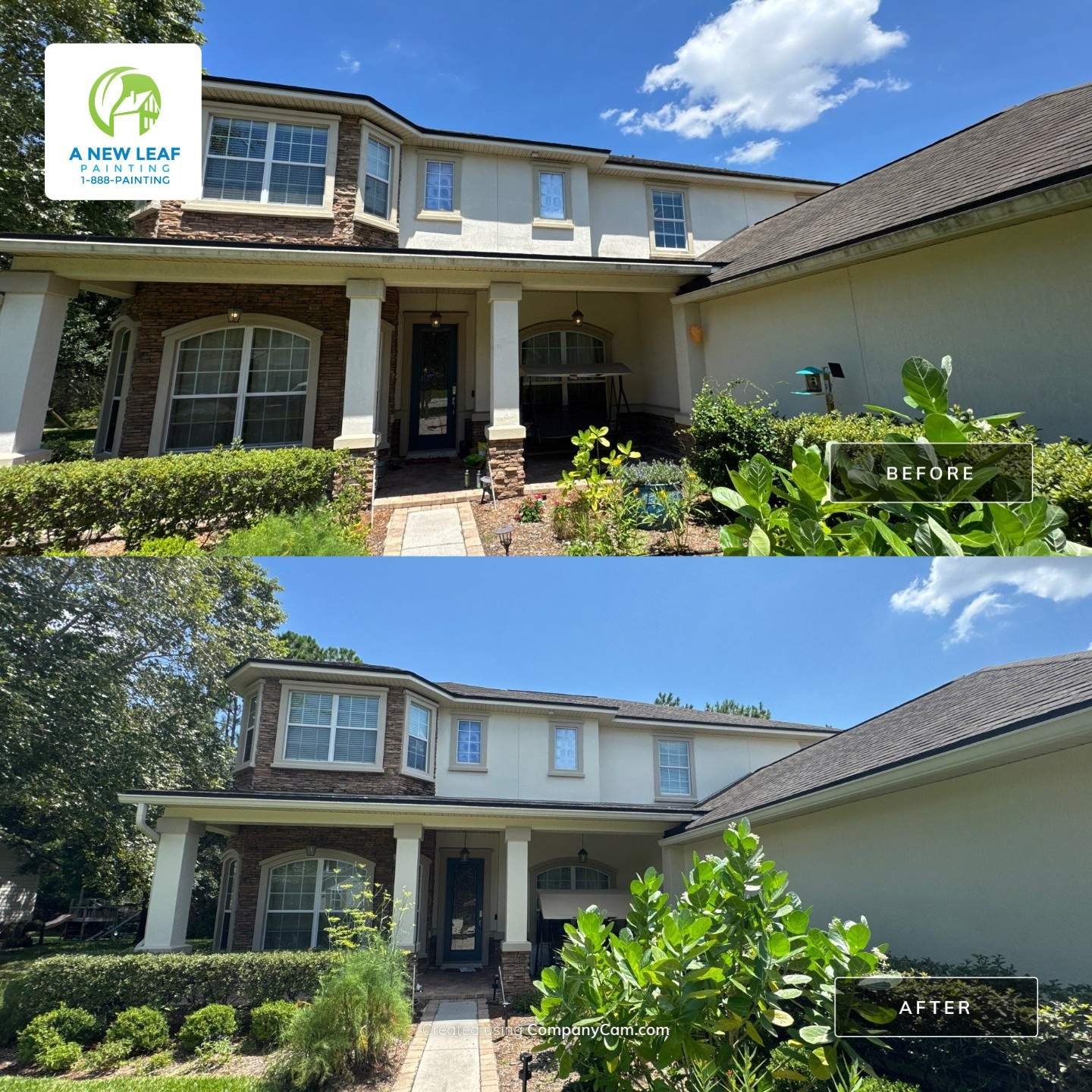
This project showcase documents a large exterior stucco repaint completed by A New Leaf Painting Contractors in Jacksonville, FL 32257 — a two-story home with substantial stucco wall surfaces, a covered entry porch, architectural columns, stone veneer accents, soffits, fascia, exterior trim, and a front door, all addressed as part of the exterior painting project. The photographs on this page are real project documentation from our crew.
A project at this scale involves considerably more than applying a new color. The existing exterior required thorough cleaning, stucco crack repair and preparation, caulking and sealing at appropriate joints and penetrations, and a coating system selected for the surfaces being painted. That preparation helps provide a properly conditioned substrate before the finish coatings are applied. For more on how our professional exterior painting in Jacksonville, FL projects are prepared and coated, visit our main Exterior Painting service page.
Project Snapshot
| Project | Large Exterior Stucco Repaint |
| Location | Jacksonville, FL 32257 |
| Service | Exterior House Painting |
| Primary Surface | Stucco (two-story, multiple elevations) |
| Additional Surfaces | Soffits, fascia, exterior trim, window surrounds, front door, columns |
| Preparation | Pressure washing, stucco surface preparation, crack preparation and sealing, caulking and sealing of joints and transitions, stucco patching where required, masking and property protection |
| Coating System | Sherwin-Williams® Loxon® XP (stucco/masonry surfaces), Sherwin-Williams® Latitude® Exterior Acrylic Latex (body/trim surfaces), Sherwin-Williams® Pro Industrial® (soffit/fascia surfaces) |
| Color | Light neutral body with white trim contrast; darker accent front door |
| Contractor | A New Leaf Painting Contractors — Serving Northeast Florida Since 2001 |

A Large Stucco Exterior Repaint in Jacksonville 32257
This is a substantial two-story home with stucco wall surfaces spanning multiple elevations — front facade, side, and rear — along with a large covered entry porch, prominent architectural columns, arched windows, stone veneer accents at the base, and an attached three-car garage wing. A project of this size involves coordinating preparation and coating work across a significant amount of exterior surface area, with different surfaces and substrates requiring different treatment.
The written scope included the stucco body walls, exterior trim and window surrounds, entry columns, soffits, fascia, and front door. Stone veneer and brick accents were not painted — they remained as architectural contrast elements. The color direction shifted the stucco body to a lighter, cooler neutral, which reads distinctly different from the weathered cream tone that had developed over time. White trim provides clean contrast throughout.
This was not a straightforward color change. The existing stucco surfaces required attention before any finish coating was appropriate, and the scope of that preparation work was determined by the actual condition of the home’s exterior at the time of the estimate walk.
Exterior Condition Before Painting
The photographs from this project document what our crew found on the initial estimate walk: a large stucco exterior that had reached the point where the existing coating had deteriorated significantly. The stucco body showed visible weathering and fading across all elevations, with the surface appearing aged and uneven in tone. A horizontal crack line was visible across the upper stucco field on the side elevation — the kind of surface movement that is common on stucco construction in Florida’s climate, where expansion and contraction cycles occur year-round.
The existing coating showed the characteristic dullness and surface degradation that develops on older exterior stucco in Northeast Florida’s UV exposure and humidity. Open or deteriorated caulk joints at transitions and penetrations are standard findings on a home of this age — areas where moisture can migrate behind the stucco surface if left unsealed going into a repaint.
None of these conditions were unusual. They are what we regularly encounter on Jacksonville-area stucco homes that are due for repainting. The preparation work addressed them systematically before any coating was applied.
Preparing the Stucco Before Repainting
Preparation on this project followed our standard exterior stucco process, with the actual scope of each step driven by the existing surface conditions documented during the estimate walk.
Pressure washing and exterior cleaning came first. The full exterior — stucco body walls, trim, soffits, and other included surfaces — was thoroughly washed down to remove environmental buildup, surface contaminants, and any loose coating material before preparation work began. Applying a new coating over a contaminated surface is one of the more common causes of adhesion failure on exterior repaints.
Stucco surface preparation followed cleaning. Loose or failing coating material was addressed, and the surface was prepared to provide a stable base for the new coating system. Where the surface required scraping or additional preparation to reach a condition appropriate for recoating, that work was completed before priming or coating.
Crack preparation and sealing. The visible horizontal scoring and surface cracking on this home — typical of stucco construction in Florida’s thermal expansion environment — was prepared and sealed as part of the painting scope. These were normal surface conditions addressed within the standard exterior painting process, not structural or building-envelope repairs. Where stucco patching was required to restore the surface, that work was included and completed before priming and coating.
Caulking and sealing of appropriate joints, trim transitions, window and door perimeters, and penetrations was completed as part of the preparation scope. Open caulk joints on a stucco home in Jacksonville’s rain-heavy climate are a preparation step, not an afterthought — unsealed transitions allow moisture to migrate behind the surface, which shortens the performance of any exterior coating system.
Masking and property protection was completed before coating work began — windows, stone veneer, hardscape, and adjacent surfaces were protected throughout the project.
Where priming, sealing, or conditioning of specific surfaces was appropriate based on substrate and existing conditions, that work was completed before finish coatings were applied.

The Exterior Paint & Coating System
Coating selection on this project followed evaluation of the existing surfaces — not a single product applied uniformly to everything. The stucco body walls, exterior trim and window surrounds, soffits, fascia, and front door each have different substrates and exposure conditions, and the coating system was matched accordingly.
Sherwin-Williams® Loxon® XP was applied to the appropriate stucco and masonry surfaces on this project. Loxon XP is a high-performance masonry coating formulated for demanding masonry substrates — it is not a primer in the traditional sense, but a coating system designed to address the porosity, surface conditions, and performance requirements of exterior stucco in climates like Northeast Florida’s.
Sherwin-Williams® Latitude® Exterior Acrylic Latex was used on appropriate exterior body and trim surfaces. Latitude is a professional-grade exterior coating formulated for durability in demanding climates, with the flexibility and adhesion performance relevant to Florida’s UV exposure and humidity conditions.
Sherwin-Williams® Pro Industrial® coatings were applied to the soffit and fascia surfaces. Soffits and fascia operate in different exposure conditions than open stucco wall surfaces — particularly on a home with a large covered entry porch and substantial roof overhang — and Pro Industrial products are formulated for the durability and adhesion that these surfaces require.
The front door received appropriate exterior coating as part of the repaint scope. We do not imply that any single product was applied to every surface on this project — the system was built around what each substrate and condition actually called for.
We do not make unsupported lifespan claims about any coating system. Performance depends on preparation, application conditions, and ongoing maintenance — all of which vary by project. For more on how we approach coating selection on Jacksonville exterior projects, see our Exterior Painting Resource Center.
The Finished Jacksonville Exterior
The completed photographs show what this home looks like after a full exterior stucco repaint that addressed the existing surface conditions properly before a single finish coat was applied.
Across the front facade, the stucco body now reads as a clean, uniform light neutral — significantly different in both tone and condition from the weathered, uneven surface documented in the before photographs. The entry columns are crisp white, providing clear contrast against the stucco body. Trim and window surrounds carry the same clean white throughout, creating a consistent architectural line across all elevations. The soffits — previously yellowed and weathered — read as a clean, painted surface. The front door provides an accent in a deeper blue-teal tone that reads well against both the light stucco body and the stone veneer at the entry.
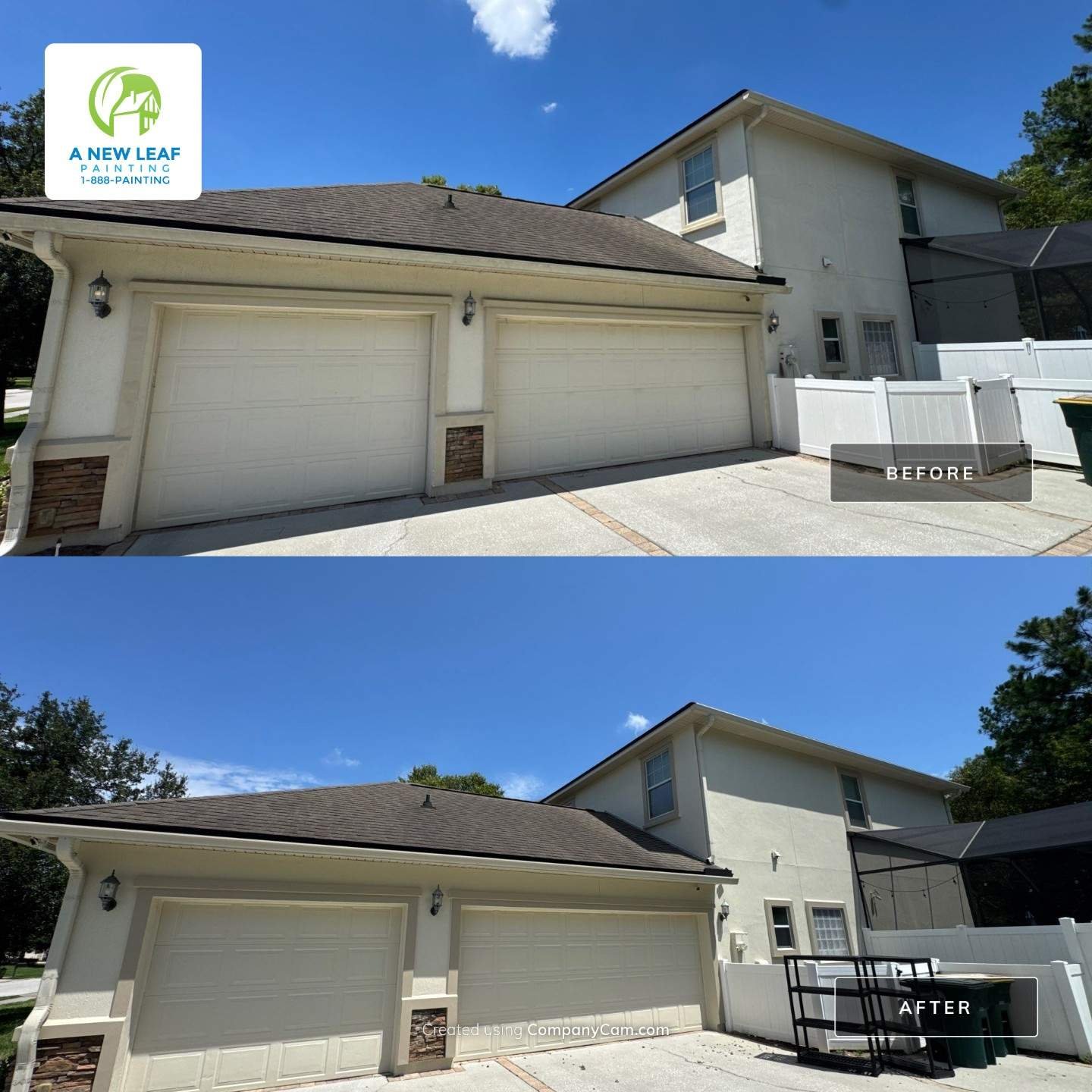
On the garage elevation, the stucco color shift is especially visible — the before and after comparison shows the extent of the weathering that had developed on the original coating and the degree of change produced by the repaint.
The stone veneer and brick accent elements were not painted, which was the right decision for this home. They provide the architectural contrast that defines the facade’s character, and they read more clearly against the refreshed stucco body than they did against the faded original.

Why Preparation Matters on Jacksonville Stucco Homes
Jacksonville’s climate is not forgiving to exterior coatings. UV exposure is intense and year-round, summer heat and humidity accelerate surface degradation, and the region’s heavy rainfall — often wind-driven — puts pressure on caulk joints, stucco transitions, and any area where moisture can find a path behind the surface.
On Jacksonville stucco homes, the result over time is predictable: chalking and surface degradation as UV breaks down the existing coating’s binders, moisture migration through unsealed joints, thermal cracking as the stucco expands and contracts through seasonal cycles, and general coating fatigue that makes the surface look aged well before the home itself is. Understanding why exterior paint becomes chalky in Jacksonville is part of understanding why the preparation step — not just the finish coat — determines how well a repaint performs.
On this 32257 project, addressing those conditions systematically before applying the new coating system was what made a multi-product, substrate-specific repaint meaningful rather than a temporary cover-up. The photographs show the result. The preparation work is what gives that result staying power.
For an in-depth look at the preparation process behind our exterior projects, see our overview of stucco repair and preparation before exterior painting.
Exterior Painting Experience in Jacksonville’s 32257 Area
Jacksonville’s 32257 zip code covers an established residential area in the south-central part of the city — a mix of mature neighborhoods, larger single-family homes, and well-established construction that ranges in age from the 1980s through the 2000s. Stucco exteriors are common throughout this part of Jacksonville, and they tend to present similar conditions when they reach the point of needing a repaint: weathered coatings, surface chalking, failed caulking at trim transitions, horizontal and hairline cracking from thermal movement, and occasionally localized stucco deterioration at areas with higher moisture exposure.
A New Leaf Painting Contractors has been working on exterior painting projects in Jacksonville and across Northeast Florida since 2001 — through Duval, St. Johns, Clay, and Nassau counties. The 32257 area represents the kind of project we encounter regularly: a substantial stucco home with a real preparation story behind it, where doing the work correctly from the ground up matters more than moving quickly from can to wall.
If your home is in this part of Jacksonville — or elsewhere in the region — and the exterior is showing the signs described here, the process begins with an evaluation of the existing surface conditions and a written estimate that defines exactly what preparation and coating work is appropriate for your home’s specific situation.
Planning an Exterior Repaint in Jacksonville?
If your Jacksonville home has weathered stucco, fading coatings, failed caulking, surface cracking, or is simply ready for a new exterior color, A New Leaf Painting Contractors can evaluate the existing surfaces and develop a written exterior painting scope based on the home’s actual condition — not a one-size-fits-all proposal.
Learn more about our exterior painting services in Jacksonville, FL.
Or call us directly to schedule a free estimate:
904-615-6599
A New Leaf Painting Contractors · Serving Jacksonville and Northeast Florida Since 2001 · Fully Licensed and Insured
More Real Project Spotlights
Different substrates, different conditions, different coating specifications.
- Stucco repair and exterior painting in Jacksonville 32246 — conventional stucco, localized delamination, substrate repair.
- Synthetic stucco exterior painting in Coastal Oaks, Nocatee — synthetic stucco, Sherwin-Williams® Duration® Exterior.
- Exterior house painting in Coastal Oaks, Nocatee — James Hardie® lap siding, Sherwin-Williams® Emerald® Exterior.
Looking for painters closer to home? Start with our exterior painters near me, residential painters near me, and painting contractors near me pages.