In this article
- Why do sprinklers leave stains on stucco?
- Why sprinkler staining is so common on Jacksonville homes
- Why the bottom of my stucco wall looks worse
- What color are the stains?
- Are sprinkler stains the same as efflorescence?
- Can sprinklers damage exterior paint?
- Is it a stain, chalking, fading, mildew or paint failure?
- Can sprinkler stains be cleaned off?
- Fix the sprinkler before you fix the wall
- Can you paint over sprinkler stains?
- Why do the stains keep coming back?
- What if the stucco is cracked too?
- Does the whole house need repainting?
- How to prevent sprinkler stains from returning
- Frequently asked questions
- Ready to have your stucco evaluated?
Sprinklers stain painted stucco because they wet the same patch of wall over and over. As the water dries it leaves minerals, iron or dirt behind, and in shady spots the constant dampness feeds mildew. Our exterior painters in Jacksonville, FL see it all the time on lower stucco walls, garage walls and anywhere a sprinkler head hits the house.
A stain doesn't automatically mean the paint has failed, so the first fix is usually not repainting. Since 2010, our approach to exterior painting in Jacksonville, FL has been the same: find what's causing the stain, fix the sprinkler, clean the wall the right way, let it dry and then see what's left. If the paint underneath is sound, cleaning may be all it needs.
Why do sprinklers leave stains on stucco?
Sprinkler staining is really a few different things that look alike at first:
- Mineral deposits. Water carries dissolved minerals. One watering leaves nothing you can see, but months and years of spray drying on the same spot build up into a visible stain.
- Iron staining. Irrigation water, especially from a well, can carry iron that leaves orange, rusty or brown marks. The iron usually comes from the water, not from the wall.
- Mildew and algae. Repeated wetting plus humidity, shade and slow drying grows dark, green, gray or blotchy patches.
- Dirt. A wet wall holds dust, pollen and splashed mulch better than a dry one.
- Weathering paint. Sprinklers don't destroy sound paint, but on paint that is already old, thin, chalky or poorly bonded, the wet area can wear faster than the rest of the house.
Why sprinkler staining is so common on Jacksonville homes
Our humidity, heat, rain, thick landscaping and shade all play into it. A sprinkler hitting a sunny wall dries fast and tends to leave mineral residue. The same sprinkler hitting a shaded wall behind shrubs keeps it damp for hours, so you get mildew instead. One system on one schedule can produce two very different stains on two sides of the same house.
Irrigation is one more stress on top of Jacksonville's humidity, sun, rain and drying conditions. The same logic explains why one side of a Jacksonville house fades faster than the others.
Why the bottom of my stucco wall looks worse
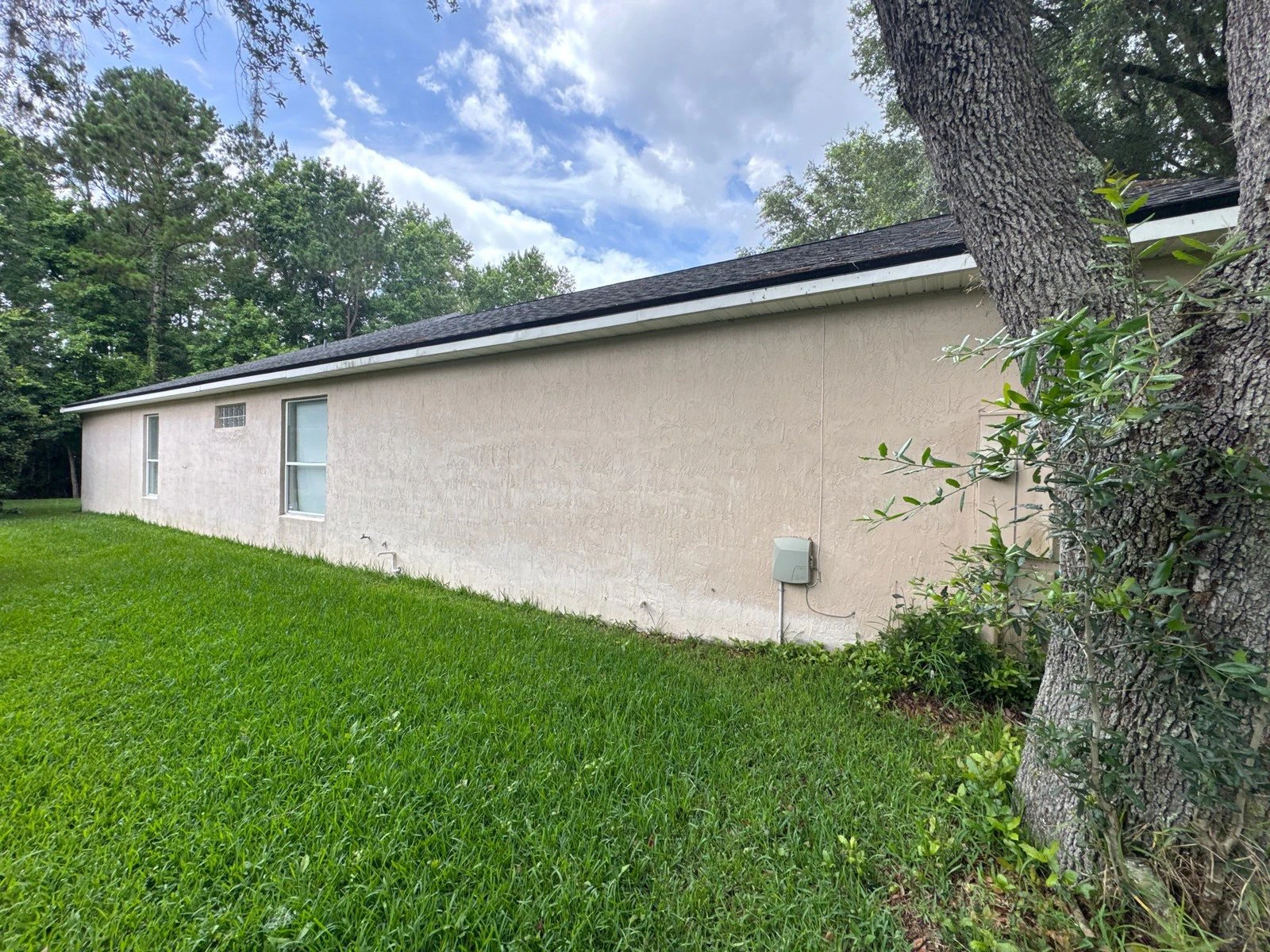
Staining along the lower few feet of a wall is the pattern we see most. When we find it, the first thing we check is whether a sprinkler is hitting that wall. If the stain follows the arc of a sprinkler head, that's a strong clue.
The lower wall gets more direct spray, splashback off the ground and walkways, and soil and mulch kicked up by watering and rain. Heads are sometimes set too close to the house, they hit the same spot every cycle, and shrubs block the airflow that would dry the wall. Garage walls, corners and side yards usually show it most because they sit closest to the beds.
What color are the stains?
Color is a useful clue, though it doesn't prove the cause on its own:
| Appearance | Possible Cause |
|---|---|
| Orange / rust-colored | Possible iron or mineral staining from the irrigation water itself. |
| White / chalky / crusty | Possible mineral deposits, efflorescence or chalking paint. These are different problems. |
| Green / black / gray | Possible mildew, algae, or other organic growth. |
| Brown / generally dirty | Possible soil, mulch, runoff, mineral content, or general environmental contamination. |
| Faded / lighter than surrounding paint | May indicate actual coating weathering rather than removable surface contamination. |
| Peeling / blistering | May indicate genuine coating failure, which needs real diagnosis beyond simple cleaning. |
Swipe to see the whole table
Are sprinkler stains the same as efflorescence?
Not necessarily. Sprinkler deposits land on the outside of the paint when water hits the wall and dries. Efflorescence comes from the other direction: moisture moving through the stucco carries salts out to the surface and leaves a similar white powder.
So don't assume every white deposit near the bottom of a wall is from the sprinklers. If the wall stays damp when the sprinklers haven't run, the deposits show up during dry spells, or there is staining inside on the same wall, water may be coming through the wall, and that deserves a closer look.
Can sprinklers damage exterior paint?
Watering alone won't ruin a properly applied coating. But constant wetting makes that area age faster when it's combined with cracks, weak adhesion, chalking, thin paint, failed caulk, damaged stucco, heavy shade or old repairs. A stain sitting on sound paint and paint that is actually peeling or blistering are different problems with different fixes. Our Jacksonville exterior paint failure guide explains how to tell them apart.
Is it a stain, chalking, fading, mildew or paint failure?
- Staining sits on the surface, and the paint underneath is still stuck. It often improves a lot with cleaning.
- Fading means the color itself has changed. Cleaning won't bring it back.
- Chalking is a powder that rubs off on your hand, a sign the paint surface is breaking down. Our guide on why stucco paint peels in Jacksonville explains how chalking leads to peeling.
- Peeling or blistering means the paint is coming off the wall. No amount of cleaning fixes it.
- Mildew is surface growth in damp, shady spots, and it usually cleans off.
You can find more than one of these in the same few square feet.
Can sprinkler stains be cleaned off?
Often, yes, but the method depends on the cause. Mildew and algae need a proper mildew cleaning treatment, not just water. Dirt and pollen usually come off with a normal exterior wash. Mineral and iron stains may need a different cleaner made for the job.
Go easy. Too much pressure or the wrong chemical can damage painted stucco, so blasting it isn't the answer. If cleaning is all the wall needs, routine exterior house washing may bring it back without paint.
Fix the sprinkler before you fix the wall
Cleaning or repainting while the sprinkler still hits the house treats the symptom. Turn heads away from the wall, change the spray pattern or nozzle, reset heads that have shifted, fix broken ones and check that runoff isn't pooling against the foundation. Keep the water on the plants, not the house.
Then follow this order: find the likely source, check the spray pattern matches the stain, fix the sprinkler, clean the wall for what's actually on it, let it dry fully and look again. Trying to judge a wet, dirty wall is guesswork. Only then repair or repaint what still needs it.
Can you paint over sprinkler stains?
Not without dealing with the cause and preparing the surface. Paint over mineral deposits, iron stains, mildew, dirt, chalk, damp stucco or loose paint can fail to bond, let the stain bleed through or look wrong soon after. The process is usually clean, dry, prep, prime where needed and paint. Not every stain needs a stain-blocking primer; that depends on what's left once the wall is clean and dry.
Why do the stains keep coming back?
Usually because the source is still there: the sprinkler still hits the wall, the water still carries iron, shrubs still trap moisture, the mildew was never fully treated or runoff keeps collecting in the same spot. Sometimes the water isn't coming from irrigation at all. If a stain comes back quickly after cleaning, look into why instead of cleaning it again.
What if the stucco is cracked too?
Sprinkler water matters more when it hits cracked or damaged stucco, because it has a path into the wall. Not every hairline crack lets in much water, so each one needs a look: how wide it is, whether old patches have held, whether it's still moving and how the paint looks around it. See which stucco cracks are cosmetic and which are dangerous.
Does the whole house need repainting?
Usually not because of sprinkler stains alone. Cleaning or a spot repair is often enough when the stain is limited to one area, the paint around it is sound and the sprinkler has been fixed. A full repaint makes more sense when fading or chalking is widespread, paint is peeling beyond the stained area, caulk is failing all over or the color and sheen can't be blended at one section. If your home is fairly new and already shows these signs, see why a newer Jacksonville home might already need painting.
How to prevent sprinkler stains from returning
- Point sprinkler spray at landscaping, not the house.
- Check a few times a year for heads that have shifted or broken.
- Don't soak stucco, trim, doors or windows with direct spray.
- Keep some airflow around heavily planted walls.
- Clean mildew while it's light.
- Have cracks looked at instead of assuming they're cosmetic.
Nothing guarantees a stain won't return in our climate, but these steps cut down how often and how badly it happens.
Frequently asked questions
Usually iron or minerals in the irrigation water, especially well water, left behind as it dries. The color generally comes from the water, not from rust in the wall.
Ready to have your stucco evaluated?
Start by fixing the sprinkler and cleaning the wall. If the paint underneath is sound, you may not need to repaint at all. If the wall is still faded, chalky, peeling or cracked after cleaning, we can look at the stucco, the paint and any repairs before recommending a next step. See our exterior painting services, our pressure washing services or the Exterior Painting Resource Center for more homeowner guides.
A New Leaf Painting Contractors has served Jacksonville and Northeast Florida since 2010. Call (904) 615-6599 for a free exterior estimate.