
Why Does Stucco Keep Cracking After It Has Been Repaired?
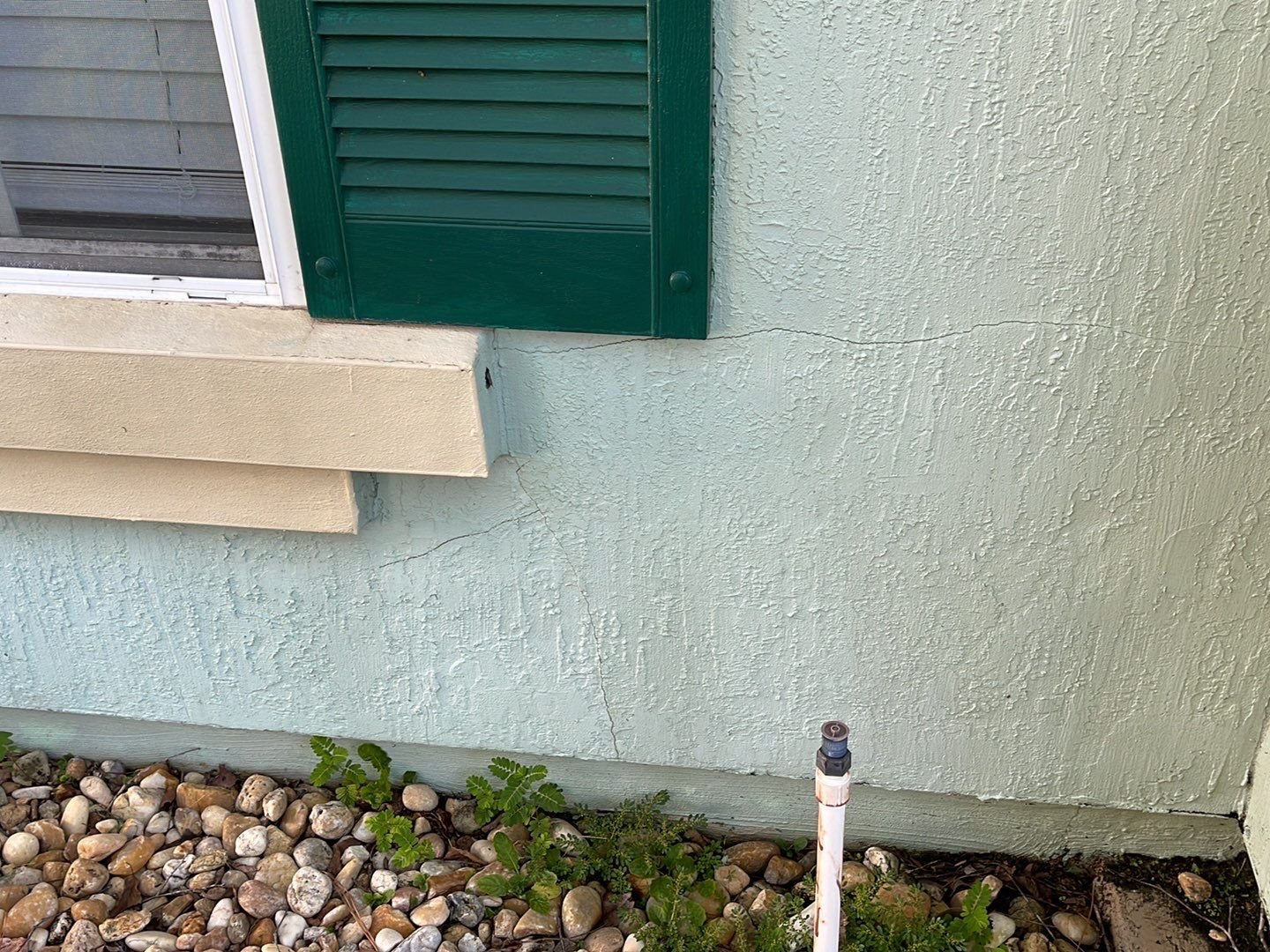
The crack was repaired last year. Patched, primed, painted, gone. Then a few months later a thin line reappeared in exactly the same place.
The usual conclusions come quickly: the product was bad, the contractor cut corners, the paint failed, or it just needs more caulk. Sometimes one of those is true. But a repair that fails in the same spot twice is usually telling you something more specific — that whatever created the crack originally is still happening.
As exterior house painters in Jacksonville, FL, we regularly encounter previously repaired stucco cracks that have reopened on homes throughout Duval, St. Johns, and Clay counties. When that happens, the productive question usually isn’t what to fill the crack with next — it’s why that location keeps moving or deteriorating, and whether the condition calls for another surface repair, more extensive stucco repair before painting, or evaluation of an underlying issue outside the painting scope.
Why Did the Crack Come Back?
Jump to what fits your situation:
- Continued wall movement — the location never stopped moving
- Wrong repair material — rigid product in a moving location
- Surface-only repair — filler bridged the top of the crack
- Poor crack preparation — nothing sound to bond to
- Material transition — two materials moving differently
- Window or door movement — recurring cracks at openings
- Moisture still entering — water hasn’t stopped reaching the area
- Substrate or lath problem — the issue is behind the finish
- Crack coming through new paint — line reappearing in a fresh coat
Why Do Stucco Cracks Reopen After Repair?
There’s a short list, and most recurring cracks trace to one or two items on it:
- The movement never stopped
- The repair was too rigid for the location
- The wrong material was specified
- The crack was filled only at the surface
- The crack was never properly prepared
- Adjacent materials continue moving at different rates
- A joint that needed flexible sealant was treated as a rigid defect
- Moisture is still entering
- Substrate or lath movement continues behind the finish
- The previous patch itself is now separating
- The movement simply exceeds what any repair at that location can accommodate
Notice what isn’t on that list: not enough filler. More material in the same crack, using the same approach, generally produces the same result on a longer timeline.
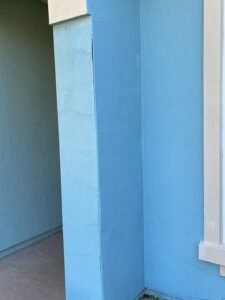
Continued Movement Is the Most Important Clue
If the wall, substrate, frame, or transition keeps moving, the repair is being asked to resist that movement. Rigid materials don’t stretch — they either hold or they fracture.
Movement exists on a spectrum, and most of it is ordinary:
- Normal building movement — every structure moves
- Settlement — usually slow, usually diminishing over time
- Thermal movement — daily expansion and contraction, relentless in Florida sun
- Framing movement — members twisting and bowing as they dry, in frame construction
- Substrate movement — what’s behind the stucco shifting relative to it
- Differential movement — two materials expanding at different rates where they meet
A recurring crack does not automatically mean foundation or structural failure. Thermal movement, material transitions, previous repair methods, moisture, and other nonstructural conditions can also cause a crack to reopen. The signs that do warrant closer evaluation are covered further down.
What Happens When a Rigid Patch Is Used on a Moving Crack
One important reason recurring cracks fail is that the repair material doesn’t match the way the location behaves.
Flexible elastomeric sealants are manufactured with different movement capabilities. Selecting the right product depends on how much movement the joint experiences, the substrates involved, and the joint design. Rigid cementitious patching compounds serve a different purpose: repairing stable areas that are not expected to repeatedly open and close.
When a rigid patch goes into a location that keeps moving, it fails predictably: cracking straight through the center, separating along one edge, pulling away from one side, or transferring the crack to the perimeter of the patch. That last one is diagnostic — a crack that now traces the outline of an old repair tells you the patch held and the wall moved around it.
A “stronger” patch doesn’t solve this. It often makes the failure sharper, because the stress relieves somewhere else instead.
Was the Crack Properly Prepared Before It Was Filled?
A repair is only as good as what it bonds to. Preparation failures we find behind recurring cracks:
- Loose or crumbling material left in place at the crack edges
- Dust and contamination in the crack at the time of filling
- The crack never opened or profiled where the repair required it
- Weak, feathered edges that had no strength to hold the patch
- An existing coating that the repair material couldn’t bond through
- Insufficient depth, so the repair had minimal contact area
- No connection to sound material anywhere
Any of these can produce a repair that looks perfect on completion day and lets go within a season. Our guide on why surface preparation matters covers the same principle across exterior work generally.
Why Surface-Only Repairs Fail
There’s a real difference between smearing filler across a visible line and repairing a defect into sound material.
A cosmetic repair bridges the top of the crack. It hides the line, and if nothing underneath is moving, it may hold indefinitely. But the crack below is unchanged. When movement continues, the surface film is the weakest thing in the assembly, and the line returns exactly where it was.
This matters most on recurring cracks in the open wall field, at the edges of old patches, and around openings — the three places we see cosmetic repairs applied most often, usually because someone wanted the wall to look right before a sale or an event.
Is It Actually a Movement Joint or Material Transition?
Material transitions are particularly important because they can look like ordinary cracks even though the location itself is designed or expected to accommodate movement.
Where stucco meets concrete, wood trim, siding, a window or door frame, a decorative band, a column, an addition, or another masonry element, you have two materials with different expansion rates bonded at a seam. That seam is going to move. It was always going to move.
Filling a moving transition with rigid patching compound can simply relocate the stress, causing the crack to return along the same line or immediately beside the repair. These locations generally call for a flexible sealant selected for the movement, the substrates involved, and the joint’s dimensions, which is a specification decision rather than a trip to the hardware store.
If your recurring crack runs along a line where one material meets another, that’s likely your answer.
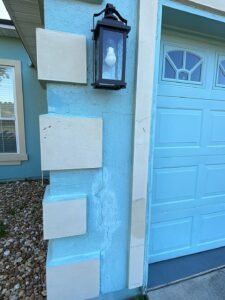
Why Cracks Around Windows and Doors Keep Coming Back
Openings interrupt the wall and concentrate stress at their corners, which is why diagonal cracking starts there in the first place. Add a frame that moves independently of the stucco around it, perimeter sealant that ages and hardens, and water that may be entering at the transition, and you have a location with several reasons to keep failing.
Repeated corner cracking at the same opening is worth reading as a signal that the opening or its transition is still moving — not just that the last patch was inadequate. See cracks around stucco windows and doors for what to check at the opening itself.
Can Moisture Make a Repaired Crack Fail Again?
Yes, potentially — though moisture isn’t behind every recurrence.
Where it is involved, the crack often remains a water pathway even after the surface was closed. Moisture can affect bond at the repair interface, contribute to corrosion of embedded metal in applicable assemblies, carry salts through the masonry, undermine the coating, and allow deterioration behind the finish to continue quietly.
Symptoms that suggest moisture is part of the picture:
- Efflorescence at or near the crack
- Rust staining
- Peeling or bubbling paint concentrated in that area
- Staining running below the crack
- Loose or hollow-sounding stucco nearby
- Deterioration that visibly worsens after heavy storms
Northeast Florida’s rainfall and wind-driven rain make this more consequential here than in drier climates — pressure pushes water into openings that would otherwise shed it.
What White Powder Around a Recurring Crack Means
White mineral deposits generally indicate efflorescence — salts carried out of the masonry by moisture and left behind as water evaporates at the surface. A crack that reopens alongside recurring efflorescence deserves closer attention because the mineral deposits indicate that moisture has been moving through the masonry in that area. See what efflorescence means on a Florida home.
What Rust Around a Recurring Crack Means
Orange or brown staining suggests corrosion of metal behind the finish — lath, fasteners, corner beads, or accessories. Corroding metal expands, and that expansion can drive cracking that no surface repair will stop. Rust plus recurrence changes the diagnostic picture meaningfully. It doesn’t, on its own, prove widespread corrosion. More at rust stains coming through stucco.
What If the Area Is Hollow or Bulging Too?
Combinations matter. A recurring crack accompanied by hollow sound, bulging, loose material, or displacement across the crack suggests the problem isn’t in the crack at all.
That combination can indicate delamination, a substrate condition, moisture, a failed earlier repair, or movement behind the finish.
Repairing the second one as though it were the first is how a homeowner ends up on their third patch. See stucco bubbling, bulging, and delamination.
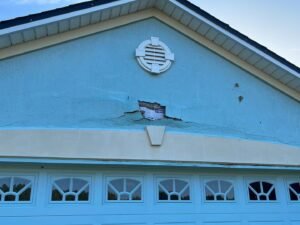
Can Paint Cause a Repaired Crack to Show Again?
Paint rarely creates the underlying crack. But it does affect when and how you see it.
A coating film telegraphs movement beneath it — the crack reappears through the paint because the paint is thinner and less flexible than the repair below. Brittle or aged coatings reveal cracking sooner than flexible ones. Poor preparation can produce localized coating failure right at the repair, which reads as the crack returning when it’s actually the paint letting go. And high-build coatings can conceal a moving crack temporarily without doing anything about the movement, which delays the reappearance rather than preventing it.
Our exterior paint failure guide covers how to distinguish coating failure from substrate failure.
Can Elastomeric Paint Stop a Recurring Crack?
Not if the crack is still actively moving.
Elastomeric coatings, correctly specified, provide a flexible film, can bridge certain small and stable surface cracks, and improve weather resistance within an appropriate system. Those are real capabilities.
What they cannot do: stop movement, stabilize a substrate, repair failed stucco, reattach delaminated material, resolve active water entry, or permanently conceal a crack that keeps opening. Applied over a moving crack, a high-build coating buys time and then fails along the same line — often more visibly, because the thicker film tears rather than hairlines.
See elastomeric vs. acrylic paint for stucco for where these systems genuinely fit.
Does a Recurring Crack Mean the Previous Contractor Did Bad Work?
Not necessarily, and it’s worth being fair about this.
Legitimate reasons a competent repair still failed:
- The location was a movement joint that nobody identified as one
- The condition causing the movement wasn’t visible at the time
- Movement increased after the repair for reasons unrelated to it
- The homeowner asked for a cosmetic repair, and got one
- The crack sits at a transition that requires periodic maintenance by nature
- A water source developed after the work was done
And the honest other side: poor preparation, the wrong material, insufficient depth, or a surface-only patch absolutely do cause premature failure, and those are workmanship issues.
We’re not interested in assigning blame on either side. What matters is figuring out which category you’re in, because the answer determines whether repeating the repair is reasonable or pointless.
How Long Should a Stucco Crack Repair Last?
There’s no universal number, and any contractor offering one hasn’t looked at your wall.
Longevity depends on whether the crack is stable, how much movement the location sees, the repair material and its suitability, preparation quality, repair depth, moisture conditions, substrate condition, location on the building, and the coating system over the top.
How Can I Tell Whether the Crack Is Still Moving?
Five minutes of documentation beats any amount of speculation:
- Photograph it with something for scale beside it — a ruler, a coin, a pen
- Date the photo so you have a fixed reference
- Mark the ends lightly in pencil to see whether it lengthens
- Re-photograph every couple of months, and after significant storms
- Compare width and length against the original shot rather than memory
- Note associated staining and whether it’s growing
- Watch nearby windows and doors — changes in how they operate is relevant information
For basic homeowner documentation, you don’t need specialized monitoring equipment. A dated photo series can help show whether the crack is changing over time and gives whoever evaluates the wall something more useful than memory alone.

When Is It Reasonable to Repair the Crack Again?
Repeating a repair makes sense when the profile looks like this:
- The crack is small and hasn’t grown between documented photos
- Movement appears stable
- Surrounding stucco is sound — no hollow sound, no bulging
- No efflorescence, rust staining, or moisture symptoms
- No displacement across the crack
- The previous repair clearly failed for an identifiable reason — poor preparation, wrong material, surface-only application
That last point is the important one. If you can name why the last repair failed and the reason is fixable, a properly selected repair is a reasonable next step. If nobody can explain the failure, another patch is a guess.
When Should a Recurring Crack Get Closer Evaluation?
Combinations matter more than any single item:
- The crack has reopened after multiple repairs
- It’s widening or lengthening between photos
- There’s displacement across the crack
- Several cracks form a consistent pattern on an elevation
- Cracking recurs around multiple windows or doors
- Rust staining is present
- Efflorescence keeps returning
- Paint repeatedly peels or bubbles in the same area
- Stucco sounds hollow nearby
- The wall is bulging
- Interior staining or dampness appears on the same wall
- Doors or windows have changed how they operate
- The movement appears progressive rather than seasonal
When Is a Painter the Right Professional?
Within normal painting and stucco repair scope
- Stable surface cracking
- Isolated failed repairs with an identifiable cause
- Minor stucco patching and texture repair
- Failed sealant joints where appropriate
- Priming and repainting
Where another professional may be needed
- Significant or progressive structural movement
- Extensive delamination
- Persistent unexplained moisture
- Major window or flashing problems
- Widespread corrosion of embedded metal
- Repeated failure across large wall areas
Depending on what’s present, that may be a structural engineer, a building-envelope consultant, a waterproofing contractor, a specialized stucco contractor, or a window and flashing professional.
On Jacksonville-area stucco homes, a recurring crack often gives us more information than a new crack because we can see how the previous repair failed. We look at whether the new crack formed through the center of the patch, along one edge, around its perimeter, or at a nearby material transition. We also look for failed sealant, moisture staining, efflorescence, rust bleed, hollow or bulging stucco, and similar cracking around nearby windows and doors. The goal isn’t simply to hide the line again — it’s to understand what the previous repair is telling us.
How A New Leaf Evaluates a Crack That Has Already Been Repaired
The old repair itself is usually the most informative thing on the wall.
- Inspect the previous repair and the wall surrounding it
- Determine exactly where the new crack formed relative to the old patch
- Note whether it came through the center, along an edge, or around the perimeter — each points somewhere different
- Inspect nearby transitions, windows, and doors for the same pattern
- Look for staining, rust bleed, efflorescence, bulging, or hollow-sounding material
- Determine whether the area appears stable enough for normal repair
- Identify anything that should be evaluated by another specialist first
- Remove failed repair material where appropriate
- Repair with materials suited to how that location actually behaves
- Match texture as closely as practical
- Prime the repair correctly for the coating going over it
- Apply the appropriate exterior coating system
Step three does more work than the rest combined. A crack through the middle of a patch and a crack tracing its outline are two different failures with two different answers.
We assess what’s visible from the exterior. We don’t perform invasive moisture testing, bond testing, or engineering analysis, and visual inspection alone doesn’t identify everything concealed behind a wall — we’d rather say that than imply otherwise. See our Jacksonville stucco painting guide for how coating selection follows wall condition.
Frequently Asked Questions
Why does the same stucco crack keep coming back?
Usually because whatever caused it hasn’t stopped — continued movement at that location, a rigid repair where a flexible one was needed, a surface-only fill, or water still reaching the area. Recurrence in the same line is diagnostic information rather than bad luck.
Does a recurring crack mean structural damage?
Not necessarily. Recurring cracks can result from thermal movement, material transitions, previous repair methods, moisture, or other conditions that aren’t structural. Progressive widening, displacement, broader crack patterns, or changes in nearby windows and doors warrant closer evaluation.
Can a repair fail because the patch is too rigid?
Yes. A rigid repair material can fail when it’s used in a location that continues to move. Rigid cementitious compounds suit stable areas that aren’t expected to open and close. Locations that keep moving generally need a flexible sealant selected for that movement. A rigid patch in a moving joint tends to fail through the center or around its own edges.
Why does a crack keep coming back around my window?
Openings concentrate stress at their corners, frames move independently of the stucco, and perimeter sealant ages. Repeated cracking at the same opening suggests the opening or its transition is still moving, not just that the last patch was inadequate.
Can moisture make a stucco crack reopen?
It can. A crack that remains a water pathway keeps affecting bond at the repair, and moisture can drive corrosion of embedded metal that expands and cracks the finish. Efflorescence, rust staining, or peeling near the crack point in that direction.
Why does a crack come back through new paint?
Paint doesn’t usually cause the crack — it reveals it. A coating film is thinner and less flexible than the repair beneath, so movement telegraphs through. High-build coatings can hide a moving crack temporarily without stopping the movement.
Will elastomeric paint stop recurring cracks?
Not on a crack that’s actively moving. Elastomeric systems can bridge small stable surface cracks when correctly specified, but they can’t stop movement, repair failed stucco, or resolve water entry.
Should a recurring crack be caulked or patched?
Depends on whether the location moves. Rigid patching suits a dormant crack in the wall field. A transition between materials, or a joint that opens and closes with temperature, generally needs a flexible sealant selected for that movement and those substrates.
How can I tell if the crack is still moving?
Photograph it with something for scale, date the photo, lightly mark the ends, and re-photograph every couple of months and after heavy storms. Compare against the images rather than memory. That answers it without any special equipment.
What if the recurring crack has rust around it?
Rust suggests corrosion of metal behind the finish, and corroding metal expands — which can drive cracking that surface repair won’t stop. Worth investigating before another repair rather than coating over.
What if the crack has white powder around it?
Likely efflorescence. Recurring efflorescence indicates that moisture has been moving through the masonry in that area. When it appears alongside a recurring crack, the moisture source is worth investigating before another repair is made.
When should I stop patching and have it evaluated?
When the crack has failed repeatedly and nobody can explain why the previous repairs didn’t hold. Also when displacement, progressive widening, hollow or bulging stucco, rust, recurring efflorescence, or interior symptoms accompany it.
Related Exterior Painting Resources
- Exterior Painting Services
What our exterior process covers, including stucco repair, preparation, and coating selection. - Exterior Painting Resource Center
Our full library of exterior guides on Florida conditions, coatings, preparation, and maintenance. - Painting Stucco Homes in Jacksonville
How wall condition and previous coatings drive the specification for a stucco repaint. - Cracks Around Stucco Windows and Doors
Why openings crack, what perimeter sealant failure looks like, and when it means water is getting in. - Why Surface Preparation Matters
Why prep quality determines how long a repair and coating last more than the products do. - Stucco Bubbling, Bulging & Delamination
How to tell coating failure from stucco that has lost bond with the wall behind it.
Crack Back Again?
Before the next repair, gather what actually helps:
- Photograph the crack and the previous repair area together
- Note whether it reopened through the center of the patch or along its edge
- Include something for scale, and date the photo
- Note nearby windows, doors, or material transitions
- Look for efflorescence, rust staining, general staining, or bulging
- Note whether it worsens after heavy rain
- Track whether it’s still changing between photos
We can evaluate visible conditions within normal stucco repair and exterior painting scope, tell you what the failure pattern suggests, and tell you plainly when the underlying condition should be looked at by another professional before another repair is attempted.
Sometimes the answer is that the last repair failed for a simple, fixable reason and a properly selected one will hold. That’s a common outcome, and a good one.
A New Leaf Painting Contractors has served Jacksonville and Northeast Florida since 2001.
Call or text 904-615-6599 for an exterior inspection.