In this article
- What Should Be Checked Before Painting Stucco?
- Stable Hairline Cracks
- Open or Recurring Cracks
- Cracks Around Windows and Doors
- Failed Sealant and Caulk Joints
- Loose, Hollow, or Delaminated Stucco
- Efflorescence Before Painting
- Rust and Water Stains Before Painting
- Peeling or Bubbling Paint
- Old Stucco Patches
- When Does a Stucco Patch Need Primer?
- When Should the Whole Wall Be Repainted Instead of Spot-Touched?
- Quick Decision Guide
- When Should Painting Wait?
- When Is a Painter the Right Professional?
- What We Look for Before Painting Stucco
You've decided to repaint. Walking the house, you notice hairline cracks near a window, an old patch that looks different in afternoon light, a white deposit under a sill and a spot that sounds hollow when you tap it.
Not all of it has to be repaired first. Some conditions only need normal prep, some need real stucco repair before paint, and a few mean painting should wait until someone else looks at the wall. What never works is using paint to hide something that is still failing underneath. The goal isn't a flawless wall; it's a wall that is sound, dry enough and properly prepared for the coating going on it.
As exterior house painters in Jacksonville, FL, we sort these conditions on homes across Duval, St. Johns and Clay counties before every repaint. Here's how we decide what needs stucco repair and painting and what doesn't.
What Should Be Checked Before Painting Stucco?
A pre-paint walkthrough looks at cracking, caulk around openings, peeling paint, chalking, efflorescence, rust bleed, hollow areas, old repairs, recurring stains and wood rot in nearby fascia and trim.
To be clear about what this is: it's an assessment of whether the visible exterior is ready for prep and coating. It isn't a structural inspection.
Stable Hairline Cracks
Fine cracking is common on stucco and doesn't always need individual repair. Where it is stable, shallow and in a sheltered spot, it can often be handled in prep and the choice of coating.
What decides that: whether the crack has changed or looked the same for years, whether it came back after an earlier repair, where it sits (a line in the middle of a wall is different from one at a window corner), whether staining, efflorescence or rust shows up nearby, and how much wind-driven rain that side of the house takes.
We won't tell you every hairline can just be coated over. That shortcut produces disappointed homeowners two years later. Our guide to types of stucco cracks covers how to read them.
Open or Recurring Cracks
Cracks wide enough to show through paint, or that came back after a repair, need more than a coating decision. A rigid patching compound belongs in a stable crack. A spot that keeps moving needs a flexible sealant chosen for that movement, so someone has to decide which it is.
If a crack was repaired and came back, find out why the last repair didn't hold before repeating it. See why stucco cracks come back after repair.
Cracks Around Windows and Doors
Window and door corners concentrate stress, which is why cracks start there. Openings also rely on caulk and flashing to keep water out, so a crack there can be two problems at once.
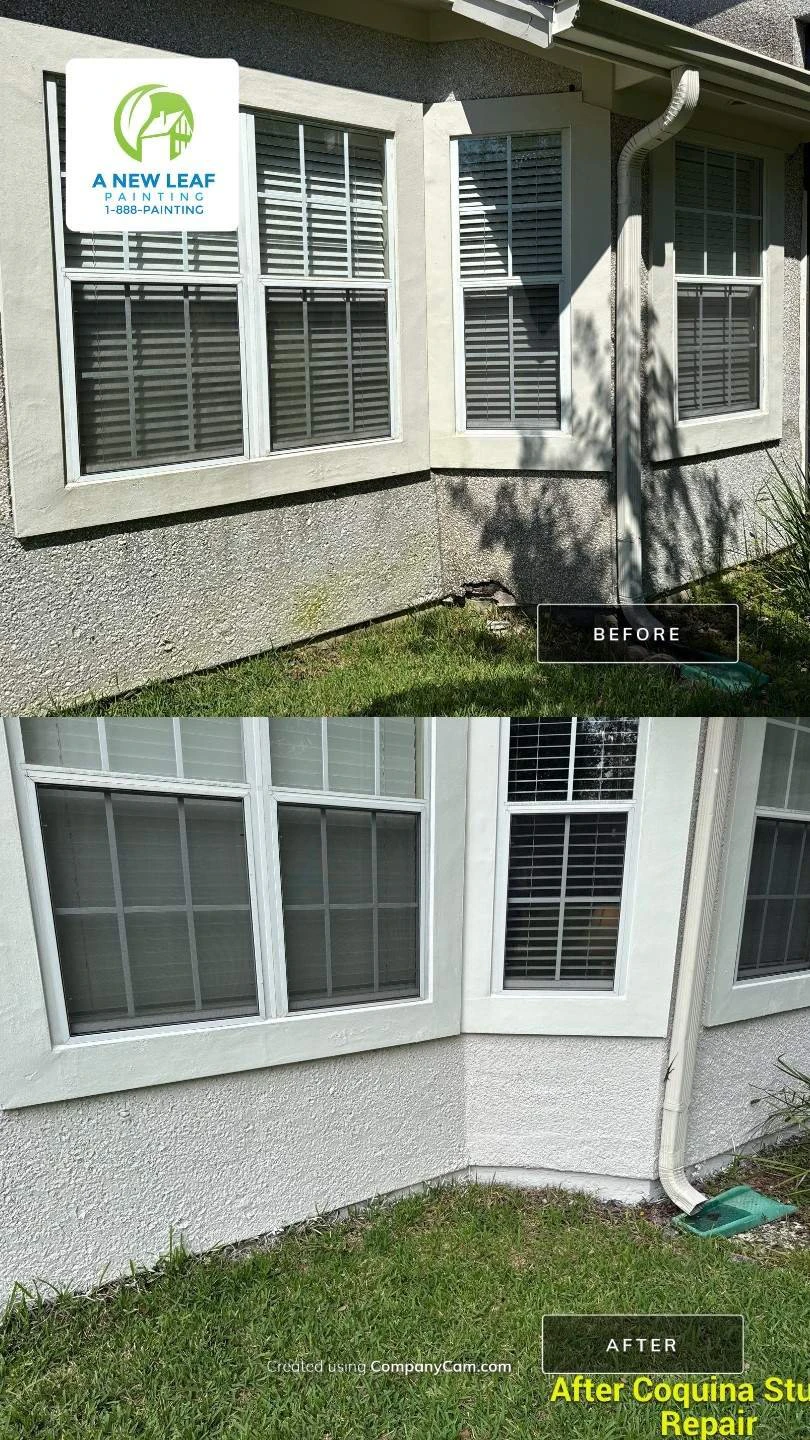
A crack running through the stucco near a window is a different repair from a gap along the frame, even though they can look alike from ten feet away. Patch a moving frame joint like a stable crack and the gap comes back. See cracks around stucco windows and doors for what to check.
Failed Sealant and Caulk Joints
Exterior caulk hardens, splits, shrinks and pulls away as it ages, faster under Florida sun. Painting over it hides the gap without closing it. The fix is to remove the failed material, prepare the joint and install an exterior sealant suited to that joint's movement and materials. Interior painter's caulk isn't the right product for exterior joints.
Loose, Hollow, or Delaminated Stucco
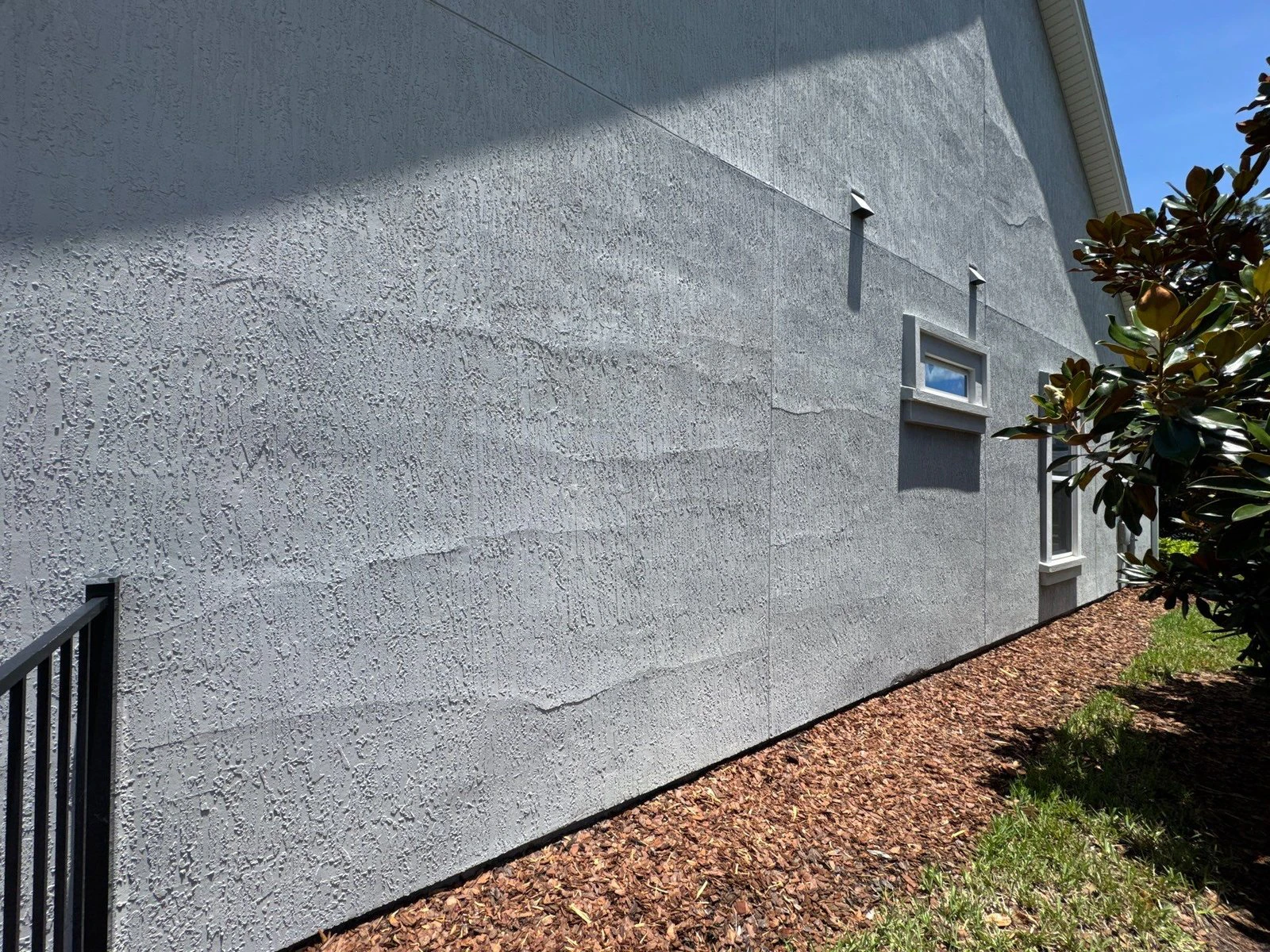
Paint can't reattach stucco that has lost its bond. Areas that sound hollow, bulge, flex under gentle pressure or have loose edges are stucco problems, not paint problems, and any coating over them is only as secure as the stucco underneath.
Unsound stucco gets removed back to sound material, the cause understood, and the area rebuilt and textured before painting. A hollow sound is a clue, not a full diagnosis: it can be delamination, a void from the original work or an old patch that never bonded. Don't pull at loose edges yourself, since unsound stucco can extend past what you see. See stucco bubbling, bulging, and delamination.
Efflorescence Before Painting
White mineral deposits are salts carried out of the stucco by moisture moving through it. Cleaning them off doesn't stop the moisture, so they can come back, and painting over them hurts adhesion because the paint bonds to loose mineral instead of the wall.
The order that works: find the moisture source, fix what can be fixed, let the wall dry, remove the deposits, then prep and paint. More in what efflorescence means on a Florida home.
Rust and Water Stains Before Painting
Rust: surface rust from a light fixture, bracket, fastener or runoff from metal above is usually a cleaning and stain-blocking job once the source is handled. Corrosion of metal behind the stucco (lath, fasteners, corner beads) is different. Corroding metal expands and can crack the stucco around it. A stain-blocking primer is part of a repair, not the repair. See rust stains coming through stucco.
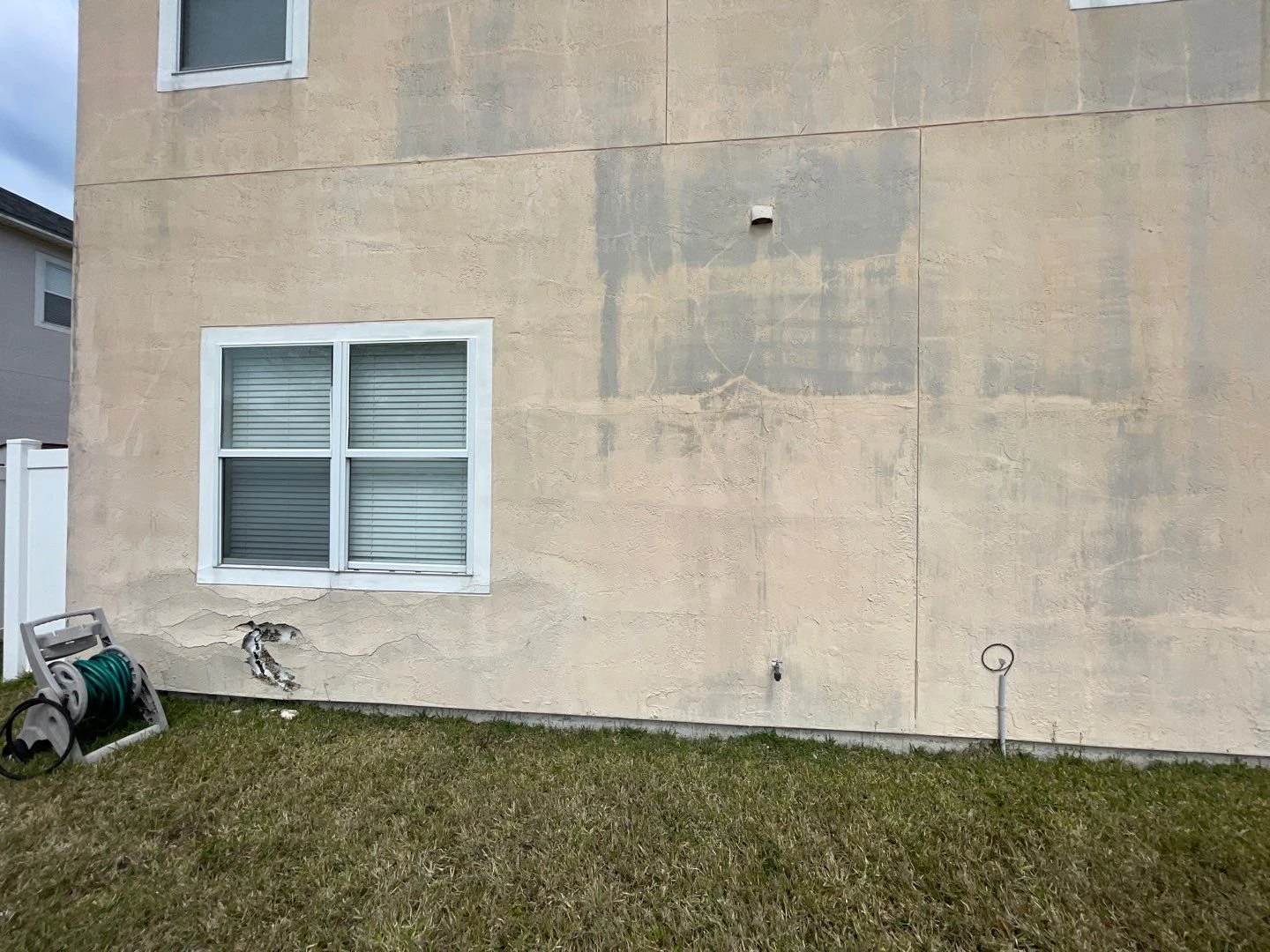
Water stains: ask whether the stain is old or active. An old stain from a problem already fixed just needs cleaning and paint. A stain that returns after rain or stays damp longer than the wall around it means water is still getting in, usually at windows and doors, cracks, roof-to-wall joints, penetrations or sprinkler spray. Painting first leads to stains coming back and paint failing.
Peeling or Bubbling Paint
Peeling and bubbling come from lost adhesion, moisture behind the paint, chalk painted over, dirt at the time of painting, incompatible coatings or shortcuts on the last job. Whatever the cause, loose paint has to come off back to a sound edge, and the reason it failed has to be understood so the new paint doesn't repeat it. Our exterior paint failure guide covers the causes.
Old Stucco Patches
A patch can be perfectly sound and still show after painting. Look at whether the texture matches, whether the edges were feathered, whether cracking has returned through or beside it, and whether it was ever painted. Repairs often soak up paint differently from the stucco around them, so a wall can be fine structurally and still look blotchy if the patches weren't primed. Good texture matching can be very good, but perfectly invisible isn't something to promise on heavy texture or a big repair.
When Does a Stucco Patch Need Primer?
Bare stucco and fresh repairs need priming. New stucco is porous and alkaline and absorbs differently from the painted wall around it, and primer evens that out. Stain-blocking primers are a separate job for stains that need sealing. The product should follow the paint manufacturer's requirements for that surface, and fresh repairs need their full cure time; don't rush it to keep a schedule.
When Should the Whole Wall Be Repainted Instead of Spot-Touched?
A spot touch-up works when the repair is small, the paint around it is sound and fairly fresh, and color and sheen still match. Repaint the whole wall when the repair is large or prominent, there are several repairs on the same side, the old paint is chalky or faded, or the wall gets strong direct sun. On a sunny Florida wall, even a matched color can read as a patch because the paint around it has faded.
Quick Decision Guide
| Condition | Typical Next Step |
|---|---|
| Stable hairline crack | May be addressed within preparation and the coating system |
| Larger or open crack | Repair with a material suited to the location, before painting |
| Recurring crack | Identify why the last repair failed before repeating it |
| Failed sealant | Remove, prepare the joint, and replace appropriately |
| Loose or hollow stucco | Evaluate extent and repair before coating |
| Efflorescence | Address the moisture source, allow drying, clean, then coat |
| Rust staining | Determine whether it’s surface rust or corrosion behind the finish |
| Peeling or bubbling paint | Remove unsound coating and understand why it failed |
| Water staining | Determine whether it’s active or historical |
| Old patch | Evaluate texture, bond, porosity, and priming needs |
Swipe to see the whole table
When Should Painting Wait?
Sometimes the right call is not to paint yet: when the wall is actively wet, a moisture source hasn't been found, stucco is loose across a large area, structural movement is suspected, windows or flashing are failing, corrosion looks extensive, or cracks keep returning and nobody can say why. Painting into any of those means paying for paint whose life is set by a problem nobody fixed. We'd rather tell you that at the estimate than after.
When Is a Painter the Right Professional?
Within normal painting and stucco repair: minor, stable crack repair, isolated stucco repair and texture matching, caulk replacement, cleaning and prep, priming and painting.
Where another professional may be needed: suspected structural movement, widespread delamination, hidden water intrusion that needs invasive testing, major window or flashing problems, extensive corrosion behind the stucco or a failing wall system. That might mean a waterproofing or stucco specialist, a building-envelope consultant or a structural engineer.
What We Look for Before Painting Stucco
At the estimate we sort what we find into three groups: what normal prep handles, what needs repair first, and what someone else should look at before anything gets painted. We walk every side of the house, not just the one you called about. We read crack patterns rather than single cracks, check caulk around every opening, look for efflorescence, rust bleed and water stains, and tap for hollow areas. Old repairs get extra attention, because how a patch has held up tells us a lot about what that wall has been doing.
We assess what's visible from outside. We don't do invasive moisture testing, bond testing or engineering analysis, and a visual inspection can't find everything hidden behind a wall. See our Jacksonville stucco painting guide for how the coating follows the wall's condition, and why surface preparation matters.
No. Stable hairline cracks can often be handled in prep and the coating. Open cracks, cracks that come back and cracks with staining or moisture signs need repair first.
Some homes need little beyond normal prep. Others have problems that should be repaired before painting. What matters is knowing the difference before the paint goes on. For more, browse our Exterior Painting Resource Center. A New Leaf Painting Contractors has served Jacksonville and Northeast Florida since 2010. Call or text (904) 615-6599 or request a free estimate, and we'll walk the house with you.