
Stucco Repair Before Painting: What Actually Needs to Be Fixed?
You’ve decided to repaint. Walking the house, you start noticing things you’d stopped seeing: a few hairline cracks near a window, an old patch that reads slightly different in the afternoon light, a white deposit under a sill, a couple of spots that sound different when you tap them.
The reasonable question is whether all of it has to be dealt with first.
The answer is no — and that’s worth saying plainly, because homeowners are often quoted as though every imperfection requires the same response. Different conditions call for different treatment, and some of them call for nothing more than normal preparation.
As exterior house painters in Jacksonville, FL, we regularly evaluate stucco conditions on homes throughout Duval, St. Johns, and Clay counties before exterior painting. Sorting those conditions — what needs ordinary preparation, what requires stucco repair and painting, and what should be evaluated by another professional — is a major part of the pre-paint evaluation.
What Condition Does Your Stucco Have?
Jump to what you’re seeing:
What Should Be Checked Before Painting Stucco?
A pre-paint walkthrough on a stucco home looks at:
- Cracking — extent, pattern, width, and whether it recurs
- Sealant condition at windows, doors, trim, and penetrations
- Peeling, bubbling, or blistering coating
- Chalking on the existing paint
- Efflorescence and other mineral deposits
- Rust bleed
- Areas that sound hollow or feel loose
- Bulging or wavy sections
- Previous repairs — texture, edges, whether cracking has returned at them
- Staining, and whether it recurs after rain
- Water-entry clues at openings, rooflines, and penetrations
- Wood rot in adjacent fascia, trim, or soffits
- Damaged or deteriorated trim
- Failing joints and penetrations
Worth being clear about what this is: an assessment of whether the visible exterior is suitable for preparation and coating. It isn’t a structural inspection, and nobody should present it as one.
Stable Hairline Cracks
Fine cracking is common on stucco and doesn’t automatically require individual repair. Where it’s genuinely stable, shallow, and in a sheltered location, it can often be addressed within surface preparation and the coating specification.
What determines whether that’s appropriate:
- Stability — has it changed, or has it looked the same for years?
- Recurrence — has it come back after a previous repair?
- Location — an isolated line in the wall field is different from one at a window corner
- Accompanying signs — staining, efflorescence, or rust nearby changes the picture
- Exposure — how much wind-driven rain that elevation takes
What we’d avoid saying is that all hairlines can simply be coated over. That’s the shortcut that produces disappointed homeowners two years later. Our guide to types of stucco cracks covers how to read them.
Open or Recurring Cracks
Cracks that are open enough to remain visible through a finish, or that have returned after previous repair, need more than a coating decision.
Open cracks require proper preparation and a repair material suited to how that location behaves — which means someone has to determine whether the location is stable or still moving. A rigid patching compound belongs in a stable defect. A location that keeps moving needs a flexible sealant selected for that movement.
Recurrence is its own signal. If a crack has been repaired and came back, the productive step is understanding why the last repair didn’t hold rather than repeating it. See why stucco cracks come back after repair.
Cracks Around Windows and Doors
Openings concentrate stress at their corners, which is why cracking starts there. They also depend on sealant and flashing details to manage water, which means a crack at an opening may involve two separate conditions at once.
The distinction that matters here: rigid patching and flexible joints are not interchangeable. A crack running through the stucco field near a window is a different repair from separation along the frame perimeter, even though they can look similar from ten feet away. Treating a moving perimeter joint like a stable stucco crack can allow the separation to reappear because the repair doesn’t accommodate the movement at that transition.
See cracks around stucco windows and doors for what to check at the opening.
Failed Sealant and Caulk Joints
Exterior sealant can harden, split, shrink, or separate as it ages, particularly under Florida’s UV exposure and weather conditions. Failed sealant should not simply be painted over — a fresh coating may hide the gap without correcting the failed joint.
What proper handling looks like: removing the failed material, preparing the joint, and installing an exterior sealant appropriate for that joint’s movement and the substrates involved. Those are specification decisions rather than a default product.
One caution worth stating: interior painter’s caulk should not be assumed to be appropriate for exterior envelope joints. Exterior joints may require sealants designed for greater movement, weather exposure, and the specific substrates involved.
Loose, Hollow, or Delaminated Stucco
Areas that sound hollow, bulge, flex under gentle pressure, show loose edges, or have pieces separating are substrate conditions rather than coating conditions. Applying a finish over unbonded material means the coating’s performance is limited by the stucco’s bond, not its own.
Unsound material needs to be addressed before coating — removed back to sound stucco, the cause understood, and the area rebuilt and textured. See stucco bubbling, bulging, and delamination for how to tell these apart from coating failure.
Efflorescence Before Painting
White mineral deposits generally indicate salts carried out of the masonry by moisture moving through it and left behind as the water evaporates.
Cleaning the deposits alone doesn’t address the moisture condition that produced them. If moisture continues moving through the masonry, efflorescence can return. Coating over active efflorescence can also interfere with adhesion, since the film bonds to loose mineral rather than to the substrate.
The order that works: identify the moisture source, address what’s addressable, allow drying, remove the deposits appropriately, then prepare and coat. More at what efflorescence means on a Florida home.
Rust Staining Before Painting
Rust requires a distinction that isn’t always explained to homeowners: staining on the surface versus corrosion behind the finish.
Surface rust — from a fixture, a bracket, a fastener head, or runoff from something metal above — is often a cleaning and stain-blocking situation once the source is addressed.
Corrosion of embedded metal is different. Lath, fasteners, corner beads, and accessories behind the stucco can corrode where moisture reaches them, and corroding metal expands, which can contribute to cracking and localized deterioration of the stucco around it.
A stain-blocking primer is a legitimate part of a repair sequence. It isn’t the repair. See rust stains coming through stucco.
Water Stains Before Painting
The useful question is whether the staining is active or historical.
Historical staining — a record of something already resolved — is a cleaning and coating matter. Active staining that recurs with rain or remains damp longer than surrounding areas suggests that moisture is still affecting that location. Painting before the moisture condition is addressed can lead to recurring staining, adhesion problems, or other coating failure.
Sources worth checking before a repaint: window and door transitions, cracks, roof-to-wall intersections, wall penetrations, and irrigation striking the wall. See how to tell where the moisture is coming from.
Peeling or Bubbling Paint
Coating failure has its own set of causes: adhesion loss, moisture behind the film, chalking that was painted over, contamination at the time of application, incompatible coating layers, or preparation shortcuts on the previous job.
Whatever the cause, the handling is consistent — loose coating should not be used as the substrate for new paint. It has to come off back to a sound, well-bonded surface, and the reason it failed needs to be understood so the new system doesn’t repeat it.
Our exterior paint failure guide covers how to distinguish the causes.
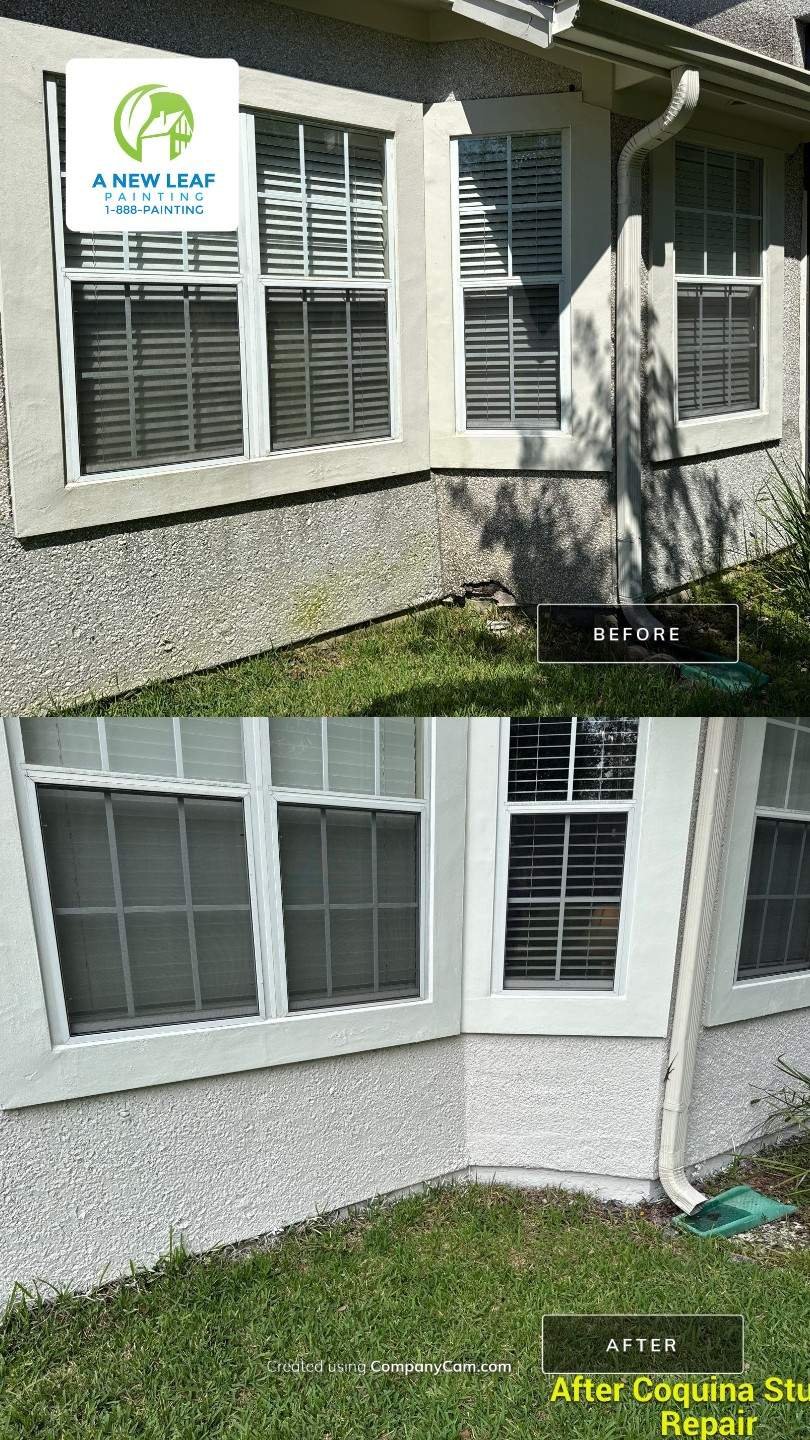
Old Stucco Patches
Previous repairs affect a repaint in ways that surprise people, because the patch itself may be perfectly sound and still cause a visible problem.
What to look at:
- Texture — whether the patch matches the surrounding finish
- Porosity — repairs often absorb coating differently than the original stucco around them
- Patch edges — feathered or poorly blended edges read through a finish
- Cracking through or beside the repair — which says the repair or the location needs another look
- Whether the patch was ever coated — bare repairs behave differently from previously painted ones
A wall can be structurally fine and still look uneven after repainting if patch preparation and priming weren’t handled for the differences in absorption.
Does Every Crack Need to Be Filled Before Painting?
No, and blanket rules are poor practice in either direction.
The right treatment depends on the crack’s width, whether it’s stable, where it sits on the wall, whether it has recurred, whether moisture is involved, the condition of the stucco around it, and the coating system being specified.
A contractor who says every crack must be routed and filled, and one who says all cracks can be handled by the coating, are both applying a rule instead of looking at the wall.
Does Every Hollow Area Need to Be Removed?
A hollow sound is a clue, not a complete diagnosis. It can reflect delamination, a void from the original application, or a previous patch that never fully bonded — same sound, different answers.
What informs the decision: the size of the area, its location, whether there’s cracking or bulging with it, whether visible bond failure exists at any edge, and the condition of the stucco surrounding it.
One practical note: avoid aggressively tapping or pulling at loose edges to investigate the area yourself. Unsound stucco can extend beyond the visible edge, and disturbing it may enlarge the damaged area.
Can Elastomeric Paint Replace Stucco Repair?
No.
Elastomeric coatings, correctly specified, can bridge certain small and stable surface cracks, provide a flexible high-build film, and improve weather resistance within an appropriate system. Those are real capabilities and there are walls where they’re the right call.
What they cannot do: repair loose stucco, reattach delaminated material, stop movement, resolve active moisture, address corroded embedded metal, or substitute for proper crack repair. Applied over any of those, a heavier film is a more expensive version of the same failure.
See elastomeric vs. acrylic paint for stucco.
When Does a Stucco Patch Need Primer?
Primer selection follows the substrate and the system rather than a single rule.
Bare masonry and fresh repairs need priming — new stucco is porous and alkaline, and it absorbs differently than the coated wall around it. Where a repair’s absorption differs noticeably from the surrounding surface, priming evens that out so the finish reads consistently. Stain-blocking primers serve a different purpose and apply where staining needs to be sealed off.
The specific product should follow the coating manufacturer’s requirements for that substrate, its condition, and the system going over it. Curing and drying requirements on fresh repairs matter as well and shouldn’t be compressed simply to keep a painting schedule moving.
Why Do Stucco Patches Sometimes Show Through New Paint?
Because a repair is a different material in a different condition than the wall around it, and paint doesn’t erase that.
Contributors include texture differences the eye catches in raking light, absorption differences that affect how the coating lays down, sheen variation across the repair, the patch’s profile sitting slightly proud or shy of the surrounding plane, and the sun angle at particular times of day.
Honest expectation-setting: good texture matching can be very good. Perfectly invisible is not something to promise, particularly on a heavily textured finish or a large repair. A repair that’s hard to find at ten feet in normal light is a good outcome.
When Should the Whole Wall Be Repainted Instead of Spot-Touched?
Spot repair makes sense when the repair is small, the surrounding coating is sound and reasonably fresh, color and sheen still match, and the patch sits somewhere that isn’t under direct scrutiny.
Full-wall repainting makes more sense when:
- The repair covers a meaningful area
- The existing coating is aged, chalked, or faded
- Sheen has changed with weathering, so a touch-up won’t blend
- The wall takes strong direct sun, which makes any difference visible
- The repair sits in a prominent location
- There are multiple repairs across the same elevation
On a sun-exposed Florida elevation, a spot touch-up in a matched color can still read as a patch because the surrounding paint has faded around it. That’s worth knowing before deciding.
Quick Decision Guide
| Condition | Typical Next Step |
|---|---|
| Stable hairline crack | May be addressed within preparation and the coating system |
| Larger or open crack | Repair with a material suited to the location, before painting |
| Recurring crack | Identify why the last repair failed before repeating it |
| Failed sealant | Remove, prepare the joint, and replace appropriately |
| Loose or hollow stucco | Evaluate extent and repair before coating |
| Efflorescence | Address the moisture source, allow drying, clean, then coat |
| Rust staining | Determine whether it’s surface rust or corrosion behind the finish |
| Peeling or bubbling paint | Remove unsound coating and understand why it failed |
| Water staining | Determine whether it’s active or historical |
| Old patch | Evaluate texture, bond, porosity, and priming needs |
When Should Painting Wait?
Sometimes the right painting decision is not to paint yet.
That’s worth considering when the wall is actively wet, a moisture source hasn’t been resolved, stucco is loose or delaminated across a meaningful area, structural movement is suspected, there’s significant window or flashing failure, corrosion appears extensive, or cracking has repeated without anyone being able to explain why.
Painting into any of those means paying for a coating whose service life is governed by an unresolved condition. That’s not a good trade, and we’d rather say so at the estimate than after.
When Is a Painter the Right Professional?
Within normal painting and stucco repair scope
- Minor and stable crack repair
- Isolated stucco repair and texture matching
- Sealant replacement where appropriate
- Surface preparation and cleaning
- Priming
- Exterior painting
Where another professional may be appropriate
- Suspected structural movement
- Widespread delamination
- Concealed water intrusion requiring invasive investigation
- Major window or flashing problems
- Extensive corrosion of embedded components
- Large-scale wall-system failure
Depending on what’s present, that may be a building-envelope consultant, a waterproofing contractor, a specialized stucco contractor, a window or flashing professional, or a structural engineer.
On Jacksonville-area stucco homes, our goal at the estimate is to sort conditions into three categories: what’s handled by ordinary preparation, what needs actual repair first, and what should be looked at by someone else before anything gets coated. We walk every elevation rather than the one you called about, read crack patterns rather than individual cracks, check sealant on all four sides of openings, look for efflorescence, rust bleed, and moisture staining, and tap for hollow or loose areas. Old repairs get particular attention, because how a previous patch has held tells us a great deal about what that wall has been doing.
How A New Leaf Evaluates Stucco Before Exterior Painting
- Walk every elevation, not just the one that prompted the call
- Identify visible crack patterns and where they sit relative to openings and transitions
- Inspect old repairs — texture, edges, and whether cracking has returned at them
- Check for hollow-sounding and loose areas
- Inspect sealant at windows, doors, trim, and penetrations
- Look for efflorescence, rust bleed, and moisture staining
- Identify coating failure and assess how far it extends
- Determine which repairs fall within normal stucco and painting scope
- Flag conditions that should be evaluated by another professional first
- Repair the stucco defects that are appropriate for us to address
- Match texture as closely as practical
- Prime repairs and bare masonry appropriately for the system
- Apply the coating system suited to the wall’s condition
We assess what’s visible from the exterior. We don’t perform invasive moisture testing, bond testing, or engineering analysis, and visual inspection alone doesn’t identify everything concealed behind a wall — we’d rather say that plainly than imply otherwise. See our Jacksonville stucco painting guide for how coating selection follows wall condition, and why surface preparation matters for the broader principle.
Frequently Asked Questions
Do all stucco cracks need to be repaired before painting?
No. Stable hairline cracking can often be addressed within preparation and the coating system. Open cracks, recurring cracks, and cracking accompanied by staining or moisture signs need repair first. The treatment depends on the crack, not on a blanket rule.
Can you paint over hairline stucco cracks?
Sometimes — where the cracking is fine, stable, shallow, and in a sheltered location, and where the coating system is selected with that in mind. It shouldn’t be assumed for every hairline on the house.
Can you paint over hollow stucco?
A coating can be applied, but it doesn’t correct the bond problem underneath. The paint is only as secure as the stucco it’s bonded to, and unsound material needs to be addressed first.
Should efflorescence be removed before painting?
Yes. The deposits should be appropriately removed before coating, and the moisture condition associated with the efflorescence should also be investigated and addressed where possible. Coating over salt deposits can interfere with adhesion.
Can rust stains just be primed?
It depends on the source. Surface rust from an external source can often be cleaned and blocked once that source is handled. Where embedded metal is corroding behind the stucco, a stain-blocking primer hides the symptom without addressing the corrosion.
Does old stucco patching need primer?
In most repair situations, yes. Fresh repairs and bare masonry are porous and absorb differently than the coated wall around them, and priming evens that out. The specific product should follow the coating manufacturer’s requirements for that substrate and system.
Can elastomeric paint replace crack repair?
No. Elastomeric coatings can bridge certain small stable surface cracks when correctly specified, but they can’t repair loose stucco, stop movement, resolve moisture, or substitute for a proper repair on an open or active crack.
Should failed caulk be replaced before painting?
Yes. Painting over hardened, split, or separated sealant hides the gap without closing it. The failed material should be removed, the joint prepared, and an appropriate exterior sealant installed.
What if my stucco is wet before painting?
It needs to dry, and how long that takes depends on the substrate, exposure, airflow, and conditions rather than a fixed schedule. Coating a substrate that hasn’t adequately dried can contribute to adhesion problems, blistering, or other premature coating failure — even when nothing appears wrong immediately after painting.
When should painting wait until another problem is fixed?
When the wall is actively wet, moisture hasn’t been traced, stucco is loose or delaminated, movement is suspected, or cracking has repeated without explanation. In those cases the coating’s service life is governed by the unresolved condition rather than by the paint.
Related Exterior Painting Resources
- Exterior Painting Services
What our exterior process covers, including stucco repair, preparation, and coating selection. - Exterior Painting Resource Center
Our full library of exterior guides on Florida conditions, coatings, preparation, and maintenance. - Painting Stucco Homes in Jacksonville
How wall condition and previous coatings drive the specification for a stucco repaint. - Why Surface Preparation Matters
Why prep quality determines how long a coating lasts more than the product on the can does. - Stucco Bubbling, Bulging & Delamination
How to tell coating failure from stucco that has lost bond with the wall behind it. - Why Exterior Paint Fails
What peeling, bubbling, and staining indicate, and how to trace a failure to its actual cause.
Planning a Stucco Repaint?
Before you focus on color, walk the house once with a different question in mind — not how it looks, but what condition it’s in:
- Cracks, and whether any have been repaired before
- Old patches, and how they read in raking light
- Sealant at every window, door, and penetration
- White deposits anywhere on the wall
- Rust bleed
- Areas that sound hollow or feel loose
- Bubbling or peeling coating
- Staining, and whether it returns after rain
We can evaluate visible conditions within normal exterior painting and stucco repair scope, sort what needs repair from what’s handled in preparation, and tell you plainly when painting should wait until something else is looked at first.
Some homes need little beyond normal preparation. Others reveal conditions that should be repaired before painting. The important part is identifying the difference before the coating system goes on the wall.
A New Leaf Painting Contractors has served Jacksonville and Northeast Florida since 2001.
Call or text 904-615-6599 for an exterior inspection.