
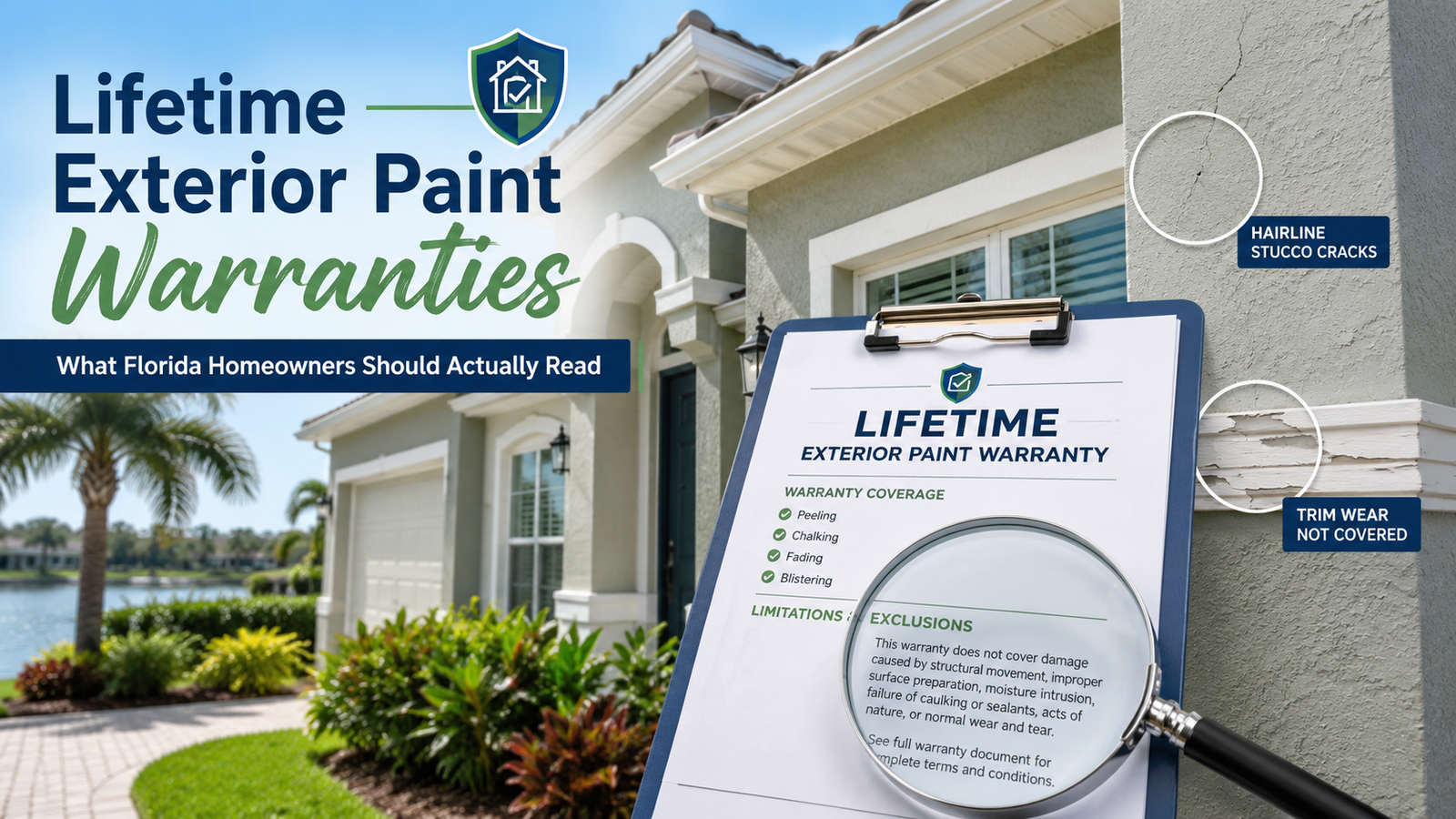
A lifetime warranty on exterior paint sounds like the end of the conversation. In practice it’s the beginning of one, because the word by itself doesn’t tell you what’s covered, who’s responsible, or what you’d actually receive if something went wrong.
This isn’t an argument that lifetime warranties are meaningless. The major manufacturers write real warranties, and they honor them. But as house painters in Jacksonville, FL, we think homeowners should understand that those documents are often narrower than the headline, and the narrowing happens in ways many people don’t discover until they actually need the coverage.
Here’s what to read before you sign, and what to ask while you still have leverage.
What Does “Lifetime Warranty” Actually Mean?
The written document controls. Whatever anyone says at your kitchen table, the warranty is the warranty.
And “lifetime” is a defined term, not a plain-English one. Depending on the document, it may refer to the original purchaser, to the period you own the property, to a specified number of years, or to something else the manufacturer has chosen to define.
Two examples from major manufacturers, both current and both publicly posted. Sherwin-Williams’ Lifetime Limited Warranty defines the term as the period beginning when the coating was purchased and continuing as long as you own that home. Benjamin Moore’s exterior warranties state they are effective for so long as you reside in your home, and are made to the original residential consumer purchaser.
In both cases, “lifetime” means the duration of your ownership — not the life of the house.
That’s not a trick. It’s a reasonable way to bound a warranty, and it’s stated plainly in documents anyone can read. But it’s a different thing from what most people picture when they hear the word. For the broader version of this question, see our guide on whether you can really “never paint your house again”.

Product Warranty vs. Labor Warranty
This is the single most important distinction in the entire subject, and it’s the one that costs homeowners real money.
A manufacturer product warranty covers the paint. If the coating fails in a way the warranty describes, the typical remedy is replacement product or a refund of the purchase price. Sherwin-Williams and Benjamin Moore both structure their exterior warranties this way.
Both also exclude labor. Benjamin Moore’s warranty states it “does not include the cost of labor for application of paint” — and gives the reason directly: the manufacturer has no control over how the surface was prepared or how the product was applied. Sherwin-Williams’ warranty excludes labor and costs associated with labor for application or removal.
That reasoning is fair. A paint company can stand behind what’s in the can. It can’t stand behind what a crew did with it three years ago on a wall it never saw.
But follow the practical consequence. If an exterior needs repainting because of a coating failure, the material is a fraction of what that job costs. The rest is preparation, protection, access, equipment and labor — and a product warranty covers none of it.
The Distinction to Hold Onto
A product warranty comes from the manufacturer and covers the material. A labor or workmanship warranty comes from the contractor and covers the work. They’re separate documents, from separate parties, with separate terms.
If a “lifetime warranty” is being used to sell you a paint job, ask which of the two is being described.
What Failure Modes Are Actually Covered?
Manufacturer exterior warranties tend to name specific failure modes rather than promising general satisfaction. Peeling and blistering come up consistently. Some warranties also address the coating wearing through to expose the previously painted surface.
Those are meaningful, and they cover the failures most likely to indicate a genuine product problem.
Now consider what a Florida exterior actually experiences over years: fading, chalking, mildew and biological growth, cracking in the substrate, movement in the wall, water finding a path at a joint, wood deteriorating behind the finish, sealant reaching the end of its service life.
Whether any of those are covered depends entirely on the specific warranty. Some address certain conditions; many don’t. The only reliable way to know is to read the document you’re being offered rather than assuming coverage extends to anything that looks like a problem. Our exterior paint failure guide covers how these conditions differ and what usually causes them.
The Exclusions Matter as Much as the Promise
Most people read the first paragraph of a warranty. The operative content is usually further down.
Exclusions in exterior coating warranties commonly address improper surface preparation, improper application, failure of a previous coating underneath, structural defects, moisture intrusion, substrate problems, biological growth, and the homeowner’s failure to maintain the property.
Not every warranty contains every one of those, and the wording differs. But notice the pattern: several of the most common exclusions describe conditions that have nothing to do with the paint and everything to do with the building or the work.
Which means a coating failure can be genuine and still fall outside coverage — if the cause traces to preparation, to the substrate, or to moisture rather than to the product itself.
What Happens When Stucco Cracks?
Stucco is a useful test case, because it’s everywhere in Northeast Florida and because it moves.
Cementitious finishes crack — from drying shrinkage, thermal movement, stress at openings, and differential movement where stucco meets another material. A coating can bridge some small stable cracks depending on the system. It can’t stop a wall from moving.
So when a crack appears through a finish a few years after a repaint, the question becomes whether that’s a coating failure or a substrate condition. A warranty on the paint is not automatically a warranty against movement in the wall underneath it, and the two are usually treated very differently.
We see this on real projects. On a Jacksonville 32246 home, localized stucco had lost bond entirely, and removing it exposed deteriorated sheathing behind the finish. No paint warranty addresses that. What addresses it is stucco repair before coating — covered in more depth in our Jacksonville stucco painting guide.
What Happens When Wood Rot Appears?
Same principle, different material.
Fascia, soffits, siding, trim, corner boards. When wood-based components deteriorate past a certain point, they need repair or replacement. A coating warranty generally doesn’t eliminate that, because the warranty is on the finish rather than on the material underneath it.
And repair triggers painting. New material gets primed and coated, which means an exterior with a lifetime paint warranty can still require painting — not because the coating failed, but because something it was applied to did. Our wood and siding repair work exists for exactly this, and our guide to rotten wood repair and exterior painting walks through how it’s handled.
Is the Warranty Transferable?
This one matters more than it seems, and it’s easy to check.
Warranties may be structured as original-owner-only, one-time transferable, fully transferable, or explicitly non-transferable. Both Sherwin-Williams and Benjamin Moore state in their exterior warranty documents that coverage is not transferable.
If you’re planning to sell within the coating’s expected service life, a non-transferable warranty has no value to the buyer — and shouldn’t be presented in a listing as though it does.
There’s a related detail worth knowing: manufacturer warranties are typically made to the purchaser of the paint. If your contractor bought the material, the paperwork may not name you at all. Ask how that’s handled before the job starts.
What Maintenance Is Required?
Warranties frequently place obligations on the homeowner, and neglect appears in exclusion language often enough to take seriously.
Practical items that may be expected: periodically washing the exterior, addressing mildew and biological growth, maintaining sealant at joints and transitions, repairing leaks promptly, and addressing substrate deterioration when it appears rather than letting it progress.
Some warranties also require documentation. If yours does, keep receipts, dates and photographs — a claim years from now is much easier to support with a record than with recollection.
None of this is unreasonable. An exterior that gets maintained genuinely does last longer, warranty or not. But it’s worth knowing what’s required rather than discovering the requirement during a claim.
What Happens If the Contractor Is Gone?
A manufacturer product warranty is backed by the manufacturer. Sherwin-Williams and Benjamin Moore are large, long-established companies, and that coverage is about as stable as a warranty gets.
A labor or workmanship warranty is backed by the contractor who performed the work. That coverage exists as long as the company does.
This isn’t a reason for alarm, and it isn’t a knock on any particular contractor. It’s simply a factor worth weighing when a warranty is measured in decades. A promise that long assumes the business lasts that long too, which is a reasonable thing to ask about.
12 Questions to Ask Before You Sign
Bring this to the estimate. Any reputable company will work through it with you.
- Who issued this warranty — the manufacturer, the contractor, or both?
- What exactly is covered?
- What is excluded?
- Is labor covered, and by whom?
- Is product replacement covered, and up to what quantity?
- Is fading covered?
- Is cracking covered?
- Is the warranty transferable if I sell the home?
- What maintenance am I required to perform?
- What documentation do I need to keep?
- How do I file a claim, and with whom?
- Who pays if the failure is determined to be substrate-related rather than coating-related?
That last question is the one that separates a clear warranty from a vague one. It is also one of the most important real-world scenarios to understand.
What a Good Exterior Painting Warranty Should Help You Understand
The best warranty isn’t the one with the longest number on it. It’s the one you can read and actually understand.
A clear exterior painting proposal should tell you which products are being used and where, which surfaces are included, what preparation is in scope, how many coats are being applied, what’s excluded from the work, what the contractor covers under workmanship, and what the manufacturer covers separately.
If a proposal contains all of that, a homeowner can make an informed decision. If it leads with a single word and gets vague about everything else, that’s worth noticing. Our guide on
whether you can really “never paint your house again”
takes a closer look at how lifetime and permanent-coating claims compare with the way exterior homes actually age and require maintenance.
Premium coatings are worth their cost — we specify them constantly, and the performance difference on a Florida exterior is real. Our comparison of
premium versus cheap exterior paint
covers why. But the reason to buy a good coating is how it performs, not what the warranty is called. More homeowner guides are in our
Exterior Painting Resource Center
.
Want a Proposal You Can Actually Read?
A New Leaf Painting Contractors has been painting exteriors across Jacksonville and Northeast Florida since 2001. Our estimates state the products, the surfaces, the preparation scope, the coat count, and what’s covered — in language you can read before you decide.
Ask us any of the twelve questions above. We’d rather answer them at the estimate than have you wonder later.
Explore Exterior Painting Services Request an Estimate
Or call or text 904-615-6599.
A New Leaf Painting Contractors
Serving Jacksonville, Northeast Florida, and St. Johns, Clay and Nassau counties since 2001.
This article is general information about how exterior coating warranties are commonly structured. It is not legal advice, and it does not describe the terms of any specific warranty you may be offered. Read the document you receive.