A Jacksonville Homeowner’s Guide
What Exterior House Colors Can Make a Home Look More Expensive?
A Jacksonville painter’s guide to the exterior paint colors, trim combinations, and accent strategies that make any home look intentional, balanced, and high-end — built for Florida’s climate. Curb appeal · color · combinations Florida-specific guidance
By Thomas Drake Founder, A New Leaf Painting | 25+ years in Northeast Florida | 750 5-Star Reviews | 5,000+ projects completed
After 25 years painting exteriors across Jacksonville, FL, I’ve seen homeowners spend $12,000 on a paint job that still looks ordinary — and others spend $8,000 on a paint job that looks like a $50,000 renovation. The difference almost never comes from the price tag. It comes from the color palette, the trim discipline, and how well the paint coordinates with the roof, brick, stone, and landscaping that were already there. That is something our exterior house painters in Jacksonville, FL consider when helping homeowners plan an exterior repaint.
An “expensive-looking” exterior isn’t really about picking a trendy color. It’s about choosing a timeless body color, framing it with the right trim, accenting it with one intentional pop on the front door, and making sure every color choice respects the home’s architecture, the Florida climate, and the materials you can’t change. This guide walks you through exactly how to do that.
An “expensive-looking” exterior isn’t really about picking a trendy color. It’s about choosing a timeless body color, framing it with the right trim, accenting it with one intentional pop on the front door, and making sure every color choice respects the home’s architecture, the Florida climate, and the materials you can’t change. This guide walks you through exactly how to do that.
Quick Answer
What exterior colors make a house look expensive?
The exterior colors that usually make a house look more expensive are warm whites, soft off-whites, greige, taupe, charcoal, deep navy, muted green, creamy beige, and classic black or dark bronze accents. The key is choosing a timeless body color, crisp trim, and one intentional accent color for the front door, shutters, or garage door.
In Jacksonville and Northeast Florida, homeowners should also consider heat, UV exposure, humidity, salt air, HOA restrictions, roof color, brick, stone, pavers, and how darker colors fade in Florida sun.
The 60-Second Summary
- Timeless beats trendy. Warm whites, greige, taupe, charcoal, navy, muted green, and cream consistently look high-end across home styles.
- One body + one trim + one accent. Three colors, deliberately chosen, almost always reads more expensive than five colors picked in isolation.
- Trim, front door, and garage door matter as much as the body color. A great body color over the wrong trim looks ordinary every time.
- Coordinate with what’s already there. Roof, brick, stone, pavers, and screen enclosure all set the palette before you ever open a paint can.
- Florida climate punishes the wrong choice. Dark colors fade faster on south and west exposures. Product selection matters as much as color.
- HOA approval is non-negotiable in most Jacksonville-area communities. Always confirm the approved palette before buying paint.
What makes an exterior color look expensive?
Before we get to specific colors, let’s establish the principle. Expensive-looking homes usually don’t look loud. They look intentional, balanced, clean, and well-maintained. That’s the whole formula, and it shows up in five concrete ways:
- Timeless color choice over trendy ones — colors that will still look right in ten years
- Clean contrast between body, trim, and accents — not five colors fighting each other
- Correct undertones — warm-toned homes need warm-toned colors, cool-toned homes need cool-toned colors
- Proper sheen — flat or matte for stucco body, satin or low-lustre for trim and doors
- Premium prep and finish quality — even the perfect color looks cheap over cracked stucco, failed caulk, or chalking paint
That last point matters more than most homeowners realize. A beautiful color over poor exterior preparation never reads as high-end. The eye sees the texture, the cracks, the unevenness — and registers the whole exterior as “needs work” regardless of the color choice.
The best exterior color families for a high-end look
Here are the six color families that consistently make Jacksonville homes look more expensive — with the specific Sherwin-Williams and Benjamin Moore colors that have proven themselves over hundreds of Northeast Florida projects.
Warm Whites & Soft Off-Whites
Clean, classic, and coastal. Soft whites look more expensive than harsh bright whites because they feel warmer and pair better with roof tones, stone, brick, pavers, and landscaping. The right warm white can make a stucco home look brand new.
Best For
- Stucco homes
- Coastal homes from Ponte Vedra Beach to Atlantic Beach
- Mediterranean-style homes
- Modern farmhouse architecture
- HOA communities with neutral-required palettes
Reliable Color Choices
- Sherwin-Williams Alabaster (SW 7008) — soft creamy white, widely HOA-approved
- Sherwin-Williams Greek Villa (SW 7551) — warm, slightly creamy
- Sherwin-Williams Shoji White (SW 7042) — soft warm undertone, photographs beautifully
- Benjamin Moore White Dove (OC-17) — soft warm white, classic Northeast Florida favorite
- Benjamin Moore Swiss Coffee (OC-45) — creamier and softer, pairs well with tile roofs
Greige, Taupe & Warm Neutrals
Probably the safest “expensive” category. Greige and taupe tones soften the exterior without feeling plain or dated. They coordinate easily with almost any roof color, brick, or stone, and they almost always pass HOA review.
Best For
- Stucco and brick homes
- Traditional architecture
- HOA neighborhoods including Marsh Landing, Glen Kernan, and Sawgrass
- Homes with brown, tan, or gray roofs
Reliable Color Choices
- Sherwin-Williams Agreeable Gray (SW 7029) — the most versatile greige in their lineup
- Sherwin-Williams Accessible Beige (SW 7036) — warmer than Agreeable Gray
- Sherwin-Williams Modern Gray (SW 7632) — lighter greige with soft warm undertone
- Benjamin Moore Revere Pewter (HC-172) — iconic warm greige
- Benjamin Moore Edgecomb Gray (HC-173) — slightly lighter than Revere Pewter
Charcoal, Deep Gray & Soft Black
Can look dramatically expensive — but use with care in Florida. Charcoal and soft black often work best as accents on a Jacksonville home (front door, shutters, garage door) rather than as the full body color. Dark body colors absorb heat and fade faster on south and west exposures, particularly in our UV intensity.
Best For
- Modern architecture
- Accent applications (doors, shutters, trim)
- North-facing or shaded full-body applications
- Homes with strong architectural detail to highlight
Reliable Color Choices
- Sherwin-Williams Iron Ore (SW 7069) — deep charcoal, near-black
- Sherwin-Williams Urbane Bronze (SW 7048) — dark brown-charcoal, very on-trend
- Sherwin-Williams Tricorn Black (SW 6258) — true neutral black
- Benjamin Moore Wrought Iron (2124-10) — soft near-black with depth
- Benjamin Moore Kendall Charcoal (HC-166) — rich, slightly green-undertone charcoal
Florida Reality CheckIf you’re putting a dark charcoal or black body color on a south-facing or west-facing exterior in Jacksonville, the paint product matters as much as the color. Sherwin-Williams Emerald exterior with deep-base UV-resistant pigmentation will hold its color for 8-10 years. Standard contractor-grade paint in the same color will start chalking and fading within 3 years.
Deep Navy & Blue-Gray
Classic, polished, and unmistakably coastal. Navy and blue-gray can give a Jacksonville home an elevated coastal look without feeling overly trendy. Best used as a full body color on cottage and traditional architecture, or as an accent door color on lighter homes.
Best For
- Coastal homes in Ponte Vedra Beach, Atlantic Beach, Neptune Beach, Amelia Island
- Cottage and traditional architecture
- Front door accent color on lighter homes
- Shutters paired with white or warm-neutral body colors
Reliable Color Choices
- Sherwin-Williams Naval (SW 6244) — deep, true navy
- Sherwin-Williams Sea Serpent (SW 7615) — blue-gray with depth
- Benjamin Moore Hale Navy (HC-154) — the classic navy benchmark
- Benjamin Moore Hudson Bay (1680) — deep navy with slight gray undertone
Muted & Earthy Greens
Perfect for Jacksonville because they harmonize with our mature live oaks, palms, and tropical landscaping. Muted greens make a home feel custom and grounded — especially when paired with warm white trim and bronze or black accents. Not every HOA approves greens, so confirm first.
Best For
- Homes with mature landscaping
- Craftsman and bungalow architecture
- Coastal cottages
- Homes with warm-toned roofs or natural stone
Reliable Color Choices
- Sherwin-Williams Evergreen Fog (SW 9130) — soft muted sage
- Sherwin-Williams Retreat (SW 6207) — deep muted green
- Sherwin-Williams Rosemary (SW 6187) — earthy mid-tone green
- Benjamin Moore October Mist (1495) — soft sage-greige
- Benjamin Moore Saybrook Sage (HC-114) — classic muted sage
Cream, Beige & Sand Tones
Classic in Florida and dominant in HOA communities. Cream and sand tones look expensive because they feel soft, warm, and architectural instead of stark. They coordinate naturally with tile roofs, stone accents, pavers, and tropical landscaping.
Best For
- Stucco and Mediterranean homes
- Coastal homes
- HOA-approved palettes throughout Northeast Florida
- Homes with tile or terra cotta roofs
Reliable Color Choices
- Sherwin-Williams Natural Linen (SW 9109) — warm sand with cream undertone
- Sherwin-Williams Creamy (SW 7012) — soft cream, classic
- Sherwin-Williams Kilim Beige (SW 6106) — warm tan-beige
- Benjamin Moore Manchester Tan (HC-81) — warm classic tan
- Benjamin Moore Muslin (OC-12) — soft warm cream
The most expensive-looking exterior color combinations
A color family is only half the equation. Combinations matter just as much. Here are the body + trim + accent palettes that consistently make Jacksonville homes look high-end:
| Body Color | Trim Color | Accent Color | The Look |
|---|---|---|---|
| Warm White | Soft White | Bronze/Black | Clean, luxury coastal |
| Greige | White | Charcoal | Timeless, upscale |
| Taupe | Cream | Wood/Bronze | Warm, elegant |
| Light Beige | White | Navy | Coastal classic |
| Soft Green | Warm White | Bronze | Custom, natural |
| Light Gray | White | Black | Modern traditional |
Each of these is built on the same simple rule: one body, one trim, one accent. Three colors, chosen together, almost always reads more expensive than five colors picked in isolation.
Trim, front door, and garage door colors matter just as much
A high-end exterior almost always comes from disciplined trim and accent choices — not just the body color. Here’s how to think about each.
Trim color: framing the home
Trim should frame the home — not compete with it. The trim color sets the visual rhythm of the entire exterior, and getting it wrong is one of the most common reasons a paint job looks cheaper than it should.
- White trim creates crisp, classic contrast — best with mid-tone and darker body colors
- Cream trim softens stucco and reads as warmer, more architectural
- Dark trim (charcoal, black, deep bronze) creates modern, high-contrast lines on light bodies
- Body-color trim (slightly lighter or darker shade of the body) creates a monochromatic, deliberately understated look
- Fascia and soffit color affects the whole look — don’t ignore them. They make up more visible square footage than most homeowners realize.
Front door color: the highest-impact accent
The front door is often the single best place to add personality without overwhelming the exterior. It’s small enough to handle a bold color, but visible enough to anchor the entire elevation. The most expensive-looking front door colors:
- Black or near-black — classic, never dated
- Deep navy — coastal, refined
- Dark green — rich and traditional
- Mahogany or stained wood — the most expensive-looking option when the door supports it
- Bronze — warm, modern, photographs beautifully
- Burgundy or deep wine — bold without being trendy
Garage door color: the often-overlooked mistake
If the garage door takes up a large part of the front elevation — and on most Jacksonville suburban homes it does — the wrong color can cheapen the entire exterior. Garage doors are bigger than people think, and bright white doors on warm-toned bodies create unintentional focal points.
The general rule: if you don’t want the garage door to be the focal point, match it to the body color or to the trim. If you want it to anchor the elevation visually, then a contrast color (dark charcoal, deep navy, or warm wood-look) works — but only if the rest of the exterior supports it.
Common MistakeStandard bright-white garage doors on warm beige or tan homes almost always look mismatched. The garage door reads as a separate object stuck to the front of the house. Match the trim color instead — it integrates the door into the overall design and makes the whole exterior look more intentional.
Coordinate with your roof, brick, stone, and pavers first
Paint colors don’t exist in isolation. Your home already has a partial palette built into its permanent materials — roof, brick, stone, pavers, screen enclosure, gutters, window frames. The paint has to coordinate with what’s already there, or the whole exterior looks disjointed.
Roof color sets the entire palette
The roof is part of the color palette whether you like it or not — and it’s far more permanent than paint. Match your body color to your roof, not the other way around.
- Brown or weathered-wood roofs need warmer body colors — taupes, warm whites, greiges with warm undertones
- Gray or charcoal roofs handle cooler colors well — soft grays, blue-grays, cooler whites, navy accents
- Red or terra cotta tile roofs need cream, taupe, beige, or warm white bodies — anything cool-toned fights them
- Metal or standing-seam roofs need careful undertone matching — bring samples to the home before committing
Brick, stone, pavers, and fixed materials
Brick has a permanent undertone (warm orange-red, soft pink, warm tan, cool gray) that the paint either honors or fights. Stone accents bring their own undertones. Pavers and driveways often have warm earthy tones that interact with the body color from below. The screen enclosure on a Jacksonville pool home has a specific charcoal or bronze tone that affects everything around it.
When you’re choosing colors, bring large samples to the home and place them directly against the roof, brick, stone, and pavers. If the sample reads as awkward against any of those, the full exterior will too.
Exterior colors that hold up best in Jacksonville’s climate
A color can look beautiful on a sample card and perform very differently on a full exterior exposed to Florida sun, humidity, and salt air. Here’s what to know before committing to a color in this market.
UV exposure punishes dark colors
Jacksonville gets 300+ days of intense sun per year. South-facing and west-facing exposures get the most UV punishment, which breaks down paint pigments and causes fading. Dark colors (charcoal, deep navy, black, dark green) fade faster than lighter colors — sometimes within 3-4 years if the wrong product is used.
If you want a dark exterior color in Florida, the product matters as much as the color. Premium Sherwin-Williams Emerald or Duration exterior with UV-resistant deep-base pigmentation can hold dark colors for 8-10 years. Standard contractor-grade paint in the same color will start chalking and fading much sooner.
Humidity creates mildew on improperly coated surfaces
Jacksonville’s humidity routinely exceeds 75%. Mildew and algae growth on north-facing walls is common, and the color choice affects how visible the growth is. Lighter colors show mildew streaking more dramatically than mid-tone or darker colors — but mildewcide-fortified paints (built into Sherwin-Williams Emerald and Benjamin Moore Aura) prevent growth regardless of color.
Salt air on coastal homes
Homes within a mile or two of the Atlantic — including parts of Ponte Vedra Beach, Atlantic Beach, Neptune Beach, Jacksonville Beach, and Amelia Island — face accelerated paint breakdown from salt-air chlorides. Coastal-specific primer systems and high-performance acrylic topcoats matter as much as color choice on these homes.
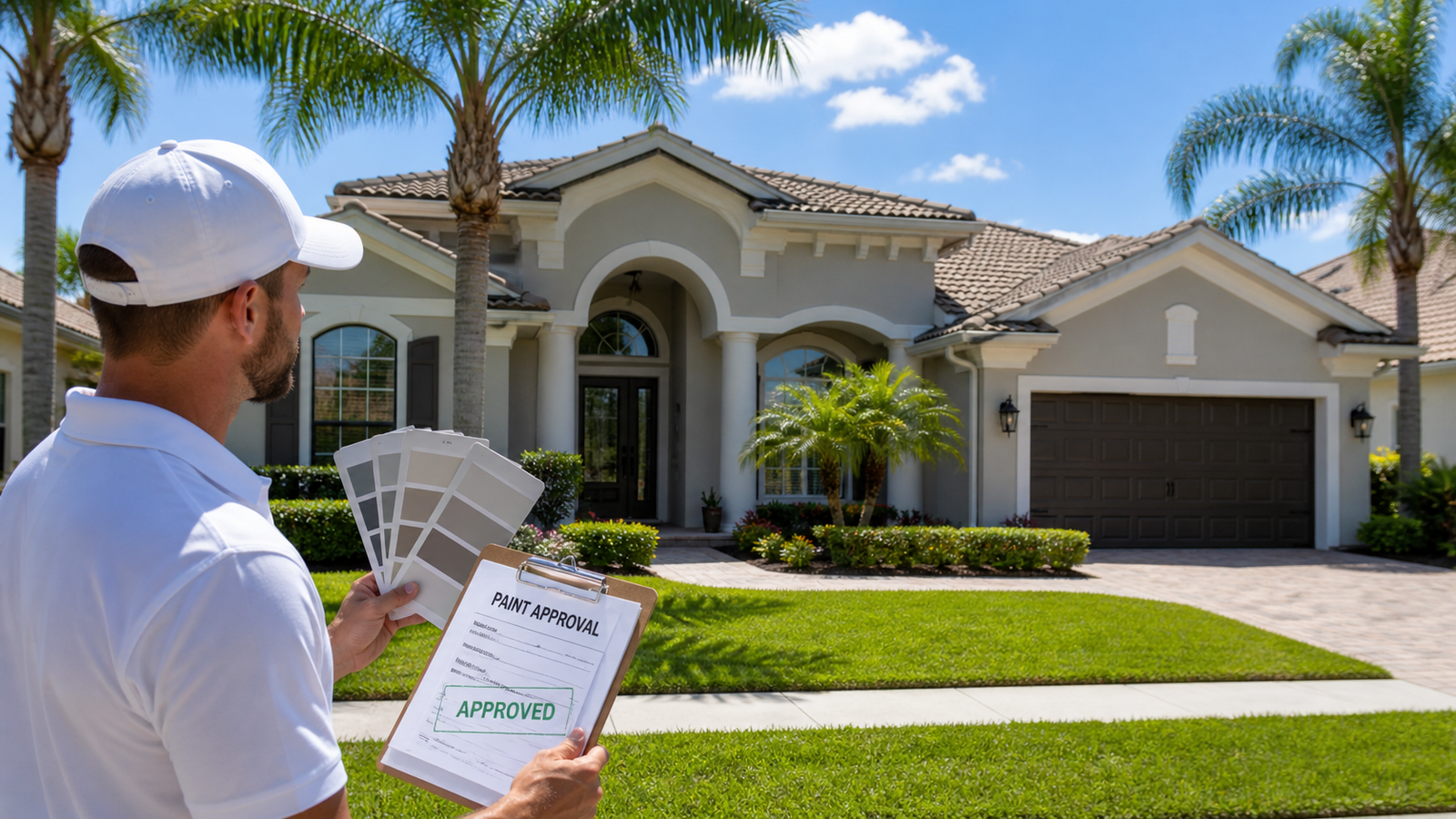
If you live in an HOA, check the approved palette first
HOA Paint Color Approval
Most Jacksonville HOAs Require Written ARB Approval Before Painting
Most gated and master-planned communities in Northeast Florida — including Marsh Landing, Sawgrass, Glen Kernan, Queens Harbour, Deerwood, Palencia, RiverTown, Nocatee, Fleming Island, and dozens of others — require written architectural review board approval before exterior paint work begins. Painting without approval can result in violation letters, fines, and forced repaints.
Important: You remain responsible for submitting the ARB application to your HOA. We help by providing the technical packet content — paint product details, color names and codes, sheens, LRV documentation, and exterior scope details typically required for board approval.
Before you commit to a color, check your community’s approved palette. Some HOAs maintain a strict pre-approved list. Others allow any color within general guidelines. A few allow homeowners to propose custom colors with submission.
Exterior color mistakes that make a house look cheap
The fastest way to understand what makes a house look expensive is to look at what makes it look cheap. Avoid these and you’ve already won most of the battle:
Avoid These Mistakes
The most common exterior color mistakes
- Too many colors. More than three colors on an exterior usually reads as cluttered, not custom.
- Harsh bright white on warm-toned homes. Pure white fights warm-tone roofs and brick. Use a warm white instead.
- Mismatched undertones. Cool-undertone trim on a warm-undertone body always looks “off” without the homeowner being able to articulate why.
- Trendy colors that fight the architecture. A Mediterranean stucco home painted slate gray will never look right.
- Garage door that stands out too much. Big white garage doors on warm-tone homes create unintentional focal points.
- Faded dark colors. A once-rich dark color that’s chalked to a dusty gray looks neglected, not premium.
- Trim that’s too stark. Bright-bright white trim on cream or beige bodies often creates jarring contrast.
- Painting brick without proper prep. Wrong product, wrong prep, wrong primer = the cheap-looking brick repaint that fails in 2 years.
- Ignoring the roof color. The most expensive paint job in Jacksonville still looks ordinary if the body color fights the roof.
The best exterior colors by home style
Different architectural styles call for different palette choices. Here’s how the high-end formula adapts across the home styles common in Northeast Florida.
Stucco Homes
- Warm white (Alabaster, Greek Villa)
- Cream (Natural Linen, Creamy)
- Taupe (Accessible Beige)
- Greige (Agreeable Gray)
- Sand and soft gray-green
Brick Homes
- Cream and warm white trim
- Greige (Revere Pewter)
- Charcoal accents
- Navy doors (Hale Navy, Naval)
- Soft white trim with dark shutters
Coastal Homes
- Warm white (White Dove)
- Sand tones
- Blue-gray bodies
- Navy and bronze accents
- Soft muted greens
Modern Homes
- True white (Alabaster)
- Charcoal (Iron Ore, Urbane Bronze)
- Black accents
- Warm wood tones
- Monochromatic palettes
Traditional Homes
- Greige (Edgecomb Gray)
- Warm beige (Manchester Tan)
- Crisp white trim
- Black shutters
- Navy or burgundy front door
HOA Homes
- HOA-approved neutrals
- Soft, low-contrast palettes
- Classic white or cream trim
- Safe accent colors (navy, charcoal)
- Always verify before purchasing
A painter’s rule for choosing exterior colors
“After 25 years and 5,000+ exterior projects across Northeast Florida, my rule is simple: one body color, one trim color, one accent color. Three colors, chosen deliberately, coordinate with the roof and the permanent materials, and tested on the actual home before painting. That formula has never let a homeowner down.”
“And if you want your home to look more expensive, spend just as much energy on prep and finish quality as you do on the color. A beautiful color over cracked stucco, failed caulk, chalking paint, or rotted trim will never look high-end. Ever.”
Thomas Drake, Founder & Master Finisher
Sheen and product guidance for exterior painting
The right sheen and product can make the same color look high-end or ordinary. Here’s how to think about it:
Sheen guide for exterior surfaces
- Flat / Matte — best for stucco body, hides imperfections
- Low-Lustre / Satin — ideal for trim, doors, shutters
- Semi-Gloss — high-durability for front doors and garage doors
- Higher sheen — reveals more surface imperfections
- Dark colors — need premium fade-resistant exterior paint
- Stucco surfaces — often need masonry primer or elastomeric coating
- Trim and doors — need durable enamel products
- Two-coat application — always for maximum durability and color depth
For premium results in Jacksonville’s climate, the products that consistently perform are Sherwin-Williams Emerald (10-year warranty), Sherwin-Williams Duration (7-year warranty), and Benjamin Moore Aura (similar 10-year warranty). For stucco-specific applications, specialty products like Loxon XP handle waterproofing and crack-bridging that standard exterior paints cannot.
Why Jacksonville homeowners trust A New Leaf Painting
The standards every estimate includes
We’ve spent 25 years building a Jacksonville house painting company we’d want our own families to hire. Every estimate includes complete written scope, named premium products, full surface preparation, two coats on every surface, and our Iron-Clad Guarantee on workmanship — including free color consultation with large-format samples brought to your home.
- Serving Northeast Florida since 2001
- 5,000+ residential and commercial projects
- 750+ verified five-star reviews
- Licensed and insured in Florida
- $5M liability coverage
- Sherwin-Williams & Benjamin Moore products
- Free color consultation included
- HOA submission support included
- Iron-Clad Guarantee on workmanship
- Stucco repair and carpentry repairs
- Cabinet painting and refinishing
- Interior and exterior painting
Exterior color questions answered honestly
What exterior color makes a house look the most expensive?
Warm whites, soft greige, charcoal, navy, and muted greens consistently look the most expensive — but the answer depends heavily on the home’s architecture, roof color, and permanent materials. For Jacksonville stucco homes, warm whites and soft greige are nearly always the safest premium choice. For coastal homes, navy and blue-gray accents look polished. For modern homes, charcoal and deep bronze read as high-end.
The truly “expensive” look almost never comes from one specific color — it comes from a disciplined three-color palette (body + trim + accent) that coordinates with the roof and fixed materials.
Do dark exterior colors really fade faster in Florida?
Yes. Florida’s UV intensity breaks down paint pigments faster than almost any other climate in the U.S., and dark pigments are more susceptible to fading. On south-facing and west-facing exposures, standard contractor-grade dark paint can start chalking within 3 years.
However, premium exterior paints like Sherwin-Williams Emerald and Benjamin Moore Aura use UV-resistant pigment technology that significantly extends color life — often 8 to 10 years for dark colors. The product matters as much as the color choice in Florida.
Should the garage door match the body or the trim?
It depends on what you want it to do. If you want the garage door to disappear visually, match it to the body color. If you want it to integrate cleanly into the design, match it to the trim color. If you want it to anchor the elevation as a deliberate accent, use a dark contrasting color — but only if the rest of the exterior supports it.
The mistake to avoid: leaving the garage door as bright builder-grade white on a warm-tone home. It creates an unintentional focal point and almost always cheapens the overall look.
Can I use any color I want if I live in an HOA?
Almost never. Most Jacksonville-area HOAs require written architectural review board approval before exterior paint work begins, and many maintain strict pre-approved color palettes. Painting without approval can result in violation letters, daily fines, and in some cases, forced repaints at your expense.
Before committing to a color, check your community’s approved palette. For more guidance, see our complete HOA painting guide and our HOA Paint Color Guide with palettes for 20+ Northeast Florida communities.
How do I test exterior colors before committing?
Never commit to a color from a paint chip or screen. Paint chips are too small, and lighting in a store has nothing to do with Florida sunlight. Instead, get large-format samples (12×12 inch peel-and-stick samples, or paint sample boards) and place them on the actual home — directly against the roof, brick, stone, and trim.
View them in multiple lighting conditions: morning, midday, late afternoon, and on a cloudy day. Colors shift dramatically in Florida light, and what looks soft and warm at noon can read pink or yellow in late-afternoon golden hour. A free color consultation from an experienced Jacksonville painter saves enormous time on this step.
What’s the best exterior trim color for a Jacksonville home?
The best trim color depends on the body color and the architectural style. For warm-toned body colors (taupe, cream, warm white), the best trim is usually a soft warm white like Sherwin-Williams Alabaster or Benjamin Moore White Dove. For cooler body colors (gray, blue-gray, charcoal), a slightly cooler white like Sherwin-Williams Pure White works better.
Avoid pure-bright stark whites on warm-toned homes — they create jarring contrast. And don’t forget the fascia and soffit color, which often gets ignored but covers a surprisingly large visible area.
How often should I repaint my exterior in Jacksonville?
Most Jacksonville homes need exterior repainting every 7 to 10 years with premium products applied correctly, and every 4 to 6 years with builder-grade or contractor-grade products. South-facing and west-facing exposures often need refresh painting sooner than north-facing walls because of UV intensity.
Signs it’s time: chalking when you wipe the wall and your hand comes back dusty, visible fading on sun-exposed walls, peeling around windows and trim, or mildew streaking that won’t pressure-wash off. See our exterior painting cost guide for typical project pricing in Jacksonville.
Does professional color consultation really make a difference?
Yes — meaningfully. Choosing exterior colors involves balancing the body, trim, accent, roof, brick, stone, pavers, landscaping, neighborhood character, and architectural style. Most homeowners try to do this from sample chips and Pinterest, which leads to the same handful of common mistakes (wrong undertones, mismatched roof coordination, harsh contrast).
A free color consultation from an experienced Jacksonville exterior painter saves an enormous amount of guesswork. We bring large-format samples to your home, place them against your roof and brick, and view them in your actual lighting at multiple times of day. The cost of getting the color wrong on a $10,000-$15,000 exterior project is far higher than the time it takes to get a professional second opinion.
Ready to choose?
Make your Jacksonville home look intentional, balanced, and high-end.
25 years. 5,000+ Northeast Florida exterior projects. 750+ verified five-star reviews. Free color consultation included with every exterior estimate — we bring large-format samples to your home so you can see how your colors actually look in your specific light, against your roof and your landscaping. Backed by our Iron-Clad Guarantee.