
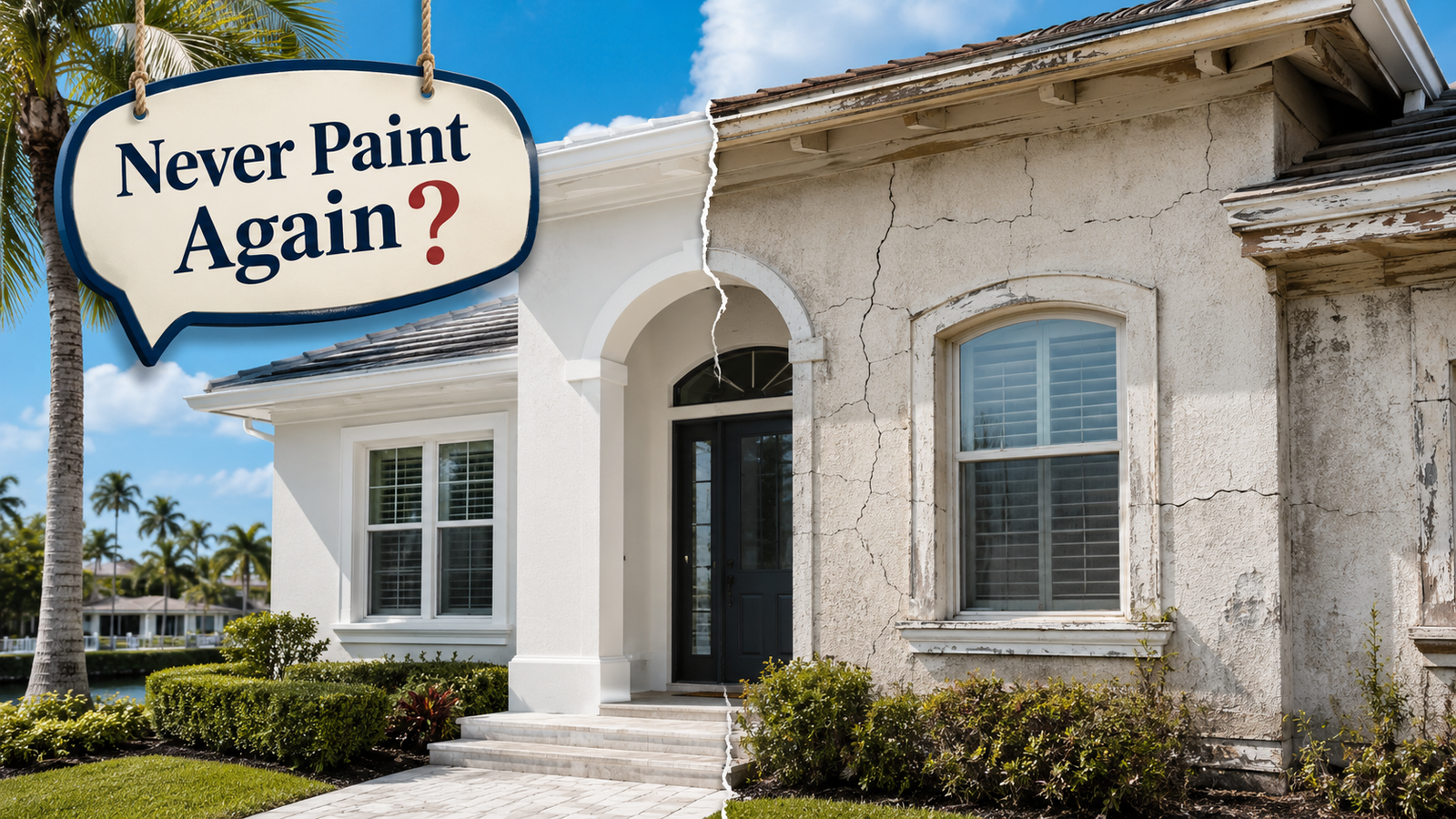
You’ve probably seen the ad. A coating that goes on once and you never paint your house again. Sometimes it comes with a lifetime warranty, sometimes with a number like 25 or 30 years, sometimes with language suggesting the whole question of exterior maintenance is behind you.
It’s worth understanding what’s actually being promised, because the phrase covers a lot of ground. Some of what these systems offer is real. A genuinely durable coating on a properly prepared exterior can last a long time, and premium products do outperform cheap ones by a wide margin. But “long-lasting” and “permanent” are different claims, and the gap between them is where homeowners get surprised.
This isn’t an argument against premium coatings. We specify them constantly as part of our work as house painters in Jacksonville, FL. It’s an argument for reading what you’re actually buying.
What Does “Never Paint Again” Actually Mean?
The phrase means different things depending on who’s saying it, and the four things it might mean have very different consequences.
Marketing language is the headline. It’s designed to be memorable, and it isn’t a contract.
Warranty language is the contract. It’s a written document with defined terms, specified remedies, and a list of exclusions. It’s usually much narrower than the headline, and it’s the only part that’s enforceable.
Expected service life is a performance estimate — how long the coating is likely to hold up under given conditions. It isn’t a guarantee, and it varies enormously with substrate, preparation and exposure.
Maintenance obligations are what you have to do to keep the coverage. Many warranties require them. Most homeowners never read that part.
If a company tells you that you’ll never paint again, the useful follow-up is: “Show me where the written warranty says that.”
Can Any Exterior Coating Truly Last Forever?
A coating can have an unusually long expected service life. “Forever” is a much stronger claim — and exterior coatings are not generally treated as permanent, maintenance-free building components.
Every exterior paint film is a thin layer of resin holding pigment in place. UV radiation breaks down that resin over time — it’s the same process that produces chalking on an older exterior, where the binder degrades and pigment releases as a loose powder. Premium coatings resist it far better than budget ones. None of them are immune to it.
The film is also being asked to move. Exterior surfaces expand and contract with daily temperature swings, and in Northeast Florida that cycle runs year-round. Coatings retain flexibility for a long time, then gradually lose it. Adhesion is similarly finite: a film bonded to a substrate stays bonded until something — moisture, contamination, substrate movement, or age — changes that.
None of this makes durable coatings a bad investment. It means a coating is a maintenance item with a long interval, not a permanent condition of the building.
The House Under the Coating Still Moves and Ages
This is the part the marketing tends to skip, and it’s the most important thing on this page.
A coating sits on top of a building. It doesn’t become the building. And the building underneath continues doing everything buildings do.
Paint does not stop stucco from cracking. It does not stop a structure from moving. It does not stop wood from deteriorating where moisture reaches it. It does not keep sealant flexible at joints and transitions. It does not stop water from finding a path at a window, a roofline, or a penetration. It does not prevent fasteners from corroding or trim from taking damage.
The Practical Consequence
Even if a coating stays perfectly intact, another component of the exterior may need repair. And when a repair happens — a stucco patch, a replaced fascia board, a rebuilt trim detail — that area has to be primed and coated afterward.
A coating that never fails still doesn’t produce a house that never needs painting.
Stucco Is a Perfect Example
Stucco is everywhere in Northeast Florida, and it makes the point cleanly.
Stucco is a cementitious finish, and cementitious finishes crack. Some of it is drying shrinkage from the original application. Some is thermal movement as the wall expands and contracts. Some appears at material transitions, where stucco meets trim, block or another element that moves at a different rate. Some shows up at window and door corners, where an opening concentrates stress.
A high-build or elastomeric coating, correctly specified, can bridge certain small and stable surface cracks and reduce their visibility. That’s a real capability and it has real value. What it can’t do is stop the wall from moving. If a location keeps moving, a coating over it eventually reports that movement.
Perimeter sealant is the other half of it. Sealant at window and door transitions ages under UV, hardens, and eventually splits or separates. That’s normal maintenance on any stucco home, on any coating system, at any price point.
We document this on real projects. A large stucco home in Jacksonville 32257 needed crack preparation and sealing across multiple elevations before any coating went on. A home in 32246 had localized stucco that had lost bond entirely — and removing it exposed deteriorated sheathing behind the finish. No coating warranty would have covered either condition. Our guides on painting stucco homes in Jacksonville and stucco repair before painting cover what these conditions require.
Wood Rot Doesn’t Care What Paint Warranty You Have
Fascia, soffits, trim, siding, corner boards, window casings. On most Florida homes, at least some of the exterior is wood or a wood-based product.
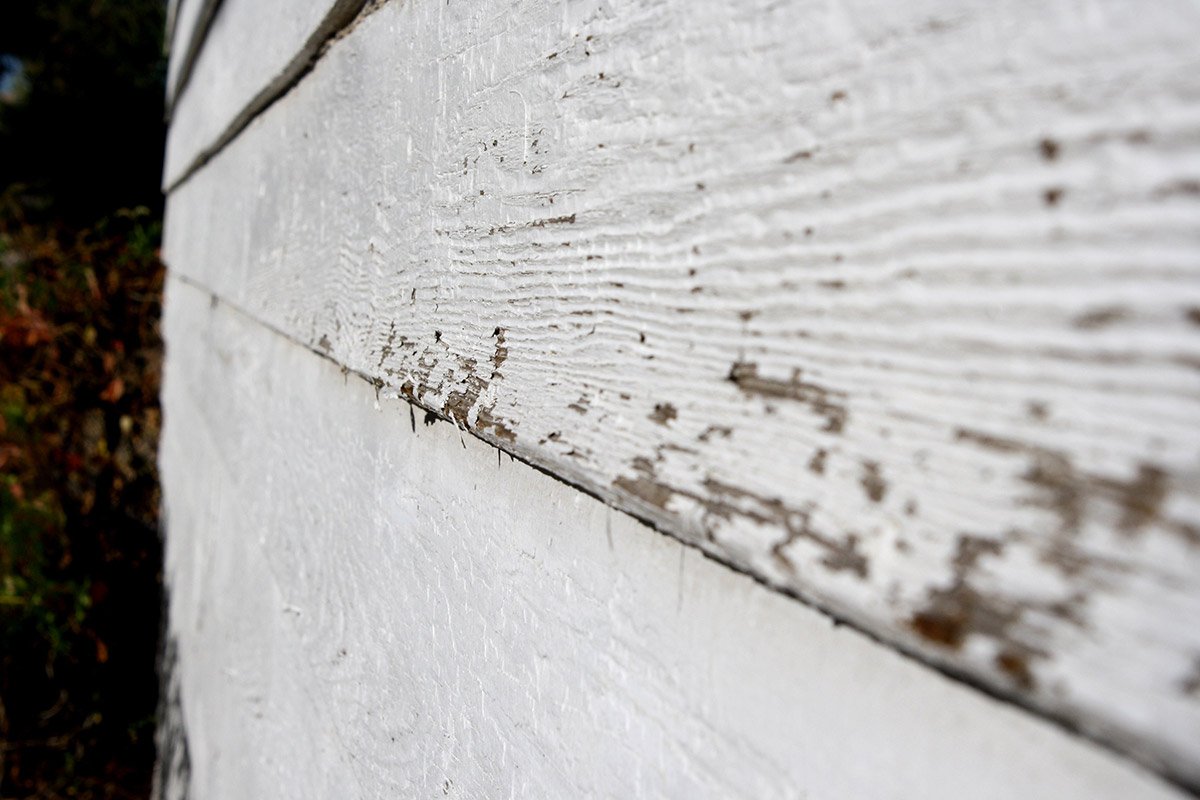
When wood deteriorates past a certain point, it needs repair or replacement. No coating warranty changes that, and no coating reverses it. On a Secret Cove project in Jacksonville 32216, T1-11 siding repairs and replacement came before the exterior painting — not because the previous coating had failed, but because the material underneath it had.
And once that wood and siding repair is done, the new material has to be primed and coated. That’s painting. More on what this looks like in practice in our guide to rotten wood repair and exterior painting.
What “Lifetime” Means in an Actual Written Warranty
Here’s where the language gets concrete, and you don’t have to take a contractor’s word for it. Manufacturers publish their warranties.
Sherwin-Williams offers a Lifetime Limited Warranty on several exterior products, and its warranty document defines the term explicitly. In the company’s own words, “Lifetime” means the period beginning when you purchased the coating and continuing as long as you own that home.
“Lifetime” is not the lifetime of the house. It’s the duration of your ownership.
The rest of the document is equally specific, and worth knowing before any conversation about warranties:
- It covers peeling and blistering. That’s the failure mode. Not fading, not cracking of the substrate, not mildew, not general wear.
- The remedy is replacement product or a refund of the purchase price. Enough paint to redo the affected area, or your money back for the paint.
- Labor is excluded. The warranty states it excludes labor and costs associated with labor for the application or removal of any product.
- It isn’t transferable. The coverage doesn’t pass to the next owner.
- Several conditions void it, including improper surface preparation, structural defects, failure of a previous coating, and improper application.
None of that makes it a bad warranty. It’s a normal, honestly written product warranty, and Sherwin-Williams makes excellent coatings. The point is what it actually is: a promise about the paint, not about your house.
That distinction matters enormously. A product warranty covers the material. A labor warranty covers the work, and it comes from the contractor rather than the manufacturer. Different warranties may be prorated, may have different exclusions, and may carry different maintenance requirements. The written document is what controls — not what anyone said at the kitchen table.
Premium Coatings Are Still Worth Paying For
It would be easy to read all of this as an argument against spending money on good paint. It isn’t, and we’d be arguing against our own practice if it were.
Premium exterior coatings genuinely deliver better adhesion, better color and gloss retention, improved flexibility, stronger resistance to chalking, better moisture resistance, and higher film build per coat. On a Florida exterior those differences are not marginal. They show up as a meaningfully longer interval before the next repaint, and as a finish that looks better throughout that interval.
The argument here isn’t against quality. It’s against a single word. Premium paint is worth the cost because it lasts longer — not because it lasts forever.
Questions to Ask Before Buying a Long-Life Coating System
Print this. Any reputable company will answer all of it without hesitation.
- What exact product are you using, by name, and who manufactures it?
- Can I see the manufacturer’s technical data sheet?
- Can I read the full written warranty before I sign?
- How does that warranty define “lifetime”?
- Is it a product warranty, a labor warranty, or both — and who pays for labor if the coating fails?
- What exactly is excluded? Is fading covered? Is mildew?
- What happens if the stucco underneath cracks?
- What happens if wood components deteriorate?
- What happens when the caulking fails?
- What maintenance am I required to perform to keep coverage, and is the warranty transferable if I sell?
- What happens to my coverage if your company is no longer in business?
That last one deserves weight. A labor warranty is only as durable as the company standing behind it, and a promise measured in decades assumes the business lasts that long too.
How Long Should Exterior Paint Actually Last in Florida?
There’s no single honest number, and anyone offering one hasn’t looked at your house.
Service life depends on the substrate, the condition of the previous coating, how thoroughly the surface was prepared, how many coats went on and at what film build, the quality of the coating system, the color chosen, how much sun and driving rain that elevation takes, whether moisture is reaching the surface, whether the exterior gets maintained, and how close the home sits to the coast.
Two identical homes on the same street can land years apart because one has a heavily shaded north elevation and the other doesn’t, or because one was prepared properly and the other was painted over chalk.
Our guides on how often you should paint your house and how long exterior paint lasts in Florida work through those variables in detail.
The Better Question: How Do I Get the Longest Life From My Exterior Paint?
This is the question worth asking, and it has a real answer that doesn’t depend on any single miracle product.
The exterior projects that last are the ones where the sequence was respected:
- Evaluate the substrate. Know what’s actually on the wall and what condition it’s in.
- Repair what’s failing. Stucco, wood, sealant, whatever the evaluation found.
- Clean thoroughly. A coating bonds to what’s there, including contamination.
- Scrape and sand where needed. Loose material has to come off.
- Seal joints properly. At the details that call for it, with an appropriate sealant.
- Prime where needed. For adhesion, stain blocking, repairs, or bare substrate.
- Select the coating system for the substrate. Not one product for every surface.
- Apply the correct film build. Coverage rate and coat count matter as much as product choice.
- Maintain it. Wash the exterior, watch the sealant, address small problems early.
None of that is exciting, and none of it fits in an advertisement. It is, however, what actually determines how long an exterior finish lasts. Our exterior painting process is built around it, and our exterior paint failure guide covers what happens when steps get skipped.
The Honest Version
There is no coating that stops a Florida home from aging. UV keeps working on the film. The wall keeps moving. Sealant keeps reaching the end of its service life. Wood keeps responding to moisture. Somewhere on the exterior, something will eventually need attention.
What does exist is a meaningful difference between exteriors that were evaluated, repaired, prepared and coated properly, and exteriors that were painted over. That difference can be many years of service life — which is a genuinely valuable thing to buy, and considerably more honest than a promise nobody can keep.
Before trusting any “lifetime” claim, it helps to understand exactly what the written warranty covers, who is responsible for labor, and what exclusions apply. Our guide to lifetime exterior paint warranties for Florida homeowners breaks that down in detail.
If a company can explain exactly what product they’re using, hand you the written warranty, tell you plainly what it excludes, and describe what your exterior actually needs before any coating goes on — that’s the conversation worth having. More homeowner guides are in our Exterior Painting Resource Center.
Want an Honest Read on Your Exterior?
A New Leaf Painting Contractors has been evaluating and painting exteriors across Jacksonville and Northeast Florida since 2001. We’ll tell you what condition your exterior is actually in, what needs repair before anything gets coated, what coating system fits the substrate — and what we can and can’t promise about how long it will last.
No magic products. Just an evaluation and a scope you can read.
Explore Exterior Painting Services Request an Exterior Evaluation
Or call or text 904-615-6599.
A New Leaf Painting Contractors
Serving Jacksonville, Northeast Florida, and St. Johns, Clay and Nassau counties since 2001.