
Stucco Bubbling, Bulging & Delamination: What Jacksonville Homeowners Should Know
You notice a bubble in the paint. Or a section of wall that looks slightly swollen when the light hits it sideways. Or you tap the stucco near a window and it sounds different than the wall three feet over.
From the driveway, all three can look like the same thing: bad stucco. They aren’t necessarily the same problem. One may be a coating failure sitting on top of otherwise sound stucco. Another may involve stucco that has lost its bond to the substrate behind it. Those conditions require very different responses, and the difference isn’t always obvious until the area is evaluated more closely.
The question that comes before any paint decision is a simple one: is the coating failing, or is the surface you’re about to paint failing? As Jacksonville exterior painters, we regularly evaluate visible stucco conditions on homes across Duval, St. Johns, and Clay counties. That’s the first distinction we’re trying to make, because loose or delaminated stucco may require stucco repair before exterior painting rather than simply another coating over the affected area.
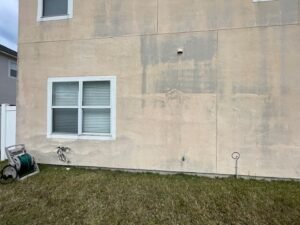
What Are You Seeing on the Stucco?
Jump to what looks closest to your wall:
- Bubbling paint — raised blisters in the coating film
- Bulging or wavy stucco — the wall surface itself protrudes
- Hollow-sounding stucco — sounds different when tapped
- Loose stucco — moves or flexes under gentle pressure
- Stucco separating from the wall — visible gap or lifted edge
- Cracks with bulging — a crack through a raised area
- Rust or white deposits — staining near the failing area
- Stucco falling away — pieces coming off the wall
What Is Stucco Delamination?
Delamination is a loss of bond — two surfaces that were supposed to stay attached no longer are. In composite materials it happens when adjacent surfaces don’t achieve enough mechanical or chemical bond to resist the stresses acting on them.
On a stucco wall, that separation can occur at several places:
- The finish coat separating from the base coat beneath it
- One plaster layer separating from another
- The stucco losing bond from masonry or concrete substrate
- The stucco separating from lath or its supporting assembly, where lath is present
Bond is controlled by three things: how the substrate was prepared, how the material was applied, and whether each coat developed enough strength before the next went over it. A finish coat applied before the base coat had cured adequately is a documented cause of delamination — one that shows up decades later and has nothing to do with weather.
That’s worth sitting with, because it means not every failure traces to something that happened recently.
What Does Hollow-Sounding Stucco Mean?
Tapping a wall and listening is a real technique, and it’s useful. Firmly bonded stucco tends to produce a solid, dull sound. Areas with voids or poor bond behind them often ring differently — a hollower, more resonant tone. Comparing across a wall, rather than judging one spot in isolation, is what makes it informative.
What it isn’t is a diagnosis.
A hollow area might be delaminated. It might be a void from the original application. It might be a previous patch that never fully bonded. Same sound, different answers.
One practical caution: tap gently, with a knuckle or a plastic-handled tool. Striking a wall hard enough to find loose stucco is also hard enough to create it, and homeowners occasionally turn a small hollow area into a hole they now have to explain to a contractor.
Bubbling Paint vs. Bulging Stucco
This is the distinction that determines everything else.
Bubbling Paint
What it looks like: A raised, blister-like area in the coating film. The paint may stretch, and it often peels or tears when disturbed. Around the edges, the coating is still attached.
What’s underneath: Frequently sound stucco. Press gently around the blister — if the wall beneath feels hard and doesn’t move, the failure is likely in the film rather than the substrate.
Possible causes: Moisture behind the coating, poor adhesion, painting over contamination or chalk, incompatible coating systems, painting masonry before it was adequately dry, excessive film build, or preparation shortcuts.
Our exterior paint failure guide covers how to distinguish the coating-side causes from one another.
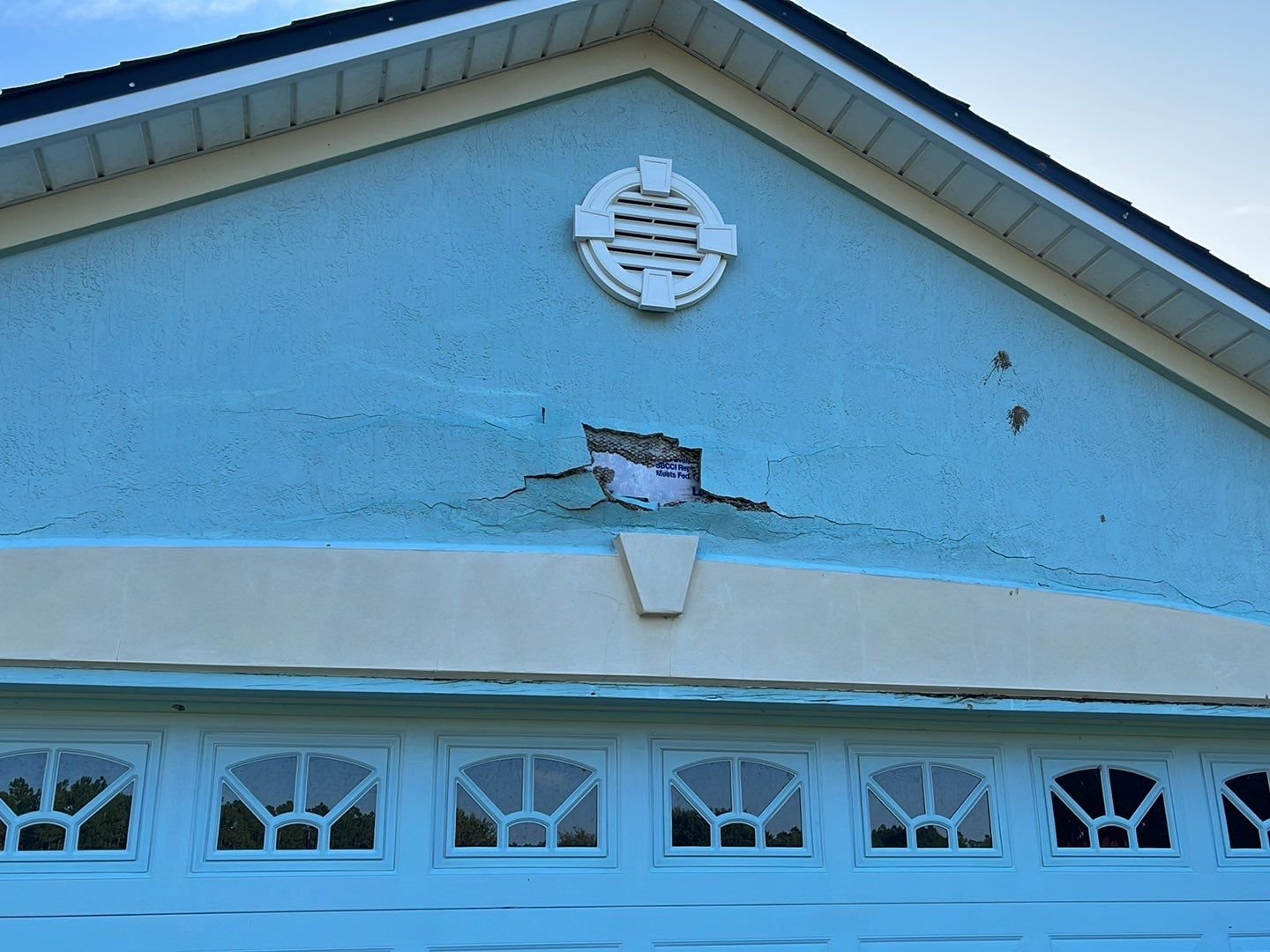
Bulging or Wavy Stucco
What it looks like: The wall surface itself protrudes. Usually a broader area than a paint blister — a swelling, a wave, or a section that reads as no longer flat when you sight along the wall. Raking light in early morning or late afternoon makes this far easier to see.
What’s underneath: Something has changed at the bond line or behind it. The stucco may have separated from its substrate, or a material behind it may have expanded or deteriorated.
Why coating won’t help: Paint doesn’t restore adhesion. Applying it over a bulge preserves the bulge and adds a film that will move with whatever the stucco does next.
Loose Stucco
Material that flexes, shifts, or gives when gently pressed. This is a step past bulging — the bond isn’t just compromised, it’s substantially gone in that area.
Don’t pull at it. Loose stucco often extends further than the visible edge, and homeowners who start picking at a loose corner routinely discover the area was three times the size they thought. That’s information a contractor wants, but not on a Saturday afternoon with no plan to close it back up.
Stucco Separating From the Wall
A visible gap, a lifted edge, or a section that has clearly parted from what’s behind it. At this stage the question is scope rather than diagnosis — how far does it extend, what caused it, and what’s the condition of the substrate underneath.
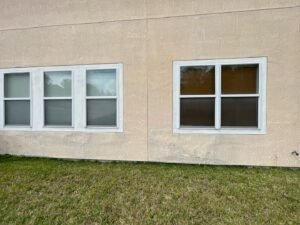
What Causes Stucco Delamination on Florida Homes?
Multiple mechanisms, and moisture is only one of them.
Original bond conditions. Stucco needs a clean, compatible, properly prepared substrate to develop adequate bond. Industry standards address how that surface should be prepared and what to do when adequate bond can’t be achieved directly. Where those conditions weren’t met at installation, the wall may have been living on borrowed bond for years — and the failure shows up decades later with no recent cause behind it.
Contamination between coats. Anything on the surface at application — dust, curing compound, form release, paint — interferes with bond.
Application over an unsuitable substrate. Overly smooth, sealed, or previously painted surfaces don’t accept stucco well.
Insufficient cure between coats. Applying a coat before the one beneath it developed adequate strength.
Moisture behind the finish. Persistent water can work at the bond line and at anything embedded in the wall.
Corrosion of embedded metal. Lath, fasteners, and accessories that corrode expand as they do, which can push stucco away from its substrate.
Substrate movement. Where what’s behind the stucco moves more than the stucco can accommodate.
Impact damage, aging repairs, and incompatible repair materials. A patch that never bonded properly, or that used a material incompatible with what surrounds it, becomes its own failure point.
Can Water Cause Stucco to Bulge or Delaminate?
Yes, moisture can contribute — but it’s not the only cause, and assuming it is leads people to chase leaks that aren’t there.
Where moisture is involved, the sequence usually runs:
- Water enters through a crack, joint, penetration, or transition
- It reaches components behind the finish
- Corrosion, deterioration, or repeated wetting occurs at or near the bond line
- The stucco eventually loosens or separates in that area
Common entry points are cracks, window and door perimeters, failed sealant, roof-to-wall transitions, and penetrations for pipes, vents, and fixtures. Northeast Florida’s heavy rainfall and wind-driven rain make those openings more consequential than they’d be in a drier climate, since pressure pushes water into gaps that would otherwise shed it.
For the opening side of this, see cracks around stucco windows and doors.
What If the Stucco Is Bulging Around a Crack?
A crack on its own is often ordinary. A crack running through an area that also bulges, sounds hollow, or shows displacement is a different situation — the combination suggests the crack may be one visible edge of a bond problem rather than simple stress relief.
Possible contributors include loss of bond, movement beneath the finish, corrosion of embedded metal, moisture, or a previous repair that failed. What it does not automatically indicate is structural failure, and diagnosing that from a bulge alone isn’t something anyone should do.
Our guide to types of stucco cracks covers how to read cracking on its own terms.
What Do Rust Stains or White Deposits Mean?
Rust staining — orange or brown bleed at or near a failing area — points toward corrosion of metal behind the finish: lath, fasteners, corner beads, or other accessories. Corroding metal expands, and that expansion can contribute to the bond loss you’re looking at. Rust near bulging or hollow stucco meaningfully changes the picture and is worth investigating rather than coating over. It does not, on its own, prove widespread lath failure.
White powdery deposits may be efflorescence — mineral salts carried out of the masonry by moisture moving through it. Efflorescence beside a bulging or hollow area suggests water has been active there, which strengthens the case for finding the source before repair. On its own, white residue doesn’t prove delamination. See what efflorescence means on a Florida home.
Why Does Stucco Separate From Concrete Block?
Concrete block and stucco are both cementitious, and under the right conditions they bond well without lath. That bond depends on the block being porous and clean enough to accept the material, and on the application achieving mechanical interlock.
Where it goes wrong: block that was sealed, painted, or coated before stucco went over it. Surfaces too smooth to provide interlock. Contaminants at the interface. Block so absorptive it pulls water out of fresh plaster too quickly, which affects both curing and bond. Or a repair added later using a material that doesn’t bond to what surrounds it.
Note what’s not on that list: the mere fact that stucco was applied directly to block. That’s a normal and long-standing assembly. The issue is whether the conditions for bond were met, not the approach itself.
Can Delamination Spread?
A localized area can stay localized for years. It can also progress if whatever caused it is still acting.
What determines which:
- The size of the affected area and how sound the bond is around its edges
- Whether moisture is still reaching it
- Whether there’s ongoing movement
- Whether corroding metal is involved, since corrosion continues as long as moisture does
- Continued exposure at that elevation
This is why mapping the area matters before repair. Cutting out an eighteen-inch square when the compromised bond extends four feet means the repair edge lands in unsound material, and the new work fails at the seam.
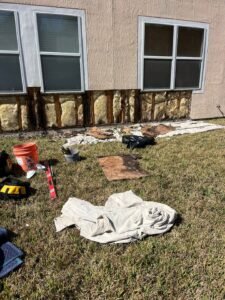
How Do You Know How Much Stucco Is Loose?
Honestly: you often can’t from the outside alone.
Visual inspection identifies obvious cases — visible separation, cracking with displacement, material that moves. Comparing sound across the wall narrows the search. Examining the exposed edges of an already-failed area shows what’s behind it at that spot.
Beyond that, determining actual bond strength is a testing question. ASTM has a standard test method specifically for measuring the tensile or bond strength of portland cement-based plaster by direct tension — which tells you something useful: the industry needed a defined test because looking and tapping doesn’t answer it. Building enclosure consultants use methods like that precisely because the extent of bond loss isn’t reliably visible.
Where the scope appears significant, invasive evaluation by a qualified professional is what actually establishes it. A visual estimate is a starting point, not a final number.
Does Loose Stucco Have to Be Removed Before Painting?
Yes. Loose or unbonded stucco shouldn’t simply be coated over.
Conceptually, the repair sequence runs:
- Identify and map the affected area
- Remove unsound material back to sound, bonded stucco
- Assess the condition of the exposed substrate
- Address whatever contributed — moisture source, corroded component, failed detail
- Rebuild the repair with appropriate materials
- Match texture as closely as practical
- Allow proper cure and dry time
- Prime the repair appropriately
- Apply the coating system
Step seven is the one that gets compressed when a schedule is tight, and compressing it is how a good repair develops its own problems.
Can Paint Hold Loose Stucco Together?
No.
Paint is a coating. It isn’t a structural adhesive, a fastener, or a repair system. A film measured in thousandths of an inch cannot hold material that has lost its bond to the wall — and applying one over that condition mostly makes it harder to see how far the problem extends.
Can Elastomeric Paint Fix Delaminated Stucco?
Also no, and this comes up often enough to address directly.
Elastomeric and high-build systems have legitimate applications. Specified correctly, they can bridge certain small, stable surface cracks and provide a thicker, more flexible film. That’s real.
What they cannot do: restore lost bond, reattach loose stucco, stop wall movement, repair corroded embedded components, resolve active moisture, or substitute for removing and rebuilding unsound material. A heavier coating over delaminated stucco is a more expensive version of the same failure, and the added film weight is working against you rather than for you.
Our comparison of elastomeric vs. acrylic paint for stucco covers where each system genuinely fits.
When Is It Mostly a Paint Problem?
Signs pointing toward coating failure rather than substrate failure:
- The blister is clearly confined to the paint film
- The stucco beneath feels hard and doesn’t move under gentle pressure
- No hollow sound in the area
- No loose or crumbling material at the edges
- The failure pattern follows a previous coating rather than the wall
- Surrounding stucco is stable
- No rust staining or efflorescence nearby
That profile usually points back to adhesion, preparation, contamination, coating compatibility, or application conditions. Our guide on why surface preparation matters covers the causes.
When Does the Stucco Itself Need Repair?
Indicators that the substrate rather than the coating is the issue:
- Material moves or flexes when gently pressed
- Pieces are separating at the edges
- Hollow areas across a meaningful portion of a wall
- Visible bulging or waviness
- Cracking with displacement across the crack
- Exposed substrate anywhere
- The same area failing repeatedly after repair
- Rust staining at or near the failure
- Efflorescence combined with loss of bond
- Material actually falling from the wall
If stucco is coming off the house, leave it and photograph it. Pulling more off doesn’t help anyone, and it removes evidence of how the failure was progressing.
When Should You Get Additional Evaluation?
Worth bringing in another professional when:
- A large area sounds hollow
- Bulging is increasing over time
- Pieces are falling away
- Cracks show displacement
- Several areas are failing across the same elevation
- Significant moisture staining accompanies the failure
- Rust staining is extensive
- Windows or doors show related damage
- There’s interior moisture on the same wall
- Wall movement is suspected
- The repair scope appears to extend well beyond isolated patching
Depending on what’s present, that may be a specialized stucco contractor, a building-envelope consultant, a waterproofing contractor, a window or flashing contractor, or a structural engineer where movement is suspected.
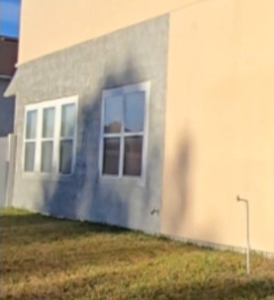
A bulge or hollow area doesn’t always mean the same thing. During exterior painting and stucco repair projects, we encounter everything from isolated coating blisters over sound stucco to aging patches, localized bond loss, cracking around openings, moisture-related staining, rust bleed, and areas of loose stucco that need repair before painting. The visible symptom tells us where to start looking — not automatically what caused it.
How A New Leaf Evaluates Bulging & Loose Stucco on Jacksonville Homes
The most useful thing we do before quoting anything is separate coating failure from substrate failure — because those produce nearly identical photographs and completely different scopes of work.
- Inspect the wall as a whole rather than the one spot that prompted the call
- Differentiate obvious coating failure from potentially unbonded stucco
- Look for cracks, staining, rust bleed, efflorescence, and failed sealant joints
- Identify the areas that are visibly unsound
- Determine whether what we’re seeing falls within normal stucco repair scope
- Flag conditions that warrant evaluation by another professional first
- Remove and repair the unsound material that’s within scope
- Match texture as closely as practical
- Prime repairs correctly for the system going over them
- Apply the coating system appropriate to the wall’s condition
We assess what’s visible from the outside. We don’t perform invasive moisture testing, bond testing, or engineering analysis, and visual inspection alone doesn’t identify everything concealed behind a wall — we’d rather say that plainly than imply otherwise. See our Jacksonville stucco painting guide for how coating selection follows wall condition.
Frequently Asked Questions
What does it mean when stucco is bulging?
The wall surface is protruding, which generally suggests the stucco has lost bond with what’s behind it or something behind it has moved or expanded. It’s a substrate condition rather than a coating condition, and paint won’t correct it.
Why does my stucco sound hollow?
A hollow sound usually indicates a void or poor bond behind that area. It can reflect delamination, an original application void, or a previous patch that didn’t bond. Sound alone doesn’t identify which.
Is hollow stucco always bad?
Not necessarily. Small hollow areas can remain stable for years. What matters is whether the area is growing, whether other symptoms accompany it, and how much of the wall is affected.
What is stucco delamination?
Loss of bond between layers, or between the stucco and its substrate. It can occur between plaster coats, at the plaster-to-substrate interface, or between the stucco and lath where lath is present.
Can moisture cause stucco to separate from the wall?
It can contribute — through deterioration at the bond line or by corroding embedded metal, which expands and pushes the stucco away. But moisture isn’t the only cause. Original bond conditions, application problems, incompatible repairs, corrosion, and movement can all contribute.
Why is paint bubbling on my stucco?
Often moisture behind the film, poor adhesion, painting over chalk or contamination, incompatible coatings, or applying to masonry that wasn’t adequately dry. If the stucco beneath the blister is hard and doesn’t move, the problem is likely in the coating.
Can you paint over hollow stucco?
Technically, a coating can be applied over it, but that does not correct the underlying bond problem. The coating is only as secure as the stucco beneath it.
Can elastomeric paint fix delaminated stucco?
No. Elastomeric coatings can bridge certain small stable surface cracks when correctly specified, but they can’t restore bond, reattach loose material, or resolve what caused the separation.
Does loose stucco have to be removed?
Yes, before any coating goes on. Unsound material has to come back to sound, bonded stucco so the repair has something to key into. Removal should be done by someone prepared to rebuild it.
Why is my stucco falling off the house?
The bond between the stucco and what’s behind it has failed in that area. Causes range from original application issues to moisture, corrosion of embedded metal, or movement. Leave the material in place, photograph it, and have the extent assessed.
What do rust stains near bulging stucco mean?
Likely corrosion of metal behind the finish — lath, fasteners, or accessories. Corroding metal expands and can contribute to the bond loss. Rust plus bulging is a combination worth investigating before repair rather than coating over.
Who should inspect a large area of loose stucco?
A specialized stucco contractor or a building-envelope consultant for extent and cause. A structural engineer if movement is suspected. A painting contractor can assess visible conditions and tell you whether the scope looks like normal repair or something more.
Related Exterior Painting Resources
- Exterior Painting Services
What our exterior process covers, including stucco repair, preparation, and coating selection. - Exterior Painting Resource Center
Our full library of exterior guides on Florida conditions, coatings, preparation, and maintenance. - Painting Stucco Homes in Jacksonville
How wall condition and previous coatings drive the specification for a stucco repaint. - Why Exterior Paint Bubbles and Peels
How to trace a coating failure to its actual cause instead of recoating over it. - Why Surface Preparation Matters
Why prep quality determines coating life more than the product on the can does. - Elastomeric vs. Acrylic Paint for Stucco
When a high-build system genuinely earns its cost, and what it can’t be expected to fix.
Not Sure If It’s the Paint or the Stucco?
Before calling anyone, gather what a contractor will actually need:
- Photograph the full affected area, far enough back that the pattern is visible
- Take close-ups of the edges, where separation shows most clearly
- Note whether the area is growing, and how quickly
- Look for cracks running through or near it
- Look for rust staining and white mineral deposits
- Note any nearby windows, doors, or penetrations
- Resist the urge to pull at loose material or paint over it
We can evaluate visible conditions within normal stucco repair and exterior painting scope, tell you what appears to be coating failure versus substrate failure, and tell you plainly when the underlying issue should be evaluated by another professional before anything gets painted.
Sometimes the answer is that it’s a coating problem on a sound wall, and the repair is straightforward. That’s a common outcome and a good one.
A New Leaf Painting Contractors has served Jacksonville and Northeast Florida since 2001.
Call or text 904-615-6599 for an exterior inspection.