
Ask three painters what the best exterior paint is and you’ll likely get three product names. That doesn’t mean two of them are wrong. It means the question is incomplete — experienced exterior painters know product selection only makes sense once the surface, its condition, and its exposure are understood.
The better question is: best paint for what surface, in what condition, under what exposure?
Walk up to a typical Fleming Island home and you may be looking at stucco walls, fiber cement accents, wood fascia and soffits, painted masonry on a chimney or knee wall, metal railings, a fiberglass front door, and a factory-finished garage door. Six or seven different substrates on one elevation. Those surfaces don’t want the same coating, and treating them as if they do is one of the more common reasons a paint job disappoints at year four — which is why painters in Fleming Island, FL should be evaluating the whole exterior system rather than defaulting to one product for every surface.
This guide walks through how coating selection actually works — substrate by substrate — and why the diagnosis has to come before the product.
Reviewed by A New Leaf Painting Contractors. Serving Northeast Florida since 2001, with more than 5,000 residential painting projects completed. What follows comes from inspecting and coating exteriors throughout Fleming Island and Clay County.
Quick Answer: What Is the Best Exterior Paint for Fleming Island Homes?
There isn’t a single best exterior paint for every Fleming Island home. The right coating depends first on what you’re painting. Stucco, fiber cement, wood, masonry, metal, and factory-finished doors all behave differently under Florida moisture, UV, and temperature movement — and they need different systems. For most homes here, the honest answer is a system of products matched to each substrate, not one premium paint used everywhere.
CONTRACTOR’S RULE OF THUMB
The best exterior paint is the coating that matches the substrate, the existing condition, the previous coating, and the exposure — after the necessary repairs and preparation have been completed.
- Stucco — diagnose cracking, moisture, and chalking first.
- James Hardie / fiber cement — inspect coating condition, joints, cut edges, and transitions.
- Wood / T1-11 — repair deterioration and prime appropriately before topcoating.
- Metal — address corrosion and adhesion before any finish coat.
Why There Isn’t One “Best” Exterior Paint
Coating performance comes down to a handful of properties, and different substrates need different balances of them:
- Adhesion — how well it bonds to what’s underneath, which depends heavily on what’s already there
- Flexibility — the ability to move as the substrate expands and contracts without cracking
- Permeability — whether moisture vapor can move out of the wall, which matters enormously on masonry and stucco and much less on fiber cement
- Moisture resistance — shedding liquid water from the outside
- Mildew resistance — relevant everywhere here, critical on shaded elevations
- Color retention — how the finish holds its value under sustained UV
- Film build — how much coating thickness the system delivers
- Compatibility — whether the new system bonds properly with the existing coating
- Primer requirements — which vary by substrate, by condition, and by what’s being covered
A product engineered to breathe on masonry and a product engineered for maximum film integrity on siding are solving different problems. Neither is “better.” They’re aimed at different walls.
What Fleming Island’s Environment Means for Exterior Coatings
Fleming Island sits inland in Clay County, wrapped by the St. Johns River to the east, Doctors Lake to the north, and Black Creek to the south, with wetlands through much of the west side. That geography produces a specific set of conditions worth understanding before you choose a system.
Humidity and Long Surface-Wet Periods
The defining factor here isn’t heat — it’s how long surfaces stay wet. Heavy morning dew, high sustained relative humidity through much of the year, and a summer storm pattern that dumps significant rain in short bursts all add up to walls that spend more hours damp than they would in a drier climate.
Practically, this means two things for coating selection. Mildew resistance is not an optional feature. And the application window matters: some products are formulated for a wider range of temperature and humidity conditions than others, which affects what can realistically be specified for a summer project here.
Mature Trees, Shade, and Mildew
This is where Fleming Island genuinely differs from newer, more exposed Northeast Florida suburbs. Established communities such as Eagle Harbor have significant mature canopy — live oaks, heavy landscaping, larger lots with real tree cover.
The consequence is that different elevations of the same house age differently. A west-facing wall taking full afternoon sun will chalk and lose color while a north-facing wall twenty feet away, shaded and slow to dry, carries dark organic staining and mildew but looks fine on color. Same house, same paint, same age, two entirely different conditions.
We factor this into system selection and sometimes into sheen selection. It also affects prep — shaded elevations usually need more thorough biological treatment before anything goes on.
UV Exposure
Florida UV works on both the pigment (which is why color fades) and the binder that holds the film together and keeps it bonded. South and west elevations take the brunt. This is a large part of why premium exterior lines are worth their cost in this market — they’re generally formulated for better color retention and film integrity under sustained exposure, though the specifics vary by product line.
Waterfront and Near-Water Properties
Homes along Doctors Lake, the St. Johns River, or Black Creek see conditions the interior streets don’t: more wind-driven rain against the water-facing elevation, reflected sunlight, higher sustained ambient moisture, and slower drying after weather.
The most consistent practical difference shows up on metal — railings, fasteners, fixtures, hardware near docks and seawalls. These want their own treatment rather than whatever’s going on the walls.
To be clear about what this isn’t: Fleming Island is an inland Clay County community and doesn’t experience the direct marine salt exposure that affects oceanfront homes at the beaches or coastal Ponte Vedra. The environmental story here is moisture, shade, and biological growth.
Best Exterior Paint for Stucco Homes in Fleming Island
Stucco is very common on Fleming Island homes, particularly through the 1990s and 2000s development. It’s also the substrate where product selection goes wrong most often — usually because someone reached for a coating before understanding the wall.
Before any product conversation, the wall needs to be assessed for:
- Condition and type of the existing coating, and whether it’s chalking
- Hairline cracking — extent, pattern, and whether it’s stable or active
- Larger or structural cracking, which is a different problem entirely
- Previous patches and whether they were finished and coated properly
- Moisture in the wall, and whether there’s an active source
- Efflorescence, where present
- Porosity and how the surface takes coating
- Compatibility between the existing system and anything new
Paint should not be used to hide unresolved stucco problems. A coating applied over active cracking or an unaddressed water source buys a season or two and then telegraphs the condition right back through — usually worse, because now there’s a thicker film to fail. If the wall has real cracking or moisture intrusion, that’s a stucco repair conversation first.
Acrylic Masonry Coatings
There’s a persistent belief in this market that every Florida stucco home needs an elastomeric coating. It isn’t true, and acting on it costs homeowners money they didn’t need to spend.
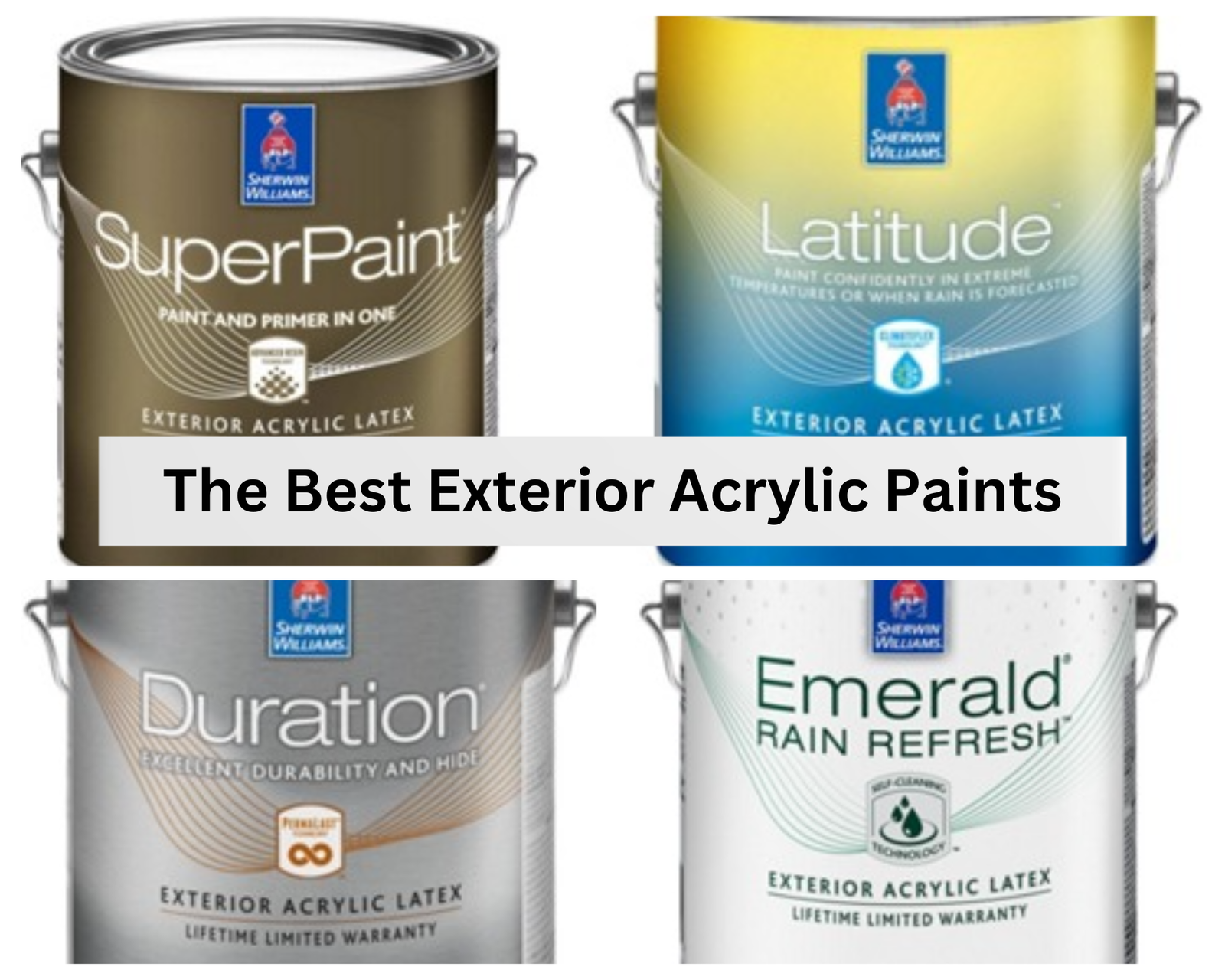
A high-quality acrylic masonry coating is entirely appropriate when the stucco is fundamentally sound, the existing coating is compatible and properly prepared, cracking is limited and stable, and the wall’s vapor movement requirements are accounted for. Plenty of Fleming Island stucco homes fall squarely in that category. Sherwin-Williams Duration and Latitude are both products we’ll specify on masonry where the conditions suit them — Latitude in particular is designed for application across a wider range of weather conditions, which has real value during a Clay County summer.
When High-Build or Elastomeric Systems Make Sense
Higher-build and elastomeric masonry systems earn their place when their specific characteristics address what the wall is actually doing: meaningful hairline crack activity where bridging is genuinely beneficial, a need for greater film build over a porous or previously repaired surface, or a substrate and system combination the manufacturer specifies them for.
What they don’t do is make a wall waterproof. That framing gets used in sales conversations here and it’s misleading. These are high-build, flexible coatings that improve a wall’s resistance to water intrusion — they’re not a membrane, and they can’t compensate for an unaddressed moisture source or a failed detail elsewhere in the assembly. Manufacturer requirements around substrate condition, moisture content, and application also tend to be stricter for these systems, not looser.
The Loxon XP System and the Stucco-Armor Hybrid
On most of our Fleming Island stucco work, the primary system is Sherwin-Williams Loxon XP — a high-build masonry coating specified for above-grade masonry and stucco. It is not an elastomeric paint, and it shouldn’t be sold as one. It’s the layer doing the substrate-oriented work.
On selected projects where conditions call for it, we specify a hybrid: the Loxon XP base system with a Sherwin-Williams Emerald Rain Refresh topcoat. Emerald Rain Refresh is a premium exterior finish designed with a self-cleaning technology that uses rainfall to help release surface dirt — on a shaded, humid, tree-heavy Fleming Island lot where organic staining accumulates, that’s a practical benefit rather than a marketing feature. The combination gives a masonry-appropriate foundation with a premium finish coat handling color retention, weather exposure, and cleanability.
The upgrade isn’t automatic. Many stucco homes here are properly served by the Loxon XP system alone, and we’ll tell you when that’s the case. This is the kind of substrate-first decision we make on Fleming Island stucco projects, where cracking, weathering, and the condition of the previous coating have to be settled before the finish system is chosen — see the Eagle Harbor project below for how that plays out on an actual house.
Best Exterior Paint for James Hardie® and Fiber Cement Siding
Fiber cement became increasingly common on Fleming Island homes from the early 2000s onward, both as a full siding and as accent on stucco bodies. It’s one of the more forgiving substrates in this climate — dimensionally stable, resistant to rot and insects, and it holds coatings well when prepared correctly.
What Matters Before Paint Selection
On a repaint, the product is the last decision. What comes first:
- Existing coating condition. Factory finish or field-applied? Chalking? Any adhesion loss? Is the new system compatible with what’s there?
- Cleaning. Chalk, mildew, and pollen have to be properly removed. New paint bonded to a chalk layer is bonded to nothing.
- Sealant details. This is where a lot of well-meaning work goes wrong. Sealant should be renewed where the siding manufacturer’s installation details call for it — appropriate trim transitions, penetrations, and terminations — not automatically forced into every siding joint. Some fiber cement installations are designed with specific joint details that allow the assembly to manage and release moisture, and indiscriminate caulking can work against that. It’s worth getting right rather than assuming.
- Cut edges. Field-cut edges absorb moisture if left unsealed. This is a common source of edge swelling and deterioration on homes that have been re-sided or repaired.
- Damaged or deteriorated material. Boards that are cracked, delaminating, or water-damaged get replaced before coating. This is where the “best paint” question becomes irrelevant — see the siding repair project below.
- Flashing and transitions. Where siding meets trim, roofline, and penetrations is where intrusion typically starts.
Appropriate Exterior Acrylic Systems
Premium exterior acrylics generally perform well on properly prepared fiber cement. On siding and wood work we most often specify Sherwin-Williams Latitude or Emerald Rain Refresh depending on the surface and exposure, and we also use Emerald Exterior, Duration, and Benjamin Moore Aura Exterior and Regal Select Exterior where the project calls for them.
Which one gets specified depends on the project rather than a ranking:
- Color depth and retention — deeper and more saturated colors push us toward lines formulated for color retention
- Application window — a summer project in Fleming Island humidity favors a product designed for a broader range of conditions
- Mildew exposure — heavily shaded elevations shift the priority toward mildew-resistant formulation
- Desired sheen and appearance
- Existing coating and what bonds well over it
- Project scope and budget — a legitimate factor, and there’s a real range of good options
Our guide to painting James Hardie® siding covers the substrate in more depth.
Best Paint for Wood Siding, Fascia, and Exterior Trim
Even on homes where the body is entirely stucco or fiber cement, the wood components usually determine how the exterior looks and performs: fascia, soffits, window and door trim, decorative elements, porch columns and rails, and siding on older properties.
Why Wood Condition Comes First
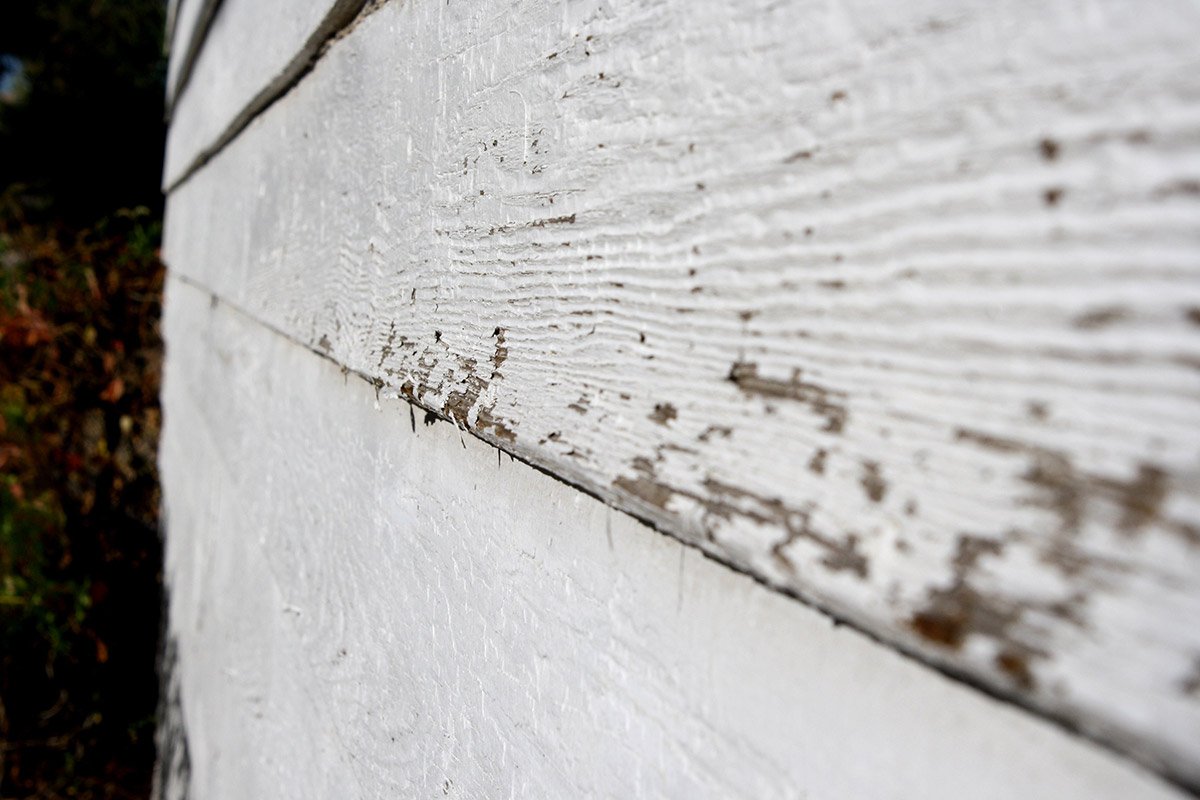
You cannot paint your way out of rotten wood. A coating over deteriorated wood conceals the condition without arresting it. The wood keeps breaking down under a surface that now looks fine, and by the time it reappears the repair scope has grown.
Fleming Island’s combination of rainfall, shade from mature canopy, heavy landscaping close to structures, and an aging stock of older sealant joints makes this worth genuine attention. On older exteriors here, one of the most important parts of an estimate is often identifying wood deterioration before it disappears underneath a fresh coat of paint.
Before coating, questionable areas should be probed for softness, with close inspection at lower edges, joints, roofline transitions, and window and door surrounds. Deteriorated material gets repaired or replaced — that’s carpentry and wood rot repair, and it happens before any primer.
When Primer Is Needed, and Which Kind
There’s no single primer answer for exterior wood. Selection depends on the wood species and whether it’s prone to tannin bleed, whether the surface is bare or previously coated, what that previous coating is, whether there’s moisture or tannin staining to block, what repairs were made, and the topcoat manufacturer’s requirements for the system.
Depending on those conditions, the right primer may be a bonding primer, a stain-blocking primer, a dedicated exterior wood primer, or a specialty product for a particular problem. Bare and repaired wood generally needs priming. Sound, previously painted trim in good condition often doesn’t need a full prime coat — spot priming at repairs and bare areas may be entirely sufficient.
Premium exterior acrylics work well as topcoats over properly primed wood. Trim and fascia frequently take a different sheen than the body, which is both an appearance decision and a practical one.
Painted Brick and Masonry
Some Fleming Island homes have brick or block elements — chimneys, knee walls, foundations, full brick facades on certain older properties.
Masonry is porous, and the governing consideration is moisture vapor. The coating needs to allow vapor to move out of the wall rather than trapping it, which is why masonry-compatible, appropriately permeable products matter here in a way they don’t on siding.
Efflorescence — the white, chalky mineral deposit that surfaces on masonry — signals moisture moving through the wall. It needs to be addressed in preparation, and ideally its source understood. Coating over it leads to adhesion failure fairly quickly.
One thing worth saying plainly: not all brick should be painted. Painting brick is a one-way decision and it commits the surface to a maintenance cycle it didn’t previously have. If your brick is sound and you like it, that’s a legitimate reason to leave it alone. This section is for already-painted masonry and for homeowners weighing the decision with their eyes open.
Doors, Shutters, Garage Doors, and Metal
These are the components most homeowners forget in a repaint budget, and they’re where substrate-specific thinking matters most.
Front Doors
The product depends on what the door is made of — wood, fiberglass, or steel — and on what finish is already on it. Fiberglass and steel doors with factory finishes need adhesion-appropriate preparation and priming. Doors also take direct handling and, on many Fleming Island homes, direct sun, so they’re commonly finished in a more durable enamel than the body of the house.
Garage Doors
Large, sun-exposed, and almost always carrying a factory finish. The system needs to bond properly to that finish, which usually means the right preparation and primer rather than simply topcoating.
Shutters
Material determines everything. Vinyl, composite, wood, and metal shutters each want different treatment, and vinyl in particular has color limitations — darker colors on vinyl can absorb enough heat to cause distortion, and some manufacturers restrict which colors can be applied. Painting them all with whatever’s in the trim bucket is a common shortcut and a common failure.
Metal Railings and Exposed Metal
Particularly relevant on the near-water properties. Any rust needs proper surface preparation before coating — coating over active corrosion just delays it. Rust-inhibitive primers and direct-to-metal systems have their place, and bleeding fasteners need to be addressed rather than painted over, since the staining will come back through the new finish within a season.
Why Surface Preparation Matters More Than the Brand Name
Homeowners spend real time comparing Emerald, Duration, Aura, and Regal Select. Those products matter — they’re genuinely different and the differences show up over time. But a ninety-dollar gallon applied over chalk, mildew, loose coating, failed sealant, or rotted wood is still going to disappoint, and no product line has ever fixed a preparation problem.
What sound preparation actually involves, depending on the home:
- Cleaning matched to the substrate and its condition — pressure and cleaning agents adjusted rather than applied uniformly
- Treatment of biological growth, not just removal of what’s visible
- Removal of loose and failing coating down to a sound surface
- Proper handling of chalking, which is its own step and frequently skipped
- Adequate drying before coating, judged by conditions rather than a fixed schedule
- Substrate repairs — stucco, wood, masonry — completed and cured
- Sealant renewal where the details call for it
- Sanding and profiling where adhesion requires it
- Priming appropriate to each substrate and condition
- Rust treatment on metal
- Compatibility verification between existing and new coatings
When we’re called to a home where the paint failed at year four, the cause is nearly always on this list — not on the label.
Premium Exterior Paint vs. Production-Oriented Coatings
Production-oriented coatings aren’t bad paint. They’re built for a different job: covering efficiently, applying quickly, and hitting a price point. On new construction, on rental turnover, on a property being prepared for sale on a short timeline, they can be an entirely reasonable choice.
Durability-oriented premium residential coatings are formulated with different priorities — film strength and flexibility, adhesion, mildew resistance, color retention, and weathering performance over a longer service life. They also generally cost more per gallon and can be more demanding to apply well.
The question isn’t which is better in the abstract. It’s what you’re optimizing for. A homeowner planning to stay ten years and wanting to maximize the interval before the next repaint is usually well served by the more durable system. A homeowner listing in four months has a different calculation, and we’d rather say that out loud than sell an unnecessary upgrade.
Does Paint Sheen Matter?
It matters, though less predictably than product formulation does.
Flatter finishes hide surface imperfections well, which is genuinely useful on older stucco with patch history and texture variation. They give a traditional appearance. Depending on the product, they can be less washable and may hold dirt differently.
Satin and low-lustre finishes generally offer improved cleanability in most product lines, which has value on shaded elevations where organic staining accumulates. The tradeoff is that any sheen highlights substrate imperfections — an uneven stucco patch that disappears in flat will read clearly in satin.
Common practice on Fleming Island homes is flat or low-lustre on the stucco body with a satin on trim, fascia, and doors, but that’s a starting point rather than a rule. Product formulation drives durability more than the sheen label does — a premium flat will outperform a budget satin.
Does Exterior Color Affect Paint Performance?
Somewhat, and less rigidly than it’s often presented.
Darker colors absorb more solar energy, which raises surface temperature and increases thermal movement in the substrate underneath. Deeply saturated colors may show visible fading more readily, particularly on south and west elevations. But formulation matters a great deal — modern premium exterior products hold deep colors considerably better than earlier generations did.
Two practical constraints worth knowing: some substrate manufacturers restrict how dark a color can be applied to their product, particularly on vinyl and certain siding and shutter materials. And HOA requirements may narrow your options regardless of what performs best.
Our color consultation works through this on-site against your actual exposure.
Older Fleming Island Homes Need a Coating Assessment, Not Just a Paint Selection
A significant portion of Fleming Island developed through the 1990s and 2000s. Many of those homes are now on their third or fourth exterior repaint.
That changes the question entirely. On a home that’s been painted four times by four contractors, “what paint should we use” can’t be answered until someone determines what we’re actually painting over. What we commonly find on these exteriors:
- Multiple coating layers of unknown type and compatibility
- A chalked coating that was painted over rather than properly prepared
- Stucco cracks that were coated instead of repaired
- Patch repairs that were never finished or texture-matched
- Several generations of sealant layered into the same joints
- Fascia and soffit deterioration under sound-looking paint
- Different products on different elevations from partial repaints
- Rusting or backed-out fasteners
Painting a new substrate is a specification exercise. Painting a thirty-year-old Fleming Island exterior is a diagnostic one. The coating recommendation frequently changes once we identify what’s underneath — and that’s the whole reason the inspection comes before the estimate rather than after it.
Real Fleming Island Projects: How Surface Conditions Change the Paint System
The difference between choosing a paint by brand name and specifying a coating system becomes a lot clearer on actual houses. The two projects below sit in the same market and were handled completely differently — because the surfaces and their conditions were completely different.
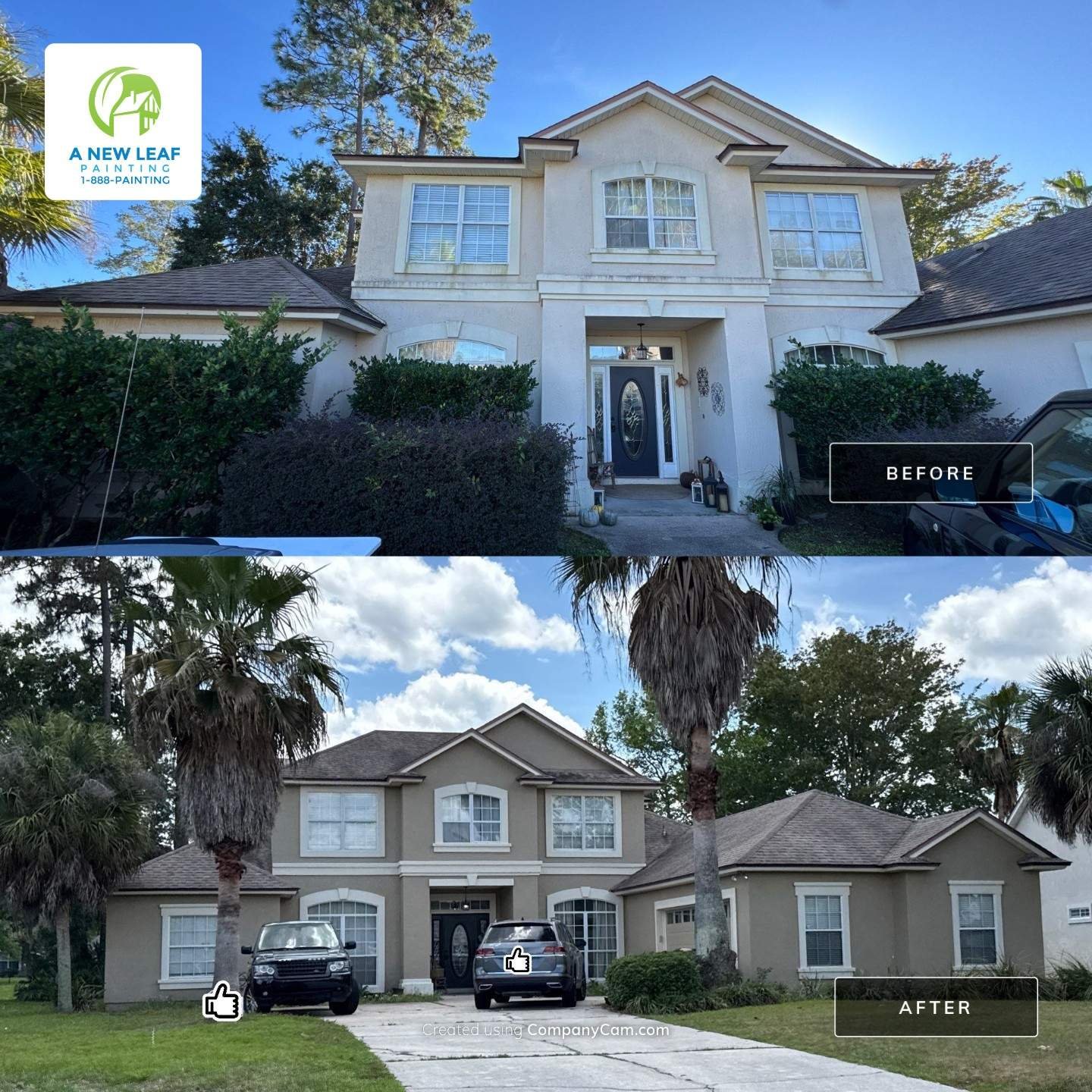
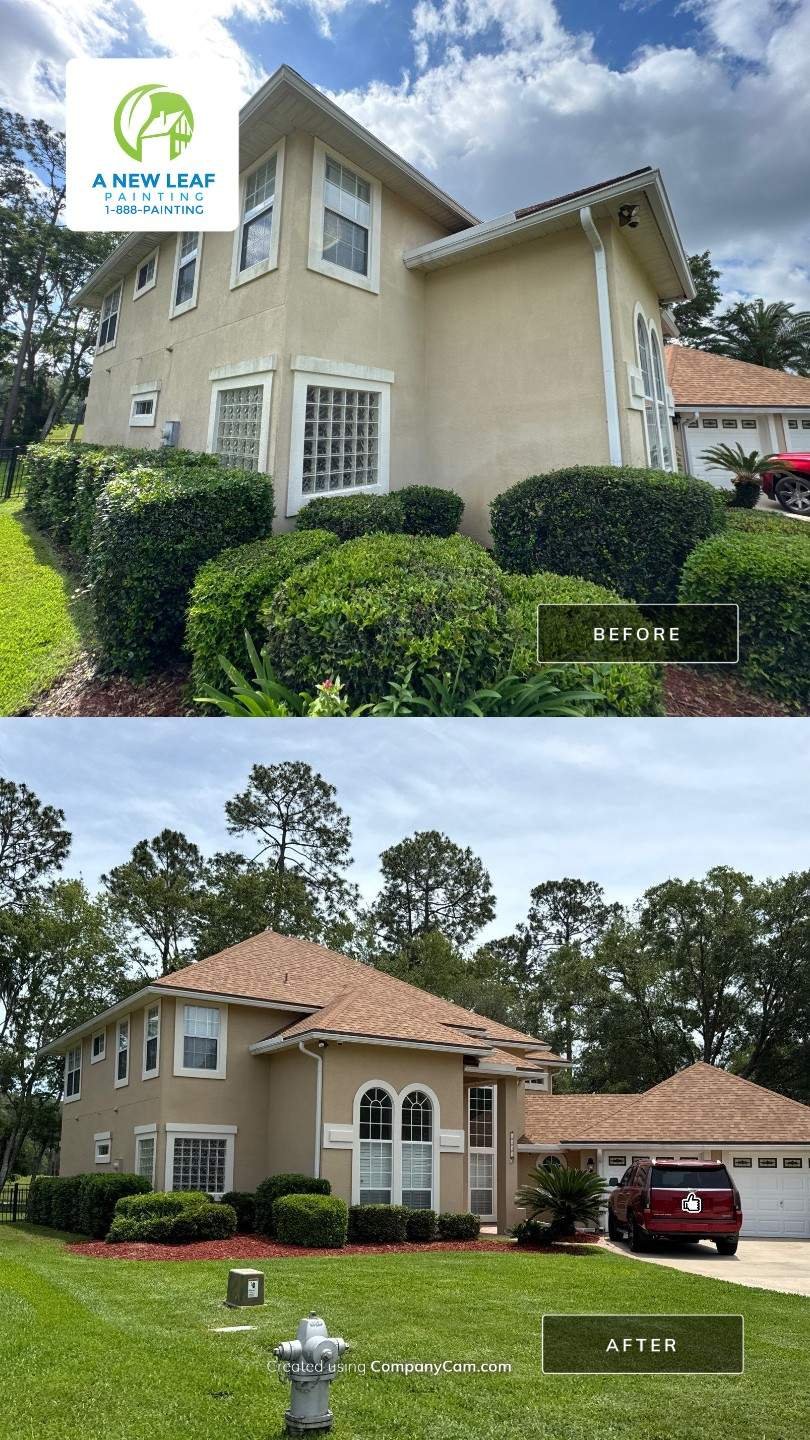
Eagle Harbor, Fleming Island — Stucco Exterior
This Eagle Harbor home came to us the way most stucco repaints do: the visible problem was fading and weathering, and the coating had clearly reached the end of its service life. That’s what the homeowner could see. It wasn’t what determined the work.
The inspection found stucco cracking along with areas that needed repair before any coating could go on, and aging sealant that was no longer doing its job where it mattered. So the sequence ran: exterior cleaning, evaluation of the stucco’s condition, crack and stucco repair where required, sealant renewal where appropriate, preparation of the repaired and deteriorated areas, priming where surface condition called for it, and then the masonry coating system — Sherwin-Williams Loxon XP.
The teaching point isn’t the product. It’s the order. This exterior didn’t need premium paint layered onto what was already failing. It needed the cracking, the deteriorated areas, and the sealant addressed first, so the coating was going onto a substrate that could actually hold it. Skip that and the same conditions come back through the new finish within a few years.
Northeast Florida — Damaged Siding, Wood Repair, and Exterior Painting
This project makes the opposite point, and it’s the better illustration of why “what’s the best exterior paint” is the wrong opening question.
Here the substrate was siding and exterior wood — including damaged boards and deteriorated trim that had to be replaced outright. No coating decision was going to matter until that was resolved. Sound fiber cement takes a premium acrylic beautifully; damaged siding, soft trim, and failed transitions take it just as beautifully and fail anyway, because the coating is only as sound as what it’s bonded to.
So the work started with replacing damaged siding and repairing deteriorated wood and trim, then moved to preparation and substrate-appropriate priming, and only then to the finish system. On siding and wood work of this kind we specify Sherwin-Williams Latitude or Emerald Rain Refresh depending on the surface and exposure.
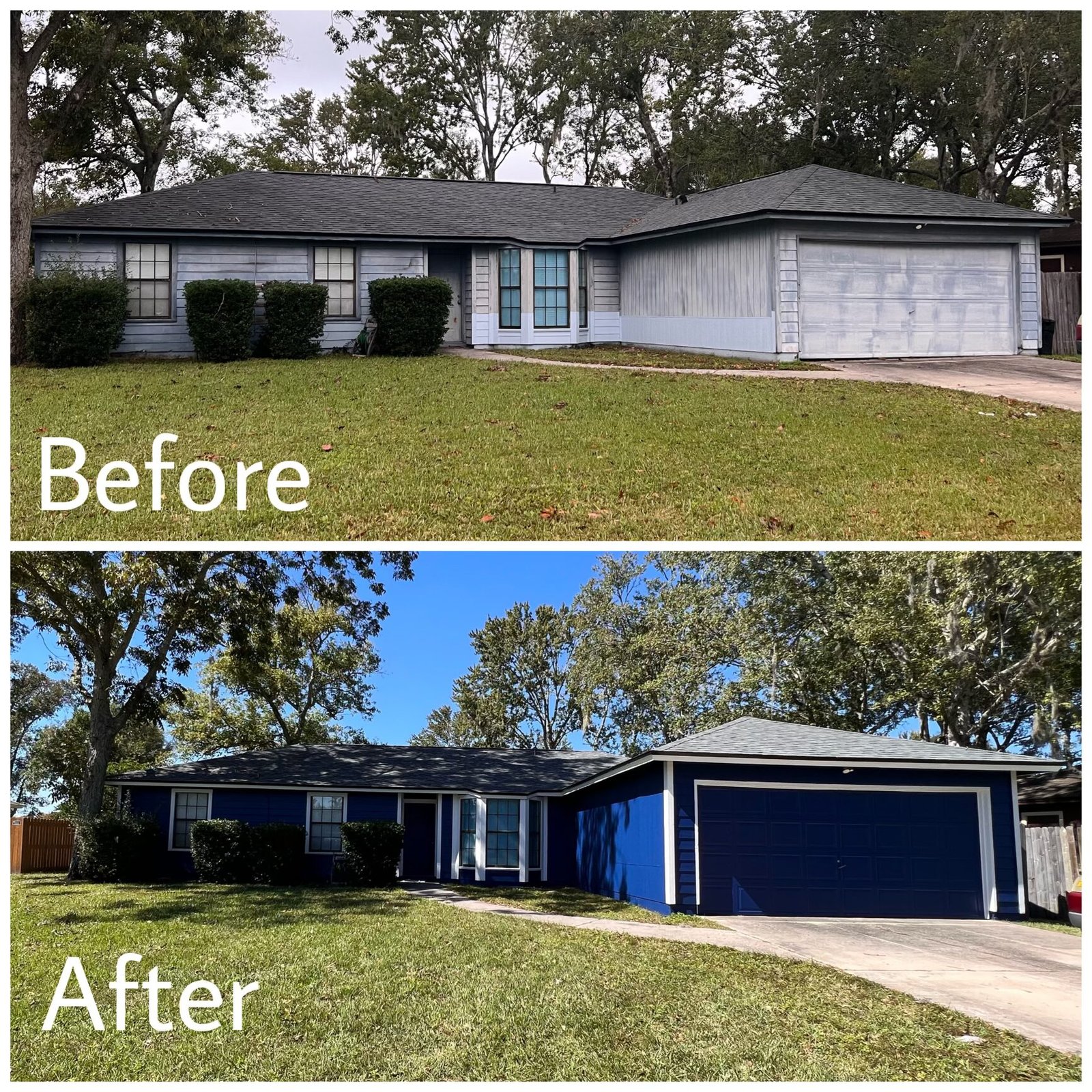
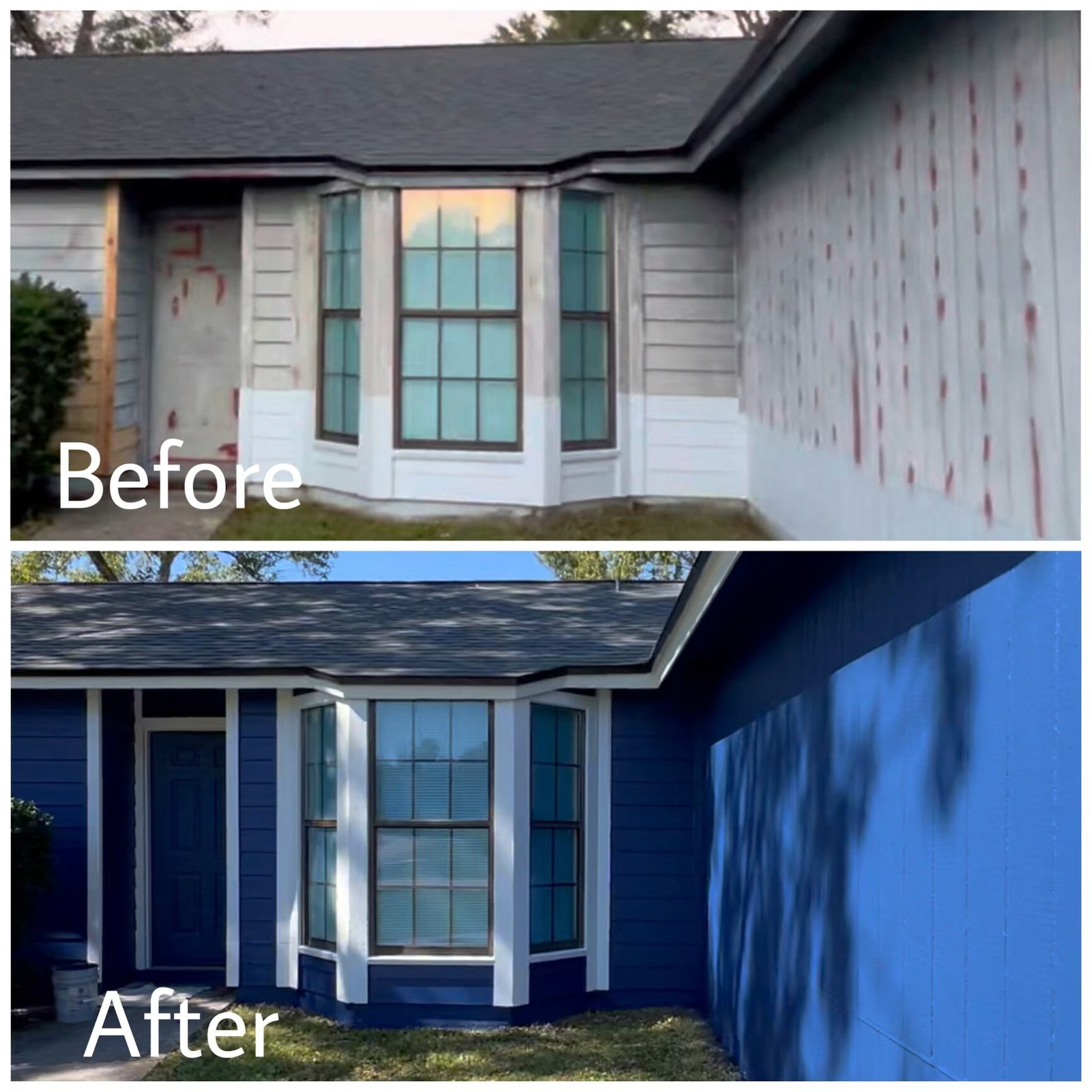
Put the two side by side and the article’s whole argument is visible: a cracked stucco exterior gets masonry-specific repair and a masonry coating system, while a damaged siding and wood exterior gets material replacement, substrate-appropriate priming, and a siding-appropriate finish. Same contractor, same region, two entirely different specifications — driven by the surface, not by a preference for one product.
More about our Fleming Island exterior painting work.
How We Choose a Paint System for a Fleming Island Home
These aren’t theoretical distinctions. A cracked stucco exterior in Eagle Harbor and a weathered fiber cement or wood exterior may sit only a few miles apart, but they should not receive the same preparation or the same coating specification.
Here’s roughly how a specification comes together on an inspection:
| Surface | Common Coating Approach | Key Local Concern |
| Stucco | Masonry acrylic, or a high-build/hybrid system where conditions call for it | Cracking, chalking, moisture in the wall |
| Fiber cement (James Hardie®) | Premium exterior acrylic over properly cleaned, compatible surface | Joint details, chalking, unsealed cut edges |
| Wood siding, trim, fascia | Primer selected to condition + premium exterior acrylic | Rot, tannin bleed, moisture at joints |
| Painted masonry / brick | Masonry-compatible coating with appropriate permeability | Moisture vapor movement, efflorescence |
| Metal railings, fixtures, fasteners | Rust-inhibitive primer + DTM or appropriate topcoat | Corrosion, bleeding fasteners — more common near water |
| Doors, shutters, garage doors | Substrate-specific enamel or acrylic with appropriate primer | Adhesion to factory finish, UV, handling, heat on dark colors |
These are approaches, not warranties. The actual specification comes out of the inspection.
HOA and Exterior Color Considerations
Fleming Island contains a number of HOA-governed communities, including several large planned neighborhoods — Eagle Harbor, Fleming Island Plantation, and Pace Island among them. It also contains neighborhoods with no HOA at all.
If you’re repainting an existing approved scheme in the same colors, this usually isn’t a factor. If you’re changing the exterior color, check your HOA or architectural review requirements before work is scheduled. Requirements vary by community and so do approval timelines — a color decision made the week before a start date can push a project by a month.
Where review applies, we can help you prepare the paint and color information the request needs: product and color specifications, sheen, and which surfaces each applies to. Approval itself rests with your board.
Frequently Asked Questions
What is the best exterior paint for Fleming Island homes?
There isn’t one. The right coating depends on the substrate first — stucco, fiber cement, wood, masonry, metal, and factory-finished doors all need different systems. Most Fleming Island homes have several of these on one exterior, so the real answer is a coordinated system of products rather than a single paint.
What is the best paint for stucco in Florida?
It depends on the wall’s condition. A quality acrylic masonry coating is appropriate for sound stucco with limited, stable cracking and a compatible existing coating. Higher-build or elastomeric systems make sense where crack-bridging and film build genuinely address what the wall is doing. Cracking and moisture problems get repaired before any coating goes on.
Is Loxon XP an elastomeric paint?
No. Loxon XP is a high-build masonry coating specified for above-grade masonry and stucco. It’s frequently confused with elastomeric systems in this market, and the distinction matters when you’re comparing quotes — the two are different products with different characteristics and different appropriate uses.
Is elastomeric paint better than acrylic on stucco?
Not inherently — they’re different tools. Elastomeric systems offer greater film build and crack-bridging, which is valuable on some walls and unnecessary on others. They also carry stricter requirements around substrate condition, moisture content, and application. Many Fleming Island stucco homes are well served by a quality masonry acrylic, and specifying elastomeric by default is a common way homeowners overspend.
Does elastomeric coating waterproof a stucco wall?
No. It’s a high-build, flexible coating that improves resistance to water intrusion. It is not a membrane and it can’t compensate for an active moisture source or a failed detail elsewhere in the wall assembly. Be cautious of anyone describing it that way.
What paint is best for Hardie Board in Florida?
Premium exterior acrylics generally perform well on properly prepared fiber cement. Which one gets specified depends on color depth, application conditions, mildew exposure, desired sheen, and what the existing coating will accept. Preparation, joint detailing, and replacement of any damaged board matter more to the outcome than which premium line you pick.
Does Hardie Board need primer before repainting?
Not always. Sound, previously coated fiber cement that’s been properly cleaned often accepts a quality acrylic directly. Priming is needed where there’s bare or exposed material, unsealed cut edges, adhesion concerns, or compatibility questions with the existing coating.
What paint should be used on exterior wood?
Typically a premium exterior acrylic over appropriate primer. The primer is the variable — selection depends on the wood species and tannin behavior, whether the surface is bare or previously coated, staining that needs blocking, repairs made, and topcoat manufacturer requirements. Bare and repaired wood generally needs priming; sound previously painted trim often needs only spot priming.
Can you paint over wood rot?
No — or rather, you can, and it’s a bad idea. Coating over deteriorated wood hides the condition without stopping it, and the underlying material continues to break down. Rotted wood needs to be repaired or replaced before it’s coated.
Does Fleming Island humidity affect exterior paint?
Yes. High humidity, heavy dew, and long surface-wet periods create favorable conditions for mildew and algae, especially on the shaded elevations common in the area’s tree-heavy neighborhoods. It also narrows application windows. Mildew-resistant formulation and thorough biological treatment during prep both matter here. Fleming Island is inland and does not see the direct marine salt exposure that affects oceanfront properties.
Is Sherwin-Williams Emerald better than Duration for every house?
No. Both are premium exterior lines with different strengths, and the right choice depends on substrate, color, application conditions, and project requirements. We specify both, along with Latitude, Emerald Rain Refresh, Loxon XP, and Benjamin Moore’s Aura and Regal Select, depending on what the home needs.
Is Benjamin Moore Aura good for Florida exteriors?
It’s a premium exterior line we use regularly, particularly where color retention on deeper or custom colors is a priority. Whether it’s the right pick for a specific home depends on substrate, existing coating, and application conditions.
Should I use flat or satin paint outside?
Flat hides surface imperfections better, which is useful on older stucco with patch history. Satin and low-lustre generally clean more easily, which helps on shaded elevations that collect organic staining — but any sheen highlights imperfections. A common approach here is flat or low-lustre on the body with satin on trim and doors. Product quality affects durability more than the sheen label does.
Does darker exterior paint fade faster in Florida?
Deeper colors absorb more solar energy and may show visible fading more readily, particularly on south and west elevations. But formulation matters significantly, and modern premium products hold deep colors far better than older generations. Some substrate manufacturers also restrict dark colors on their products — worth checking before committing.
Do I need HOA approval to repaint my Fleming Island house?
It depends on your community — some Fleming Island neighborhoods are HOA-governed and some aren’t. Repainting an existing approved scheme in the same colors typically isn’t an issue. A substantial color change often requires architectural review approval before work begins. Check your governing documents before scheduling.
Related Guides
- Exterior Painting Services
- Stucco Repair
- Wood Rot and Carpentry Repair
- How Often Should You Paint a House in Fleming Island, FL?
- Jacksonville Stucco Painting Guide
- Painting James Hardie® Siding Guide
- Exterior Paint Failure Guide
- Exterior Painting Cost Guide
About A New Leaf Painting Contractors
A New Leaf Painting Contractors has served Northeast Florida homeowners since 2001 and has completed more than 5,000 residential painting projects. We work as residential exterior painting contractors throughout Fleming Island, Orange Park, Oakleaf Plantation, Middleburg, Green Cove Springs, Jacksonville, and the surrounding communities.
Our experience with Northeast Florida stucco, fiber cement, and exterior wood is the reason our estimates start with an inspection rather than a product recommendation. We specify Sherwin-Williams and Benjamin Moore systems matched to the substrate and its condition, we’re fully insured, and we back our work with a written warranty on workmanship and materials. We hold 750+ verified five-star reviews from homeowners across Northeast Florida.
More about our work as painters in Fleming Island, FL.
Not Sure Which Exterior Paint System Your Fleming Island Home Needs?
The first step isn’t picking a product — it’s finding out what you have. An exterior inspection looks at the substrate on every elevation, the condition and type of the existing coating, chalking, cracking, moisture, wood deterioration, sealant condition, previous repairs, and how each side of the home is exposed.
That assessment is what determines the system. We’ll walk it with you, show you what we found, and explain why we’d specify what we’re specifying — including the parts where a less expensive approach is the right call.
Call or text 904-615-6599 to schedule an exterior painting consultation.
Serving Fleming Island • Orange Park • Oakleaf Plantation • Middleburg • Green Cove Springs • Jacksonville • Ponte Vedra