
Why Are My Sprinklers Staining My Stucco?
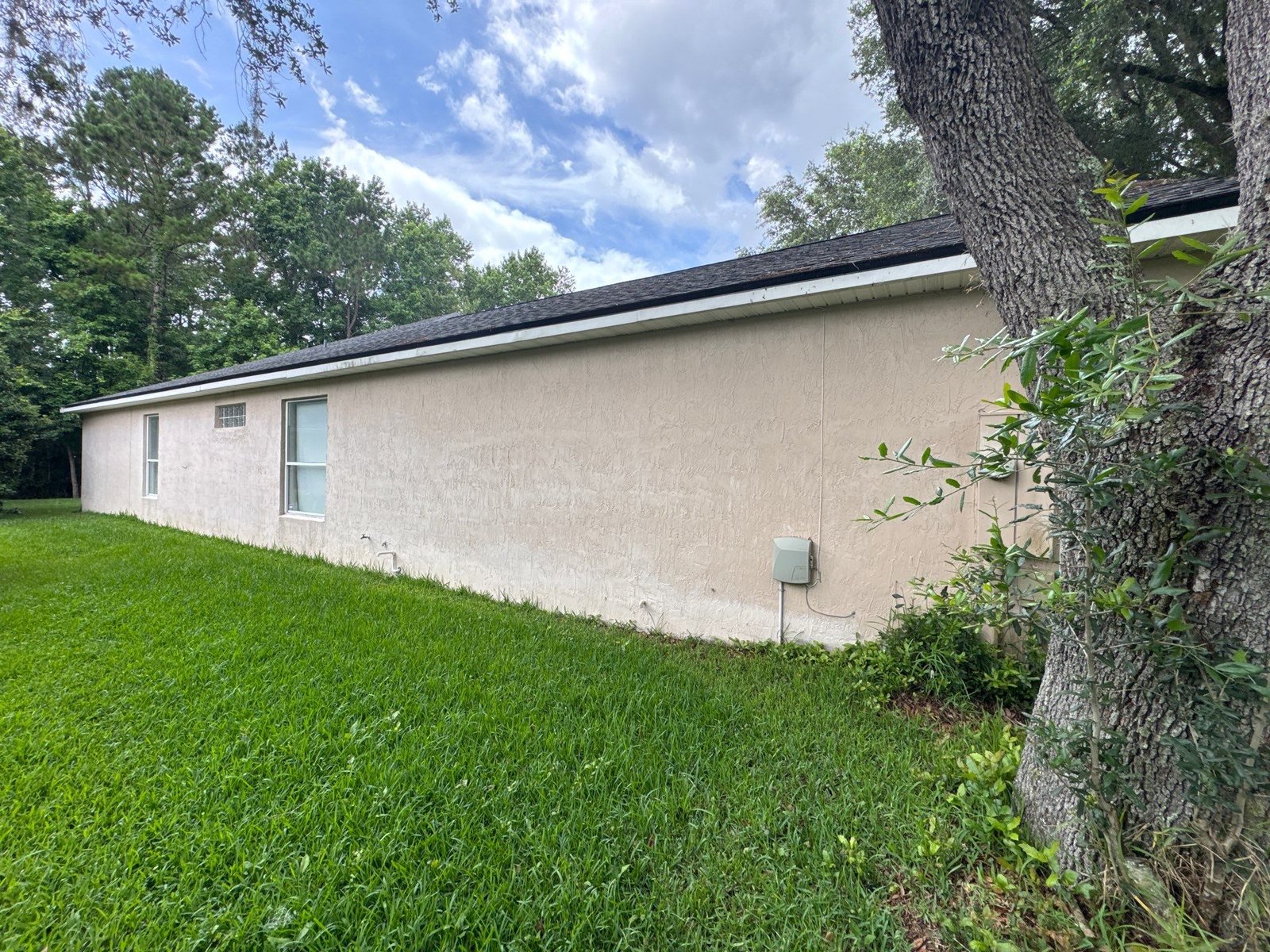
Sprinklers can stain painted stucco because irrigation repeatedly wets the same section of wall, and as that water evaporates it can leave behind minerals, iron, dirt, or other residue. Constant wetting also keeps shaded areas damp longer than they’d otherwise stay, which encourages mildew and other organic growth. Our exterior painters in Jacksonville, FL frequently see this exact pattern concentrated along lower stucco walls, garage elevations, and any spot where a sprinkler head repeatedly strikes the house.
In Jacksonville, this becomes especially noticeable because irrigation exposure combines with high humidity, warm temperatures, dense landscaping, shade, and frequent rainfall — all working together rather than any single factor acting alone. After more than 25 years of exterior painting in Jacksonville, FL, we’ve learned that discoloration doesn’t automatically mean the paint itself has failed. The first solution usually isn’t repainting. It’s identifying what’s actually causing the stain, correcting the sprinkler pattern where possible, cleaning the surface using a method appropriate for painted stucco, letting it dry fully, and then evaluating what condition actually remains. If the coating underneath is still sound, cleaning may be enough. If cleaning reveals fading, chalking, peeling, damaged stucco, or another real coating problem, additional preparation or repainting may be the right next step.
Why Do Sprinklers Leave Stains on Stucco?
There isn’t one single mechanism at work here — sprinkler staining is really several different things that can look similar at a glance.
Mineral deposits. Water often contains dissolved minerals, and when sprinkler spray repeatedly hits the wall and evaporates, that residue can remain behind. A single cycle rarely leaves a visible mark, but repeated cycles over months and years can gradually build into real, visible discoloration.
Iron staining. Some irrigation systems, particularly those drawing from well water, can carry iron content. Repeated exposure can produce orange, rusty, reddish, or brown discoloration on the wall. It’s worth being clear about the source here: this isn’t necessarily rust coming from the stucco or any metal component in the wall itself — the iron is often coming from the irrigation water striking the surface.
Mildew, algae, and organic growth. Repeated wetting combined with humidity, shade, nearby landscaping, slow drying, and warm temperatures creates favorable conditions for organic growth. This tends to appear dark, greenish, gray, or blotchy — visually distinct from the orange or white deposits tied to minerals.
Dirt accumulation. A wet surface collects airborne dirt and pollen more readily than a dry one, simply because moisture helps particles stick rather than blow off.
Coating weathering. Repeated moisture exposure doesn’t automatically cause paint to fail. But persistent wetting does create a genuinely different environment on that specific section of wall. If the coating there is already aging, chalking, cracked, thin, or poorly adhered, the sprinkler-exposed area can end up showing deterioration differently than the rest of the house — not because the sprinkler destroyed sound paint, but because it accelerated wear on paint that already had a weakness.
Why Sprinkler Staining Is So Common on Jacksonville Homes
This isn’t just “Florida weather is harsh” — there’s a specific set of relationships worth understanding. Jacksonville’s humidity, warm temperatures, frequent rainfall, dense landscaping, and shade all interact with irrigation and painted stucco in ways that produce genuinely different outcomes depending on exposure.
A sprinkler repeatedly hitting a sunny wall may leave visible mineral residue as the water evaporates quickly in the heat. A sprinkler repeatedly hitting a shaded wall surrounded by landscaping can create an entirely different problem — the wall stays damp far longer, which encourages mildew and organic growth instead of mineral buildup. The exact same irrigation system, running on the exact same schedule, can therefore produce two very different-looking conditions on two different elevations of the same house.
Repeated moisture is only one part of the picture. Jacksonville’s humidity, sun, rain, and drying conditions also affect how exterior coatings weather generally — irrigation is one added variable layered on top of a climate that’s already demanding on exterior paint. And because every elevation of a home experiences its own combination of sun, shade, and moisture, it’s worth understanding why one side of a Jacksonville house fades faster than the others — the same logic that explains uneven fading also explains uneven staining.
Why the Bottom of My Stucco Wall Looks Worse
Staining concentrated along the lower few feet of a stucco wall is one of the most consistent patterns we see. One of the first things we check when discoloration is concentrated along the bottom of a Jacksonville stucco wall is whether the irrigation system is repeatedly hitting that elevation, and if the discoloration follows the exact arc of a sprinkler head, that pattern is an important clue on its own.
A few specific reasons the lower band of a wall tends to show it first: sprinkler trajectory naturally sends more direct spray toward lower wall sections, splashback off the ground or nearby hardscaping adds even more moisture right at that height, irrigation heads are sometimes positioned too close to the home to begin with, water often hits the exact same location every single cycle rather than spreading evenly, nearby landscaping holds moisture close to the wall longer than open ground would, soil and mulch splash during watering or heavy rain, shrubs reduce airflow right where the wall needs it most to dry, and minerals concentrate as water evaporates repeatedly in the same spot. Garage walls, corners, and side elevations often show this pattern especially clearly, since they’re commonly closer to sprinkler heads and landscaping beds than a home’s more open front elevation.
What Color Are the Stains?
Color is a useful clue, though it doesn’t prove the cause on its own:
| Appearance | Possible Cause |
|---|---|
| Orange / rust-colored | Possible iron or mineral staining from the irrigation water itself. |
| White / chalky / crusty | Possible mineral deposits, efflorescence, or coating chalking — these are not the same thing, covered in more detail below. |
| Green / black / gray | Possible mildew, algae, or other organic growth. |
| Brown / generally dirty | Possible soil, mulch, runoff, mineral content, or general environmental contamination. |
| Faded / lighter than surrounding paint | May indicate actual coating weathering rather than removable surface contamination. |
| Peeling / blistering | May indicate genuine coating failure, which needs real diagnosis beyond simple cleaning. |
Are Sprinkler Stains the Same as Efflorescence?
Not necessarily, and this distinction is worth understanding rather than glossing over. White deposits on masonry can have genuinely different causes. Sprinkler-related mineral deposits are left on the exterior surface by water hitting the wall from the outside, evaporating, and leaving residue behind on top of the coating. Efflorescence is a different process entirely — it happens when moisture moves through the masonry itself and carries soluble salts toward the surface from inside the wall, leaving a similar-looking white, powdery residue but from the opposite direction.
A homeowner shouldn’t automatically assume every white deposit near the bottom of a stucco wall comes from the sprinkler system. If there’s evidence that moisture is coming through the wall rather than simply landing on it — persistent dampness that doesn’t track with your watering schedule, staining on the interior side of that same wall, or deposits appearing even during dry stretches — that’s worth a closer look rather than assuming irrigation is automatically the source.
Can Sprinklers Damage Exterior Paint?
Repeated irrigation exposure doesn’t automatically destroy a properly applied exterior coating. But persistent wetting can contribute to conditions that make that specific area age differently than the rest of the house, particularly when it’s combined with existing cracks, weak coating adhesion, chalking, poor original preparation, thin coating, failed caulk, porous or damaged stucco, prolonged shade, limited airflow, or areas with previous repairs.
It’s worth drawing a clear line between staining sitting on top of otherwise sound paint and actual failure of the paint film itself — these are genuinely different problems with genuinely different fixes. If the coating is actually peeling or blistering rather than simply stained, that’s a different conversation than a surface that just needs cleaning — see our Jacksonville exterior paint failure guide for how to tell the two apart.
Can Sprinkler Stains Be Cleaned Off?
Often, yes — but the right cleaning method depends on what actually caused the stain in the first place. Organic growth typically responds to an appropriate mildew and algae cleaning treatment rather than plain water alone. Loose dirt and pollen usually respond well to routine exterior washing. Mineral deposits or iron staining sometimes need a different, compatible cleaning approach than either of those.
We won’t recommend aggressive chemical recipes or acids here, and it’s worth being cautious generally — painted stucco can be genuinely damaged by excessive pressure or incompatible cleaning chemicals, so high-pressure washing isn’t automatically the answer just because it’s fast. If cleaning is all the wall actually needs, routine exterior house washing may restore the appearance without any repainting involved at all.
Why Cleaning Should Come Before Repainting
This is one of the more important principles in this whole conversation: diagnose the stain first, repaint second. A reasonable sequence looks like this: identify the likely source of the staining, inspect the irrigation pattern for a match, correct sprinkler overspray where that’s realistic, clean the surface appropriately for what’s actually causing the discoloration, allow the stucco and coating to fully dry, re-evaluate the wall once it’s dry, determine whether what remains is staining, fading, chalking, or actual coating failure, and only repair or repaint the areas that genuinely need it.
A wall can be stained without the coating underneath actually failing at all. After cleaning and letting the wall dry, we can get a much clearer read on whether we’re looking at surface contamination, real fading, chalking, or true coating failure — trying to make that call on a wet, dirty wall is guesswork. A strong general rule worth stating plainly: don’t repaint a sprinkler-stained wall while the sprinkler continues hitting that same location every day. Otherwise, the maintenance problem that created the stain in the first place hasn’t actually changed, and the new paint is exposed to exactly the same conditions the old paint was.
Why You Should Adjust the Sprinkler Before Fixing the Wall
If irrigation is repeatedly striking the home, cleaning or repainting without correcting the irrigation pattern addresses the symptom, not the cause. Possible corrections include adjusting sprinkler direction, changing the spray pattern or head type, correcting heads that have physically shifted over time, repairing damaged heads, reducing unnecessary spray exposure on the wall itself, reviewing where landscaping is positioned relative to the house, and checking whether irrigation runoff is collecting near the foundation rather than draining away properly. The underlying principle is simple: keep irrigation on the landscaping, not on the house.
Can You Paint Over Sprinkler Stains?
Usually not without first addressing the cause and properly preparing the surface. Painting directly over mineral deposits, iron staining, mildew, dirt, chalk, a damp surface, or an already-unstable coating can create real adhesion problems, bleed-through, or appearance issues that show up again shortly after the new paint goes on. Depending on the specific condition found, the actual process may involve cleaning, allowing the surface to fully dry, additional surface preparation, a stain-blocking or otherwise compatible primer where it’s genuinely warranted, and then the finish coating. Not every stain needs primer — that decision is condition-specific, based on what’s actually found once the wall is clean and dry, not a blanket rule applied to every sprinkler mark.
Why Do the Stains Keep Coming Back?
Recurring stains almost always mean the underlying source is still there. If the sprinkler continues hitting the wall after repainting, the condition that created the problem in the first place hasn’t changed — so the stain returns on schedule with the irrigation cycle. Other possible reasons stains keep reappearing include ongoing iron or mineral content in the irrigation water itself, dense landscaping continuing to trap moisture against the wall, recurring mildew that was never fully treated, persistently slow drying in a shaded spot, drainage or runoff that keeps collecting in the same area, moisture coming from a source other than irrigation entirely, or an underlying coating or substrate condition that keeps reacting the same way to repeated exposure. This is exactly why it’s worth investigating the actual pattern rather than repeatedly cleaning or repainting the same spot and hoping the outcome changes.
Is It a Stain, Chalking, Fading, Mildew, or Paint Failure?
These conditions can overlap, but they’re worth understanding separately:
Staining — discoloration sitting primarily on the surface, with the coating underneath still adhered, and appearance that may improve substantially after proper cleaning.
Fading — the color itself has genuinely changed, and cleaning won’t restore the original shade because the pigment itself has weathered.
Chalking — a powdery coating residue that may transfer to your hand or a cloth, indicating the coating’s surface layer is breaking down. Our guide on why stucco paint peels in Jacksonville covers how chalking connects to eventual adhesion failure.
Peeling or blistering — the coating is physically separating from the substrate, and cleaning alone won’t repair it regardless of how thoroughly it’s done.
Mildew or organic growth — surface contamination, often concentrated in damp or shaded locations, that generally responds well to appropriate cleaning treatment.
More than one of these can genuinely be present on the same wall at the same time — it’s entirely possible to find mineral staining, some early chalking, and a patch of mildew all within the same few square feet of sprinkler-exposed stucco.
What If the Stucco Is Cracked Too?
Sprinkler exposure becomes a more meaningful concern when repeated water is striking stucco that’s already cracked or damaged, since that gives moisture a more direct path into the wall rather than just sitting on the surface. That said, not every hairline crack allows serious water intrusion — cracks genuinely need individual evaluation rather than a blanket assumption in either direction. Worth checking: hairline cracks versus wider ones, any previous patches and how well they’ve held up, cracks that are still open versus ones that have been properly sealed, texture repairs that may not match the surrounding wall, evidence of ongoing movement, and coating condition specifically around any prior repair. For more on telling these apart, see our guide on which stucco cracks are cosmetic and which are dangerous.
Does the Whole House Need Repainting?
Usually not solely because of sprinkler staining. Localized cleaning or repair tends to be sufficient when the staining is genuinely isolated to one area, the surrounding coating remains sound, the irrigation source has actually been corrected, cleaning restores an acceptable appearance, and there’s no significant coating failure elsewhere. Broader repainting becomes the more sensible conversation when fading is widespread rather than localized, multiple elevations are chalking, paint is peeling or blistering somewhere beyond the stained area, extensive repairs are needed across the home, caulk is failing throughout rather than in one spot, color and sheen can’t realistically be blended at just the stained section, or the exterior coating has generally reached the point where repainting makes sense on its own merits. If your home is relatively new and you’re already seeing some of these signs beyond just sprinkler staining, our guide on why a newer Jacksonville home might already need painting covers that specific situation in more depth.
What We Look for Before Repainting Sprinkler-Stained Stucco
Before recommending any repainting on a sprinkler-stained wall, we evaluate a fairly specific list: where the sprinkler heads are actually positioned, whether the spray pattern genuinely reaches the house, whether the staining pattern lines up with that spray, whether the wall is shaded, the surrounding landscaping and airflow, any stucco cracks, previous repairs, caulk condition, chalking, paint adhesion, mildew or organic growth, mineral or iron staining specifically, whether the coating is genuinely faded rather than just dirty, whether water might be coming from somewhere other than irrigation entirely, and — critically — whether cleaning actually changes the wall’s appearance once it’s done. The guiding principle throughout is straightforward: diagnose the stain first, repaint second.
How to Prevent Sprinkler Stains From Returning
- Keep sprinkler spray directed toward landscaping rather than the house itself
- Periodically check for heads that may have shifted or rotated out of their intended position
- Correct damaged or misaligned sprinkler heads promptly rather than letting them run as-is
- Avoid repeatedly soaking stucco, trim, doors, and windows with direct spray
- Maintain reasonable airflow around heavily landscaped walls where practical
- Clean organic buildup while it’s still light rather than letting it become severe
- Investigate any stain that returns unusually quickly after cleaning rather than just cleaning it again
- Keep an eye on exterior coating and caulk condition generally, not just the stained area
- Have cracks and damaged surfaces inspected rather than assumed to be purely cosmetic
None of this guarantees a stain will never return — Florida’s climate, irrigation needs, and landscaping all remain part of the picture — but it meaningfully reduces how often and how severely it happens.
Frequently Asked Questions
Why are my sprinklers turning my stucco orange?
This is often iron or mineral content in the irrigation water depositing on the surface as the water evaporates, rather than rust originating from the wall itself.
Can sprinkler water stain exterior paint?
Yes — repeated wetting can leave mineral deposits, iron staining, or encourage mildew growth, particularly in shaded or poorly ventilated areas.
How do I remove sprinkler stains from painted stucco?
It depends on the cause — organic growth typically needs an appropriate cleaning treatment, while mineral or iron staining may need a different, compatible approach. Aggressive pressure or harsh chemicals can damage painted stucco and generally aren’t the answer.
Can well water cause orange stains on stucco?
Yes — well water systems can carry higher iron content, which is a common source of orange or rust-colored staining on exterior walls repeatedly exposed to that water.
Are white sprinkler stains efflorescence?
Not necessarily. Sprinkler mineral deposits form on the surface from water hitting the wall externally, while efflorescence forms when moisture moves through the masonry from the inside — they can look similar but come from opposite directions.
Can sprinklers cause mildew on stucco?
Yes, especially in shaded or poorly ventilated areas, where repeated wetting keeps the surface damp long enough for organic growth to establish.
Can I pressure wash sprinkler stains off my house?
With appropriate technique, sometimes — but excessive pressure can damage painted stucco, so a lower-pressure or appropriate cleaning-solution approach is often the safer choice.
Will sprinkler stains bleed through new paint?
They can, if the stain isn’t properly cleaned and addressed before painting — which is part of why cleaning and drying come before any repainting decision.
Do I need primer over sprinkler stains?
Sometimes, depending on the specific condition found once the wall is clean and dry — it’s not a universal requirement for every stain, but a stain-blocking or compatible primer is often warranted for staining that could otherwise bleed through.
Can sprinklers cause exterior paint to peel?
Not typically on their own, but persistent moisture exposure can contribute to peeling when combined with existing weaknesses like cracks, poor adhesion, or thin original coating.
Should sprinklers ever hit the side of my house?
Generally, no — irrigation should be directed at landscaping rather than the home itself, and repeated direct contact with walls, trim, doors, or windows is a common source of the staining covered in this guide.
Does sprinkler staining mean my stucco needs repainting?
Not necessarily — many sprinkler-stained walls just need proper cleaning and an irrigation adjustment. Repainting becomes more relevant if cleaning reveals genuine fading, chalking, or coating failure underneath.
Can I repaint only the stained section of my house?
Often, yes, if the staining is isolated and the surrounding coating is sound — though achieving an acceptable color and sheen match at just one section is worth evaluating before committing to a spot repaint.
Why do sprinkler stains keep coming back after cleaning?
Usually because the underlying source — the sprinkler pattern, water mineral content, or a shaded, slow-drying condition — hasn’t actually changed, so the same conditions simply recreate the stain over time.
Ready to Have Your Stucco Evaluated?
If sprinkler staining has left part of your Jacksonville home discolored, start by identifying the source and correcting the irrigation pattern. If proper cleaning restores the surface and the coating underneath remains sound, repainting may not be necessary at all.
If the wall remains faded, chalky, peeling, cracked, or otherwise damaged after cleaning, our exterior painters can evaluate the stucco, existing coating, any repairs, and the surrounding conditions before recommending the appropriate next step. See our exterior painting services, our pressure washing services, or explore the full Exterior Painting Resource Center for more Jacksonville-specific homeowner guides covering stucco, exterior paint problems, maintenance, repairs, Florida weather, and coating systems.
Call 904-615-6599 to schedule a free, no-pressure exterior evaluation.
A New Leaf Painting Contractors is a trusted team of exterior house painters serving Jacksonville, FL and Northeast Florida since 2001. Our work includes stucco painting, exterior maintenance evaluations, and full exterior repaint projects across the region. If irrigation, humidity, or Florida’s climate has left your stucco stained, faded, or in need of attention, our exterior painting team is glad to take a look and recommend the right next step. Call 904-615-6599 for a free exterior evaluation.