
Best Exterior House Paint for Jacksonville’s Heat, Sun & Humidity
Jacksonville homeowners looking for exterior painters in Jacksonville, FL face a specific challenge that many generic paint guides overlook: Northeast Florida’s heat, UV exposure, frequent summer thunderstorms, year-round humidity, and coastal salt air can shorten the life of an exterior coating system when the surface preparation or product selection is wrong.
This guide explains how to choose an exterior paint system based on your home’s surface type, existing paint condition, sun exposure, moisture concerns, and distance from the coast. You will find practical guidance on coating systems for stucco, Hardie Board and fiber-cement siding, wood trim and siding, exterior paint sheens, color selection, preparation, and realistic repaint-planning expectations.
Whether you are planning a repaint in Jacksonville, Jacksonville Beach, Ponte Vedra Beach, Mandarin, Nocatee, or another Northeast Florida community, the goal is the same: identify the condition of the home first, repair issues within the approved scope, and use a compatible coating system designed for the specific surfaces being painted.
About this guide: A New Leaf Painting Contractors has served Jacksonville and Northeast Florida homeowners since 2001. Our recommendations reflect exterior conditions we regularly see on stucco, fiber cement, wood trim, siding, coastal properties, and older homes throughout the region. Product recommendations should always be confirmed against the actual surface, the existing coating, and current manufacturer instructions for the specific project.
Quick Answer: What Is the Best Exterior Paint for Jacksonville Homes?
The best exterior paint system for a Jacksonville home is usually a premium acrylic coating selected for the home’s surface type, existing paint condition, sun exposure, moisture history, and coastal exposure. Sherwin-Williams Emerald or Duration and Benjamin Moore Aura or Regal Select are often strong options, but the product alone doesn’t determine performance.
For stucco, the right system may include crack repair, a masonry primer, and either a premium acrylic or a high-build/elastomeric coating where
compatible and appropriate. For Hardie Board, wood siding, trim, and fascia, surface repair, caulking, primer selection, and the correct finish sheen matter just as much as the topcoat.
In Jacksonville, proper preparation and a compatible coating system matter more than simply buying the most expensive paint on the shelf.
For help comparing systems and planning your project, explore our exterior painters in Jacksonville, FL services or schedule a professional exterior evaluation.
How to Choose the Right Paint System for Your Home
Before comparing paint brands, it helps to know which category your home falls into. This isn’t a substitute for an on-site evaluation, but it’s a useful starting point.
Decision Guide
| Your Home’s Condition | Common Recommendation to Discuss | Why |
|---|---|---|
| Sound painted stucco with minor wear | Masonry-compatible primer where needed + premium acrylic topcoat | Good adhesion and weather resistance without overbuilding the system |
| Stucco with recurring hairline cracks | Crack repair + high-build or elastomeric system where appropriate | Helps address surface movement and recurring crack areas |
| Hardie Board with open joints or exposed edges | Caulk and joint repair + compatible acrylic system | Protects vulnerable joints and cut edges |
| Wood siding or trim with peeling | Scrape, repair, spot-prime bare wood + premium acrylic topcoat | Paint can’t solve rot or failed wood — that needs carpentry repair first |
| Coastal home | Salt-residue cleaning, metal inspection, detailed prep, exposure-appropriate coating | Coastal exposure increases maintenance needs |
| Dark color change | Product and sheen selected for heat, color, and coverage needs | Dark colors can complicate repainting and long-term maintenance |
Why Jacksonville Exterior Paint Fails Faster
Jacksonville, Florida presents four overlapping conditions that make it a demanding environment for exterior coatings: intense UV exposure, sustained humidity, frequent heavy rain, and — for many homes — coastal salt exposure. Understanding each one explains why experienced painters here lean toward premium coating systems over budget alternatives.
UV Radiation and Color Fading
Florida receives more annual solar radiation than most of the country. UV rays are the primary cause of paint fading — they break down pigment
at the molecular level over time. Premium acrylic latex paints like Sherwin-Williams Emerald include UV-blocking technology designed to slow
that breakdown.
Lighter colors (whites, beiges, light grays, and pastels) tend to hold their appearance longer in Florida sun than dark or saturated colors. If you love a bold color, ask your painter about fade-resistance data for that specific product and shade before committing.
Humidity and Mildew Growth
Jacksonville averages relative humidity in the 70–90% range for much of the year. Mildew-prone areas — shaded, damp, or north-facing walls —
can discolor faster than sun-exposed elevations. Paint without mildew-resistant additives is more likely to show staining sooner. This
isn’t just cosmetic; ongoing mildew growth can affect how well a coating adheres to the surface beneath it over time.
Rain, Storm Season, and Moisture
Jacksonville receives roughly 52 inches of rain a year, well above the U.S. average, with frequent summer thunderstorms from June through September. Paint without adequate moisture resistance can allow water to work into cracks, joints, and porous areas of the substrate, leading to peeling, bubbling, wood rot, and stucco damage over time. High-quality acrylic latex and elastomeric coatings help create a more continuous, weather-resistant film when applied over properly prepared and repaired surfaces.
Coastal and Intracoastal Salt Exposure
Homes within a few miles of the Atlantic coast, the Intracoastal Waterway, or the St. Johns River tend to see faster paint wear from
airborne salt. Salt is corrosive — it can accelerate paint film breakdown, promote rust on metal surfaces, and speed up degradation of
wood and masonry substrates. Coastal homes often need more frequent washing, careful salt-residue removal, attention to exposed metal and
fasteners, and a coating system selected for the surface and exposure conditions.
Climate Factors at a Glance
| Climate Factor | Common Effect | What Helps |
|---|---|---|
| Intense UV Sun | Color fading, film breakdown | UV-inhibitor acrylic (e.g. SW Emerald) |
| High Humidity | Mildew, adhesion concerns | Mildew-resistant acrylic latex |
| Salt Air (Coastal) | Faster film wear | Exposure-appropriate coating, more frequent maintenance |
| Heavy Rain / Storms | Moisture intrusion, peeling | Elastomeric or water-resistant acrylic, sound caulking |
Best Exterior Coating Systems by Surface
Jacksonville homes are built with a handful of common exterior materials, each requiring its own approach to prep and coating selection. Using the wrong product for the surface is one of the more common reasons paint fails early.
Stucco
Stucco is the dominant exterior finish on Florida homes, especially those built after 1970. It holds up well when maintained, but it
naturally develops hairline cracks from thermal movement and settling.
For stucco, the right system depends on the existing coating, chalking, cracking, moisture history, surface porosity, and manufacturer
compatibility. Some homes benefit from a high-build or elastomeric coating system; others perform well with a masonry primer and premium
acrylic topcoat. The goal isn’t simply to apply the thickest coating — it’s to select a compatible system that addresses the condition of the
surface.
- Critical prep step: Pressure wash to remove dirt, mildew, and chalky residue. Fill cracks larger than 1/16 inch with compatible caulk or filler before painting.
- Avoid: Oil-based paints on stucco — they tend to trap moisture and can lead to earlier failure in Florida’s humidity.
Fiber Cement Siding (Hardie Board)
Fiber cement siding has become the most common siding material for new home construction in Northeast Florida over the past 20 years. It’s dimensionally stable, termite-resistant, and generally holds paint well when properly maintained.
- Recommended coating: Premium acrylic latex (Sherwin-Williams Duration or Emerald, or Benjamin Moore Aura or Regal Select) in satin finish.
- Critical prep step: Inspect and replace caulking at joints and corners. Cut edges and joints should be sealed since fiber cement can absorb water at exposed edges.
- Note on factory-primed fiber cement: Factory-primed siding should be evaluated against the current manufacturer instructions, the condition of the primer, exposed cut edges, caulk joints, and weathering since installation. Your painter should inspect and prepare those areas before coating rather than working off a fixed deadline.
Wood Siding
Wood siding takes more prep and maintenance than stucco or fiber cement, but it can hold a good finish for years when properly treated.
- Recommended coating: High-quality acrylic latex in satin finish, over a full coat of oil-based or shellac-based primer on bare wood.
- Critical prep step: Check for rot, especially at lower courses, around windows, and at trim intersections. Replace any rotted boards before painting — paint won’t fix structurally compromised wood.
- Note: Wood is the most moisture-sensitive substrate on a home. Gaps in caulking or failed paint film should be addressed promptly to help prevent water intrusion and rot.
Brick and Masonry
Brick and concrete block are porous materials that need breathable coatings so moisture doesn’t get trapped behind the paint film.
- Recommended coating: Breathable masonry paint or acrylic latex with good vapor permeability. Vapor-barrier coatings like elastomeric generally aren’t appropriate on unpainted brick unless the entire wall will be coated.
- Critical prep step: Remove efflorescence (white salt deposits) with a masonry cleaner before painting — painting over it tends to cause early adhesion failure.
- Worth knowing: Painting over unpainted brick is essentially a permanent decision. It typically needs repainting every 5–10 years and is difficult to reverse.
Premium Product Options
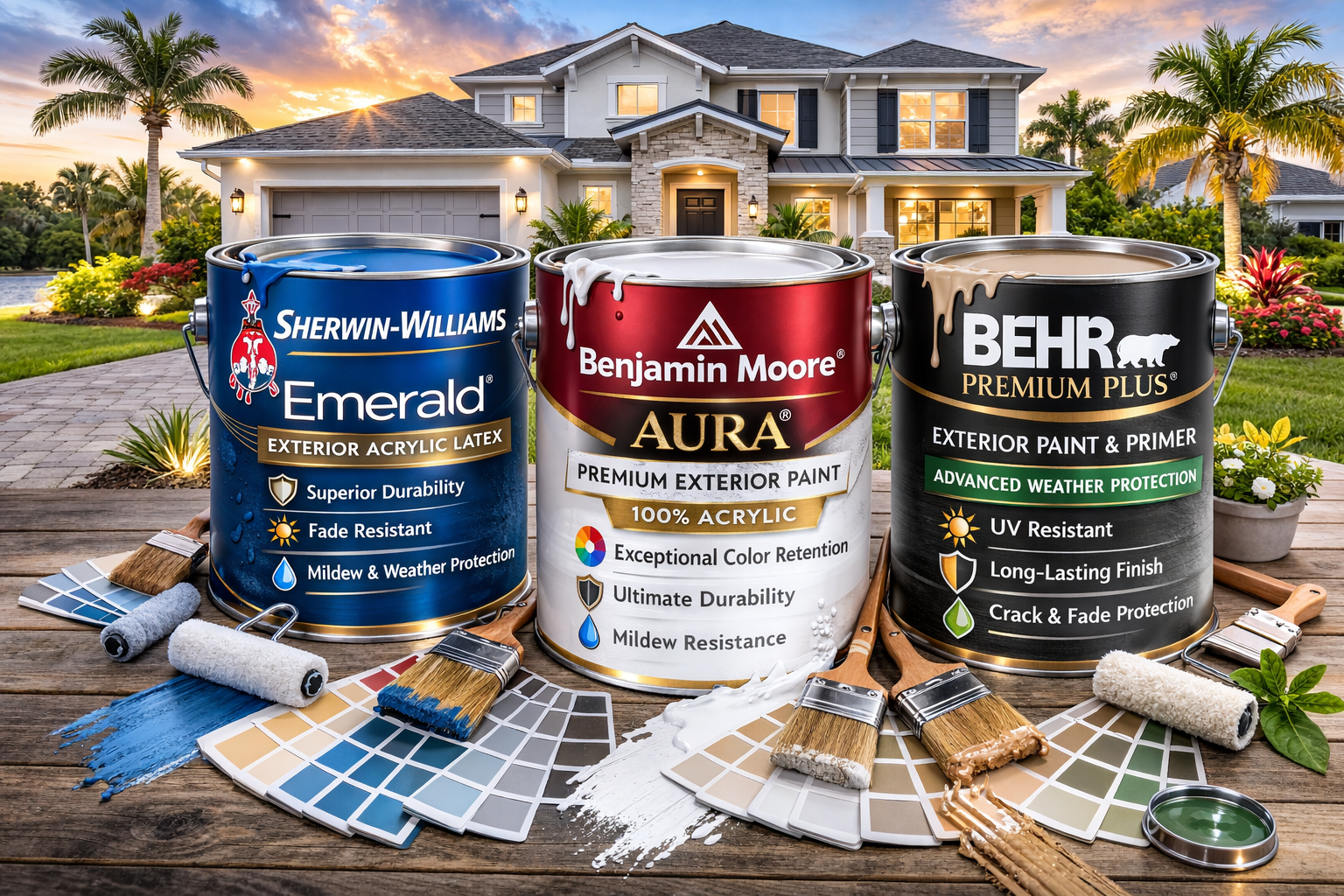
Sherwin-Williams and Benjamin Moore are the two manufacturers we most often recommend for Jacksonville exteriors — both invest heavily in product testing for humid, coastal, and high-UV environments. Premium products like these are often strong options, but the best choice depends on substrate, existing coating condition, sheen, color, exposure, and the prep beneath the finish coat.
Sherwin-Williams Emerald Exterior Acrylic Latex
Emerald is Sherwin-Williams’ flagship exterior product and a strong option where color retention and long-term durability are the priority. It includes ColorAccurate technology for fade resistance, a thicker film build, and mildew-resistant formulation.
- Often a fit for: Exterior surfaces where color retention and durability are the top priority
- Typical coverage: Around 400 sq ft per gallon at the manufacturer’s recommended film thickness
Sherwin-Williams Duration Exterior Acrylic Latex
Duration uses Sherwin-Williams’ PermaLast technology for a thick, flexible coating with strong adhesion. Its mildew-resistant formulation makes it a common choice in Jacksonville’s humid climate, particularly for homes with a history of mildew.
- Often a fit for: Homes with prior mildew issues; fiber cement siding; wood
Sherwin-Williams SuperPaint Exterior
SuperPaint sits a tier below Emerald and Duration but still outperforms most paint sold at general home improvement stores. It offers solid adhesion, good fade resistance, and a dependable weather barrier at a more accessible price point.
- Often a fit for: Budget-conscious homeowners who still want professional-grade performance
Benjamin Moore Aura Exterior
Benjamin Moore markets Aura Exterior as a premium coating built around Color Lock technology, designed to bond pigment more securely and resist fading — particularly relevant for deep or custom colors.
- Often a fit for: Homes with bold or custom colors; high-UV exposure
Benjamin Moore Regal Select Exterior
Regal Select emphasizes adhesion on hard-to-coat surfaces, including fiber cement, wood, and primed stucco, with a smooth, consistent finish. It’s a common alternative to Sherwin-Williams Duration at a similar price point.
- Often a fit for: Fiber cement (Hardie Board) siding; wood trim; second-story siding
Product Comparison
| Product | UV/Fade Resistance | Mildew Resistance | Common Surfaces |
|---|---|---|---|
| SW Emerald | Very Good | Very Good | All exteriors |
| SW Duration | Good | Very Good | Wood, fiber cement |
| SW SuperPaint | Good | Good | Most surfaces |
| BM Aura | Very Good | Good | All exteriors |
| BM Regal Select | Good | Good | Fiber cement, wood |
Exterior Paint Sheens for Jacksonville Homes
Sheen affects both the look and the durability of a paint job, and the
right choice depends on the surface and how much exposure it gets.
Flat / Matte — Common on Stucco Walls
Flat finish has no reflective sheen and gives stucco a natural, matte look that hides minor texture variation well. It’s also easier to touch up without visible sheen mismatches, though it’s harder to clean than satin or semi-gloss and more prone to showing mildew staining in humid conditions.
Satin — Widely Used for Jacksonville Siding
Satin offers a low-luster sheen that’s generally more durable and easier to clean than flat, which makes it a common choice for exterior siding in Florida. Satin is commonly used on fiber cement siding, wood siding, smooth stucco, and large wall surfaces — but sheen should still be selected by surface and product guidance rather than treated as a fixed
rule.
Semi-Gloss — Common for Trim, Doors, and Shutters
Semi-gloss is durable, easy to clean, and moisture-resistant, which makes it a frequent choice for exterior trim, window frames, doors, shutters, soffits, and fascia — areas that see direct weather exposure and frequent handling. A satin body with semi-gloss trim is one of the more consistent, well-maintained-looking combinations for Florida homes.
Preparation: What Actually Determines How Long Paint Lasts
The single biggest factor in exterior paint longevity is surface preparation — not the brand of paint. A premium coating applied over a dirty, chalky, or cracked surface will tend to fail early regardless of price. Proper prep is what allows premium paint to reach its intended lifespan.
How many coats will be applied, and at what thickness, based on the manufacturer’s guidance for this product and color? If a painter can’t answer that, it’s worth asking more questions before signing.
What Should Be Included in Your Estimate?
This is one of the most useful things to check before hiring an
exterior painter in Jacksonville. A thorough written estimate should
identify:
- Surfaces included and excluded
- Pressure washing / cleaning method
- Repairs included and excluded
- Caulking scope
- Primer type and where it will be used
- Product line and sheen by surface
- Coat count or manufacturer-required coverage
- Color-change considerations
- Protection for landscaping, fixtures, windows, and walkways
- Change-order process for damage discovered mid-project
- Guarantee terms and what’s covered
A New Leaf Painting Contractors provides itemized, written proposals
that walk through each of these before work begins — no surprise scope
changes, no guessing at what’s included.
How Long Does Exterior Paint Last in Jacksonville?
Repaint timing varies significantly based on surface type, product quality, prep quality, and environmental exposure. The ranges below are general starting points, not guarantees for any individual home — a home’s actual location, elevation exposure, and maintenance history all move the number.
General Repaint Range by Surface
| Surface | Typical Range With Proper Prep & Premium Product | Key Variable |
|---|---|---|
| Stucco (inland) | 8–12 years | Coating system chosen; crack condition |
| Stucco (coastal) | 6–9 years | Salt air exposure level |
| Fiber Cement Siding | 10–15 years | Caulk maintenance at joints |
| Wood Siding | 7–10 years | Primer quality; moisture control |
| Exterior Trim | 5–8 years | Exposure; sheen selected |
| Brick / Masonry | 8–12 years | Use of breathable coating |
Budget paint and inconsistent prep can cut these ranges substantially — often to a third or less of the premium/proper-prep range. Over the life of a home, the gap between a rushed repaint and a properly prepped one is often the difference of a full extra repaint cycle.
Five Things That Shorten Exterior Paint Life in Jacksonville
- Painting over chalking without proper cleaning or priming first.
- Caulking over failed wood or active water intrusion instead of repairing it.
- Treating every stucco home as an automatic elastomeric job instead of evaluating the actual surface condition.
- Choosing a dark color without factoring in sun exposure and, where applicable, HOA restrictions.
- Hiring a painter who quotes a brand name instead of walking through a full prep-and-coating plan.
Three Recent Jacksonville Exterior Projects
Surface: Stucco. A full exterior repaint for a stucco home in the
Coastal Oaks section of Nocatee, addressing surface prep and finish
coating appropriate for the community’s coastal-adjacent exposure. View more Nocatee area projects →
Surface: Stucco and Hardie siding. This project included full pressure washing, surface prep, caulking, wood rot and Hardie siding repair, a Sherwin-Williams Loxon XP masonry primer for added water resistance, and a Sherwin-Williams Emerald Rain Refresh topcoat. View more Fleming Island area projects →
Surface: Stucco. Detailed stucco preparation — surface cleaning, crack repair, and caulking — ahead of finish coating, aimed at giving the coating system a sound base to bond to before the topcoat went on. View more Jacksonville area projects →
Exterior Paint Maintenance Timeline
Jacksonville Exterior Paint FAQs
What is the best exterior paint for Florida homes?
A premium acrylic latex product formulated for high-UV and high-humidity environments is usually the strongest starting point. Sherwin-Williams Emerald Exterior and Benjamin Moore Aura Exterior are both commonly used for their UV resistance, mildew resistance, and moisture protection. For stucco homes specifically, a high-build or elastomeric system can be a good fit when the existing surface condition supports it.
What exterior paint brands do professional painters use in Jacksonville?
Sherwin-Williams and Benjamin Moore are the two brands most commonly specified for exterior residential projects in this market. Sherwin-Williams
Emerald and Duration are frequently used for mildew resistance and durability; Benjamin Moore Aura is a common choice when color retention and depth are priorities.
How often do Jacksonville homes need to be repainted?
Timing varies by surface, exposure, prep quality, and product — most homes with professional-grade paint over properly prepared surfaces fall
somewhere in the 8–12 year range, with coastal homes often on the shorter end due to salt air exposure. Homes with budget-grade products or inconsistent prep can need repainting significantly sooner.
Is elastomeric paint the right choice for stucco homes in Florida?
Sometimes. A high-build or elastomeric coating can be a strong option for stucco with recurring hairline cracking, since the thicker film can
bridge small cracks and help create a more continuous, weather-resistant surface. It isn’t automatically the right choice for every stucco home,
though — sound, well-maintained stucco with minor wear often does well with a compatible primer and premium acrylic topcoat instead. The right
answer depends on the existing coating, crack pattern, and moisture history.
What paint finish is best for the exterior of a house in Florida?
Satin is commonly used for siding and main wall surfaces, and semi-gloss for trim, doors, window frames, and shutters. Satin balances durability and cleanability on large surfaces, while semi-gloss adds hardness and easy cleaning to high-contact areas. For stucco, flat or low-sheen options are often preferred since they hide texture variation better than a reflective finish. Sheen should ultimately be selected by surface and product guidance rather than a one-size-fits-all rule.
What colors are most popular for exterior house painting in Jacksonville?
Soft coastal blues, warm beige and sand tones, light and medium grays, classic white with dark trim, and muted sage green are all popular
choices in this market. They tend to complement Northeast Florida’s landscape and hold up reasonably well under intense UV exposure.
How do I know if my house in Jacksonville needs to be repainted?
Common signs include: paint that’s peeling, bubbling, or cracking away from the surface; mildew or algae staining that won’t clean off; colors
that have faded noticeably from their original appearance; bare spots where paint has worn through; and caulking around windows, doors, or
trim that’s cracked, missing, or no longer adhering.
Can I paint my own house exterior, or should I hire a professional?
Homeowners can paint their own exterior, but inadequate preparation is one of the most common causes of early paint failure — and prep is also the most physically demanding part of the job. Professional painters bring pressure washing equipment, proper access equipment, and experience spotting substrate issues most homeowners miss. For larger homes, stucco, soft wood, or known mildew issues, professional prep and application will generally deliver better long-term results than a DIY approach.
What is the best primer for exterior painting in Florida?
It depends on the substrate. Bare wood generally does best with an oil-based or shellac-based primer. Stucco typically calls for a masonry primer or a direct-to-surface acrylic primer. Factory-primed fiber cement should be evaluated against current manufacturer guidance and the condition of the existing primer rather than a fixed timeline. Any surface with rust, tannin bleed, or water staining generally needs a stain-blocking primer before the topcoat.
How much does it cost to paint the exterior of a house in Jacksonville, FL?
Exterior painting costs vary based on home size, surface type, condition, and product selection. As a general starting point, a
typical single-story home in the 1,500–2,000 sq ft range often falls somewhere in the $2,500–$5,000 range for professional prep and a
two-coat premium application — larger homes, two-story structures, and homes needing significant repair work will run higher. For an accurate
number, contact A New Leaf Painting Contractors at 904-615-6599 for a free on-site assessment.
About A New Leaf Painting Contractors
A New Leaf Painting Contractors was founded in Jacksonville, Florida in 2001 and has served homeowners throughout Northeast Florida ever since.
Our team has completed 5,000+ residential and commercial painting projects across Jacksonville, Jacksonville Beach, Atlantic Beach,
Neptune Beach, Ponte Vedra Beach, Fleming Island, Orange Park, Nocatee, St. Augustine, and surrounding communities.
Our approach is shaped by the specific challenges of Florida exterior painting — UV exposure, humidity, coastal salt air, and stucco-heavy
construction that make Florida homes different from homes in most other parts of the country. We’re insured with $5M+ in coverage, Google
Guaranteed, BBB-Accredited, EPA Lead-Safe Certified, and hold a Duval County Certificate of Competency, with 750+ verified 5-star reviews
across eight platforms.
What We Offer Jacksonville Homeowners
- Free exterior painting estimates with no obligation
- Professional color consultations using Sherwin-Williams and Benjamin Moore color systems
- Full surface preparation, including pressure washing, repairs, and caulking
- Coating systems matched to your specific surface type and exposure level
- Itemized, written proposals so you know exactly what’s included
- Backed by our Iron-Clad Guarantee
Ready to protect your Jacksonville home?
Call or text 904-615-6599 to schedule your free exterior painting
estimate.