
By Thomas Drake, Owner — A New Leaf Painting Contractors
Founded 2001 · 5,000+ Projects · Jacksonville, FL
You’re walking around your home and you spot it — a crack in the stucco. Maybe it’s a thin line running along a corner. Maybe it’s a web of fine cracks across a sun-facing wall. Maybe it’s a gap that’s been there so long you stopped noticing it.
The question every Jacksonville homeowner asks at that point is the right one: Is this something I need to deal with now, or can it wait?
The answer depends entirely on what type of crack you’re looking at. Not all stucco cracks are equal — and in Northeast Florida’s climate, the difference between a cosmetic crack and a dangerous one is the difference between a $300 repair and a $15,000 wall rebuild.
Here’s how to tell them apart.
Why Jacksonville Stucco Cracks in the First Place
Before we get into crack types, it helps to understand why stucco cracks here more than almost anywhere else in the country.
Stucco is a rigid material. It doesn’t flex. But the framing beneath it does — it expands in Jacksonville’s summer heat and contracts when cooler fronts roll through in winter. That movement happens thousands of times over the life of a home, and stucco responds the only way it can: by cracking.
Add to that the salt air in coastal communities, the constant UV bombardment, the heavy seasonal rain that pushes against exterior walls sideways, and the high humidity that seeps into every unsealed gap — and you have conditions that stress stucco harder and faster than anywhere in the continental United States.
Cracks aren’t a sign that something went wrong. They’re a normal part of owning a stucco home in Florida. What matters is understanding what each crack is telling you.
The Four Types of Stucco Cracks — and What Each One Means
1. Hairline Cracks
What they look like:
Very thin, shallow lines — less than 1/16 of an inch wide. Often follow the lines of the mesh or lath beneath the stucco. Frequently appear after the first summer or two in a new home.
What causes them:
Normal thermal expansion and contraction. These are the stucco responding to temperature swings in the way it’s designed to.
Are they dangerous?
On their own, no. Hairline cracks in an otherwise sound stucco surface are cosmetic. The problem is what they become if left untreated — in Jacksonville’s heavy rain environment, even a hairline crack is an open water entry point. During a summer storm with wind-driven rain, water finds these gaps and works its way behind the stucco.
What to do:
Seal with an elastomeric caulk or elastomeric coating before water has a chance to penetrate. Don’t paint over them with standard paint — standard paint doesn’t bridge cracks. Elastomeric coatings do.
2. Spider Cracking (Crazing)
What they look like:
A web or network of fine cracks radiating from a central point or spread across a section of wall — similar to the pattern on a cracked eggshell. Most common on south and west-facing walls.
What causes them:
UV degradation of the top coat combined with the expansion and contraction cycle. The surface layer has lost its flexibility and is essentially shattering in place.
Are they dangerous?
Moderately concerning. Spider cracking itself is a surface phenomenon, but the pattern creates dozens of small water entry points across a large area. Each one is small — but together they’re allowing moisture to permeate the surface constantly during rain events.
What to do:
Don’t just paint over spider cracking. The new paint will follow the same crack lines within a season. The right approach is an elastomeric base coat — applied at several times the thickness of standard paint — that bridges and seals the entire cracked surface and creates a continuous waterproof membrane.
3. Structural Cracks
What they look like:
Wider than 1/4 inch. Often diagonal, running at 45-degree angles from corners of windows and doors. May have one side slightly higher than the other — a step pattern — indicating the two sides have moved independently.
What causes them:
Actual movement in the structure — foundation settling, framing shifts, or soil movement beneath the home. In Northeast Florida, this can be caused by the sandy soil that characterizes much of the region, particularly after heavy rain events.
Are they dangerous?
Yes. Structural cracks are telling you something is moving that shouldn’t be. Painting over a structural crack is a waste of money — the crack will reappear through any coating within months because the underlying cause hasn’t been addressed.
What to do:
Have a structural engineer or foundation specialist assess the cause before any painting or repair work begins. Once the structural issue is addressed, the crack can be properly repaired and the surface recoated.
4. Water Damage Cracks and Staining
What they look like:
Cracks accompanied by brown or rust-colored staining, bubbling paint, efflorescence (white chalky deposits), or soft spots in the stucco that feel hollow when tapped.
What causes them:
Water has already been behind the stucco for an extended period. The staining is often from the lath or framing rusting or organic material breaking down. The hollow spots mean the stucco has separated from the substrate beneath it.
Are they dangerous?
Highly dangerous. Water has been in the wall cavity long enough to cause damage to the framing. Left untreated, this leads to wood rot, mold behind the walls, and eventually structural compromise.
What to do:
This is beyond a painting repair. The stucco in the affected area needs to be removed, the damage behind it assessed and repaired, and then new stucco applied before any coating goes on. Do not paint over efflorescence or water staining — it will bleed through any finish coat.
The Jacksonville Moisture Rule
In a dry climate, a hairline crack is genuinely cosmetic. In Jacksonville, no crack in stucco is purely cosmetic — because our rainfall volume, humidity, and wind-driven rain events mean that any unsealed opening in an exterior surface will eventually admit water.
The practical rule: if you can see it, seal it.
The economics are simple. An elastomeric coating applied over a properly repaired surface costs a fraction of what it costs to repair water damage that develops over two or three years of neglect. We’ve seen hairline cracks that were ignored turn into $8,000 framing repairs. We’ve seen spider cracking that was painted over with standard paint lead to mold remediation that cost more than the original paint job.
Stucco in Jacksonville is forgiving if you catch issues early. It becomes expensive when you wait.
What a Proper Stucco Repair and Repaint Looks Like
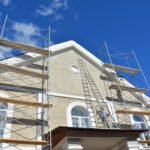
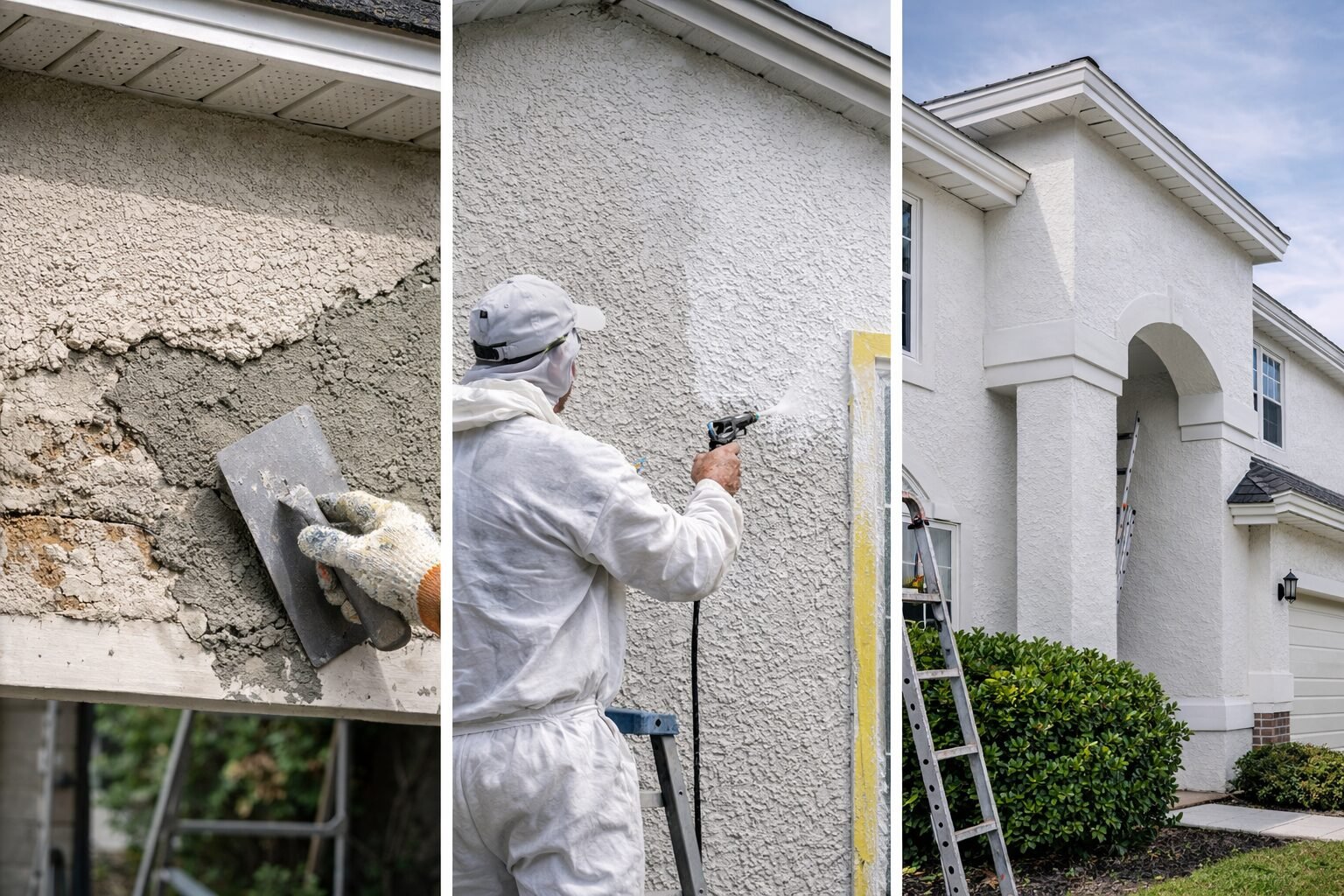
When A New Leaf Painting approaches a stucco home, we assess every crack before we quote the job. Here’s what a thorough repair and repaint sequence looks like:
- Step 1 — Full Surface Assessment: Every wall, every elevation. We identify crack types, map water staining, tap for hollow spots, and assess the overall condition before any prep begins.
- Step 2 — Crack Repair: Hairline cracks get elastomeric caulk. Larger cracks get cut open, cleaned out, packed with appropriate filler, and allowed to cure before coating.
- Step 3 — Power Washing: Industrial pressure washing removes chalking, mildew, salt deposits, and any failing paint.
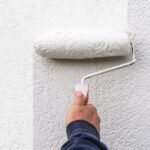
- Step 4 — Elastomeric Base Coat: Applied at four to five times the thickness of standard paint. This is the step most painters skip — and it’s the step that determines whether a paint job lasts 3 years or 12.
- Step 5 — Premium Acrylic Finish Coat: Sherwin-Williams® Emerald or equivalent. Two coats minimum on stucco.
- Step 6 — Re-Caulking: All window and door perimeters, penetrations, and joints recaulked before the finish coat goes on.
Quick Reference: Stucco Crack Guide
| Crack Type | Width | Urgency | Action |
| Hairline | Under 1/16″ | Moderate | Seal with elastomeric caulk or coating |
| Spider / Crazing | Surface pattern | Moderate | Elastomeric base coat before repaint |
| Structural | Over 1/4″, diagonal | High | Engineering assessment before any repair |
| Water damage | Any width + staining | Urgent | Remove affected stucco, repair substrate |
A New Leaf Painting: Stucco Repair and Repainting in Jacksonville, FL
We’ve been repairing and repainting stucco homes in Jacksonville, Ponte Vedra Beach, Fleming Island, Amelia Island, and all of Northeast Florida since 2001. Our stucco repair and elastomeric coating system is designed for Florida’s specific conditions — not adapted from a national playbook.
If you’re seeing cracks and not sure what you’re looking at, call us. We’ll assess the surface honestly and tell you exactly what you need — whether that’s a simple elastomeric coating or a more involved repair before repainting.
Call (904) 615-6599 or visit anewleafpainting.com/contact-us for a free stucco assessment.
Thomas Drake founded A New Leaf Painting Contractors in Jacksonville, FL in 2001. The company has completed more than 5,000 interior and exterior painting projects across Northeast Florida and holds 750+ verified five-star reviews.
A New Leaf Painting has been protecting and transforming Jacksonville homes since 2001. Every project begins with professional power washing and honest surface assessment. If we find damaged wood, our carpentry repair team handles it first — because no paint job lasts on a compromised surface. For stucco homes, we treat and patch cracks with our stucco repair service before any coating goes on. When every surface is ready, our exterior painting team applies premium Sherwin-Williams® and Benjamin Moore® products in two full coats — the professional standard for Florida’s UV, humidity, and salt air.
Explore More Jacksonville Exterior Painting Resources
Stucco is just one piece of the exterior painting picture in Northeast Florida. For a complete breakdown of color selection, cost, contractor vetting, surfaces, and Florida climate considerations, browse our Jacksonville exterior painting resource library — 25 years of First Coast experience, organized by topic.
When you are ready, call or text 904-615-6599 for a free, no-surprise estimate backed by our Iron-Clad Guarantee.