
White Powder on Stucco: What Efflorescence Means on a Florida Home
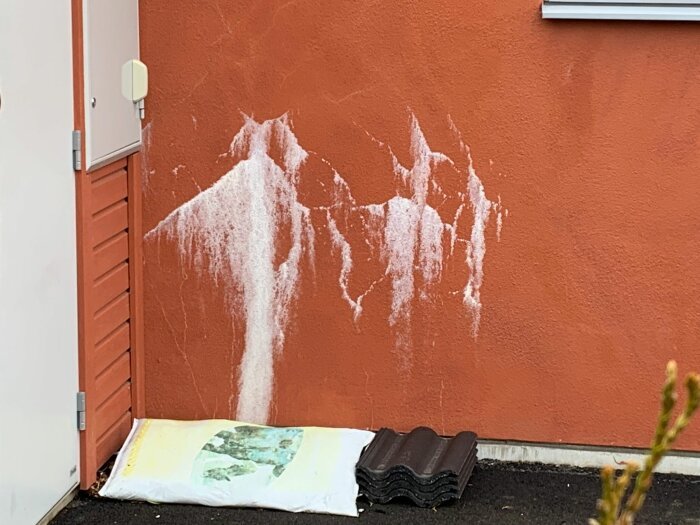
You walked past the side of the house and there’s white powder on the stucco that wasn’t there before. Maybe it brushes off on your hand. Maybe it’s a chalky film across a patch of wall, or a streak running down below a window, or a crusty deposit collected along a crack near the bottom of the wall.
The first guess is usually mold. The second is that the paint is failing. Both are reasonable, and both are often wrong.
What you’re most likely looking at is efflorescence — a mineral deposit left behind when moisture moves through masonry and evaporates at the surface. The deposits themselves are rarely the main problem. What matters is what they may be telling you: moisture has been moving through the masonry. Our professional exterior painting crews regularly encounter efflorescence on stucco homes across Duval, St. Johns, and Clay counties. The useful question isn’t simply how to remove the white deposits — it’s where the moisture is coming from, whether that source has been addressed, and whether the affected area needs cleaning and preparation or more extensive stucco repair before painting.
What Are You Seeing on the Stucco?
Jump to what looks closest to your wall:
- Fine white powder — dusty, brushes off easily
- White streaks — running down the wall in lines
- Crusty deposits — thicker, crystalline-looking buildup
- White material around cracks — concentrated along a crack line
- White deposits below windows — under a sill or corner
- White material near the bottom of the wall — low band near grade
- Paint that looks chalky instead — powder that carries the wall’s color
- White growth that may be mildew or algae — biological rather than mineral
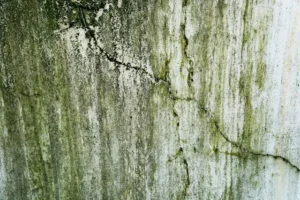
What Is Efflorescence on Stucco?
The Portland Cement Association describes efflorescence as a crystalline deposit, usually white, that can develop on the surfaces of masonry construction. The mechanism is straightforward once you see it laid out.
Portland cement is used in concrete block, mortar, and stucco. As cement hydrates, it produces calcium hydroxide and other soluble compounds. When water moves through that material, it dissolves those salts and carries them along. When the water reaches the surface and evaporates, the salts have nowhere to go — they stay behind, react with carbon dioxide in the air, and become the visible white deposit.
The Concrete Masonry & Hardscapes Association describes three conditions that all have to be present: soluble salts in the masonry, moisture to dissolve and carry them, and a force — usually evaporation — to move the solution to the surface. Remove any one of the three and efflorescence stops forming.
That’s why cleaning alone rarely settles anything. The salts and the evaporation aren’t going anywhere. Moisture is the variable you can actually change.
What Does It Look Like?
Fine White Powder
A dusty white film that brushes off with a dry hand or a soft brush. The lightest and most common presentation, and the one most likely to be recent or minor.
White Streaks
Vertical or angled lines of white running down a wall, following the path water takes. Streaking tells you something a general haze doesn’t — it shows you the route the water traveled, which is often the most useful clue on the wall.
Crusty Deposits
Thicker, sometimes crystalline-looking buildup rather than a dusting. Heavier deposits generally reflect more moisture movement over a longer period, or repeated cycles of wetting and drying at that spot.
White Material Around Cracks
Deposits concentrated along a crack line, sometimes on both sides of it. When efflorescence follows a crack, the crack is functioning as a pathway — water is getting in or moving along it, and depositing minerals as it evaporates at the opening.
This combination matters more than either condition alone. A stable hairline crack with no deposits is a different situation from the same crack ringed with white. Our guide to types of stucco cracks covers how to read the crack side of that.
White Deposits Below Windows
Deposits forming under a sill or beneath a lower corner of an opening. Common, and worth attention because openings are where a wall’s water management is most dependent on sealant and flashing details.
Important caveat: the place the deposit appears is not necessarily where the water entered. Water travels within a wall assembly before it emerges. Deposits under a sill can originate at the head or a jamb. See cracks around stucco windows and doors for what to check at the opening itself.
White Material Near the Bottom of the Wall
A band of deposits in the lower portion of a wall, often within a couple of feet of grade. On Florida homes this is frequently tied to something specific and fixable — irrigation, splashback, or drainage. More on that below.
Paint That Looks Chalky Instead
If the powder carries the color of your paint rather than being white, you’re probably looking at chalking, not efflorescence. Separate condition, separate cause — covered in its own section below.
White Growth That May Be Mildew or Algae
Biological growth is usually darker — green, gray, or black — but light-colored growth does occur and can be confused with mineral deposits. The distinction matters because the cleaning approach is different. Also covered below.
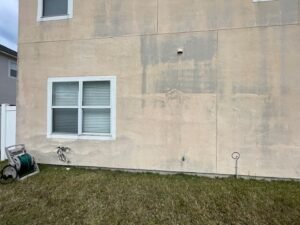
Where Moisture Comes From on Jacksonville & Northeast Florida Stucco Homes
Rain Entering Through Cracks
Hairline and open cracking can provide a pathway. In Northeast Florida this matters more than it would in a drier climate — wind-driven rain doesn’t just fall on a wall, it’s pressed against and into it, so small openings admit more water than their size suggests.
Windows and Doors
Failed perimeter sealant, cracking at corners, and open transitions all give water a way past the finish at the most vulnerable point in the wall. Sealants age under Florida UV and eventually stop adhering, and openings are where that failure has consequences.
Roof and Wall Intersections
Runoff concentrates where a roof meets a wall, and these details depend on flashing to redirect it. Repeated wetting at those junctions can contribute to deposits below. Worth noting: staining near a roofline doesn’t automatically prove a flashing problem — concentrated runoff alone can produce it.
Irrigation and Sprinklers
This one is easy to overlook and easy to check. A sprinkler head striking a stucco wall several times a week is repeatedly wetting masonry on a schedule nobody is watching. If your deposits are in a low band on one elevation, watch a full irrigation cycle before you assume anything more complicated.
Splashback and Drainage
Rain bouncing off a patio, driveway, or hardscape repeatedly wets the lower wall. So does grading that directs water toward the foundation, or landscaping and mulch piled against the stucco. All of these keep the bottom of a wall wetter than the rest of it.
Moisture Moving Through the Masonry Itself
Block, mortar, stucco, and patching materials are porous. Moisture can migrate through them without any defect being present. This doesn’t mean your stucco is defective — it means the material behaves the way masonry behaves.
Does Efflorescence Mean Water Is Getting Into My Wall?
It means moisture has moved through or within the masonry. By itself, it doesn’t tell you where that moisture originated, how much there was, or whether the wall assembly has been damaged.
The distinction that actually matters is between a one-time occurrence and a recurring one.
Limited or One-Time Efflorescence
Can be associated with new masonry drying out, recent stucco or patch repairs curing, or a temporary moisture exposure. Industry guidance notes that when efflorescence appears fairly uniformly across a facade shortly after construction, it generally reflects normal water loss from the building materials — sometimes called new building bloom — and that rain will eventually wash it away.
Recurring Efflorescence
This is the meaningful version. Efflorescence normally becomes lighter and less extensive over time unless there’s an external source of salts or continued water migration through the wall.
So deposits that keep returning after cleaning aren’t telling you the wall needs cleaning again. They’re telling you water is still moving.
Is Efflorescence Dangerous?
The deposit itself is generally an appearance and symptom issue rather than a hazardous material. Efflorescence itself is generally a surface deposit and is not, by itself, evidence of structural failure. It is not mold, and treating it as a health hazard overstates it.
The reason to take it seriously is what it indicates. Persistent moisture in a wall can contribute to coating adhesion problems, recurring staining, corrosion of embedded metal, deterioration of adjacent materials, and loss of bond between stucco and its substrate.
There’s also a related condition worth knowing about: when salts crystallize just beneath a surface rather than on it, the crystal growth can push against the material from within. That’s a different mechanism from the powder you can wipe off, and it’s one reason unresolved moisture is worth addressing rather than managing cosmetically.
Efflorescence vs. Paint Chalking
These get confused constantly, and the difference is easy to check.
Efflorescence is mineral salt carried out of the masonry by moisture. It’s white or off-white regardless of your paint color. It tends to be localized or patterned — following a crack, below an opening, in a band near grade — and it recurs where moisture continues.
Chalking is degradation of the paint film. UV breaks down the binder holding the coating together, and pigment particles release as loose powder. It carries the color of your paint, and it’s usually spread fairly evenly across whichever elevations take the most sun.
A practical check: rub a dark cloth across the deposit. If the powder is white on a beige or gray wall, and the surrounding coating still looks intact, that points toward efflorescence. If the powder comes off tinted with your wall color, and it’s distributed across a whole sun-exposed elevation rather than clustered, that points toward chalking. Look also for what’s nearby — cracks, staining, and moisture signs accompany efflorescence far more often than chalking.
This isn’t a laboratory identification, but it settles most cases. Our guide on exterior paint chalking covers that condition in depth.
Efflorescence vs. Mildew or Algae
Efflorescence is mineral. Mildew and algae are biological growth, and they need moisture too — which is why they sometimes appear in the same areas.
Growth typically presents darker: green, gray, or black, often on shaded and slow-drying elevations. Light-colored growth exists though, and appearance alone doesn’t confirm what something is with certainty.
The practical reason to care: the cleaning approach differs. Biological growth requires treatment rather than just rinsing, while mineral deposits respond to different methods entirely. Using the wrong approach on either one wastes the effort.
Can You Paint Over Efflorescence?
Not while it’s active or while the moisture producing it is unresolved.
Coating over salt deposits means the paint is bonding to loose mineral rather than to the substrate, which compromises adhesion from day one. Beyond that, salts continue forming as long as moisture keeps moving, and they’ll work at the coating from underneath. Moisture in the wall can also contribute to blistering and peeling in that area regardless of how good the product is.
The sequence that works:
- Identify the likely moisture source and address it
- Allow the affected area to dry
- Remove the deposits appropriately for the surface
- Repair cracks, joints, and failed sealant where they’re part of the pathway
- Prepare the masonry surface
- Prime where the substrate and system require it
- Apply the appropriate coating system
Step one is the one that gets skipped, and skipping it is why the same wall gets painted twice in five years. Our guide on why surface preparation matters covers the broader principle.

How Is Efflorescence Removed?
Start with the least aggressive method that works.
Dry brushing handles light deposits on many surfaces. Often it’s enough on its own.
Low-pressure water rinsing can remove what brushing doesn’t. Keep the pressure low — aggressive pressure washing can damage stucco, drive water into the wall, and make the underlying problem worse rather than better.
Proprietary masonry cleaners exist for stubborn deposits and should be used according to the manufacturer’s directions for that specific product and substrate, with adjacent surfaces and landscaping protected and thorough rinsing afterward. Some products require neutralizing. We’d steer homeowners away from improvising acid solutions from general advice — stucco finishes vary, and the wrong product or concentration can etch a surface permanently.
Why Does Efflorescence Keep Coming Back?
Because moisture is still reaching or moving through the masonry.
Efflorescence naturally diminishes over time as available salts are depleted — unless water keeps moving through and bringing more to the surface. So recurrence after a proper cleaning is genuinely useful information rather than a nuisance.
What’s usually still active:
- Rain entering through unrepaired cracking
- Failed sealant at a window, door, or transition
- Irrigation striking the wall on a schedule
- Drainage or grading keeping a lower wall wet
- A roof-to-wall detail concentrating runoff
- Moisture within the masonry that hasn’t been given a chance to dry
- A previous repair that closed the visible symptom without addressing the path
Recurring symptoms are information. A wall that shows deposits after every heavy rain is telling you something specific about that wall.
Can Efflorescence Cause Paint to Peel or Bubble?
The relationship is indirect but real.
Efflorescence doesn’t attack a coating by itself. What causes the trouble is the combination of salt deposits interfering with adhesion and ongoing moisture behind the film. Together those can contribute to blistering, peeling, staining that keeps returning, and finish failure that repeats in the same location no matter how many times it’s addressed.
Coating failure concentrated in the same area as white deposits is a strong signal that moisture is the common cause. Our exterior paint failure guide covers how to distinguish that from other failure modes.
When Should Efflorescence Get Closer Evaluation?
Patterns and recurrence matter more than any single observation. Worth a closer look when:
- Deposits return after cleaning
- The affected area is growing
- Deposits form around cracks
- Deposits repeatedly appear below the same window
- Paint is peeling or bubbling in the same area
- Rust staining appears nearby
- Stucco sounds hollow when tapped
- Stucco is bulging or wavy
- There’s interior staining or dampness on the same wall
- A wall stays chronically wet
- Cracking in the area continues to grow
- Deposits appear after every heavy rain
When Is a Painter the Right Professional?
Within normal painting and stucco repair scope
- Removing visible deposits once the moisture source has been resolved
- Surface preparation and masonry cleaning
- Minor crack repair
- Sealant replacement where appropriate
- Isolated stucco repairs
- Priming and repainting
Where another professional may be appropriate
- Persistent moisture with no explanation visible from the exterior
- Suspected window or flashing failure
- Large-scale delamination
- Structural movement
- Chronic water entry
- Wall-system failures
Depending on what’s present, that may be a building-envelope consultant, a waterproofing contractor, a window or flashing contractor, a specialized stucco contractor, or a structural engineer.
We assess what’s visible from the outside. We don’t perform invasive moisture testing or engineering analysis, and we’d rather say so than guess.
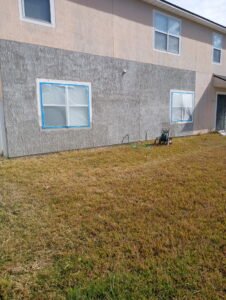
How A New Leaf Evaluates Efflorescence on Jacksonville Stucco Homes
On stucco homes around Jacksonville and Northeast Florida, the distinction that shapes almost every recommendation is whether the deposits look historical or whether moisture is still moving through the wall. A wall that dried out years ago and a wall that’s actively wetting can look nearly identical in a photograph — what separates them is the pattern, the recurrence, and what else is happening around them.
- Determine whether the material appears consistent with efflorescence or with another surface condition — chalking and biological growth get ruled in or out first
- Inspect the surrounding wall rather than just the deposit
- Look for the visible moisture clues: cracks, failed sealant, staining, irrigation exposure, drainage, coating failure, hollow-sounding areas
- Assess whether the condition appears active or historical
- Identify what falls within normal stucco repair and painting scope
- Flag anything that should be evaluated by another professional first
- Clean and prepare the masonry appropriately for its condition
- Repair suitable cracks and defects
- Prime as the substrate and system require
- Apply the coating system suited to the wall
The fourth step is where most of the value sits. Deposits from a repair that cured two years ago and deposits that reappear after every storm call for entirely different responses, and telling them apart comes down to reading the wall and asking the right questions about what it has been doing through recent rain and irrigation cycles. See our Jacksonville stucco painting guide for how coating selection follows from wall condition.
Frequently Asked Questions
What is the white powder on my stucco?
Most likely efflorescence — mineral salts carried out of the masonry by moisture and left behind as the water evaporates at the surface. It’s a moisture clue rather than a growth or a contaminant.
Is efflorescence mold?
No. Efflorescence is a mineral deposit from within the masonry. Mold and mildew are biological growth. They can appear in the same areas because both are associated with moisture, but they’re different materials requiring different treatment.
Is efflorescence the same as paint chalking?
No. Chalking is degradation of the paint film, and the powder carries your paint’s color, usually spread across sun-exposed elevations. Efflorescence is white regardless of paint color and tends to be localized around cracks, openings, or lower walls.
Does efflorescence mean my wall is leaking?
It means moisture has moved through the masonry. It doesn’t identify the source or prove damage. A single occurrence after construction or repairs is often normal drying; deposits that keep returning suggest an active pathway.
Is efflorescence dangerous?
The deposit itself is generally an appearance issue and doesn’t affect structural performance. The persistent moisture it indicates is what’s worth addressing, since it can contribute to coating failure, corrosion, and deterioration over time.
Can I paint over efflorescence?
Not while it’s active. Coating over salt deposits compromises adhesion, and salts keep forming while moisture keeps moving. Resolve the source, let the area dry, remove the deposits, then coat.
Why does efflorescence keep coming back?
Because water is still moving through the wall. Deposits normally diminish over time as available salts deplete — recurrence means something is continuing to bring more to the surface.
Can rain cause efflorescence on stucco?
Rain entering through cracks, failed sealant, or open transitions can. Wind-driven rain makes this more consequential in Northeast Florida, since pressure pushes water into openings that would otherwise shed it.
Can sprinklers cause efflorescence?
Yes, and it’s one of the most common and most fixable causes we see. A head striking the wall repeatedly keeps that section of masonry wet on a schedule. Watch a full irrigation cycle before assuming anything more complicated.
Why is efflorescence appearing below my windows?
Openings depend on sealant and flashing to manage water, and both can fail. Worth remembering that where the deposit appears isn’t necessarily where water entered — it can originate at the head or a jamb and emerge lower.
Can efflorescence make exterior paint peel?
Salt deposits interfere with adhesion, and the moisture producing them can work behind the film. Together those contribute to blistering, peeling, and failure that repeats in the same spot.
Who should inspect recurring efflorescence?
A painting or stucco repair contractor can assess visible exterior conditions and tell you whether it’s within normal repair scope. Persistent unexplained moisture points toward a building-envelope consultant or waterproofing contractor; suspected window or flashing failure toward that trade.
Related Exterior Painting Resources
- Exterior Painting Services
What our exterior process covers, including masonry preparation, repairs, and coating selection. - Exterior Painting Resource Center
Our full library of exterior guides on Florida conditions, coatings, preparation, and maintenance. - Painting Stucco Homes in Jacksonville
How wall condition, porosity, and previous coatings drive the specification for a stucco repaint. - Why Exterior Paint Fails
What peeling, bubbling, and staining indicate, and how to trace a failure to its actual cause. - Why Surface Preparation Matters
Why prep quality determines coating life more than the product on the can does. - Exterior Paint Chalking
How to tell chalking from other white residue, and what heavy chalking means for a repaint.
Seeing White Deposits on Your Stucco?
Before you call anyone, five minutes of documentation will make the conversation far more useful:
- Photograph the deposits close up, and photograph the whole wall area so the pattern is visible
- Note whether they return after rain, and how quickly
- Check for cracks, failed sealant around windows, and peeling paint nearby
- Watch a full irrigation cycle and see whether any heads reach the wall
- Note whether the affected area is growing or staying the same
We can evaluate visible exterior conditions within normal stucco repair and exterior painting scope, tell you what appears to be within that scope, and tell you plainly when something looks like it needs another specialist before painting. Sometimes the answer is that the deposits date from an old repair, the wall has been dry for years, and cleaning and coating is all that’s needed.
If your stucco turns out to be ready for repair and recoating, our Jacksonville exterior painting services cover the masonry preparation, crack and sealant repair, and coating work that follows. A New Leaf Painting Contractors has served Jacksonville and Northeast Florida since 2001.
Call or text 904-615-6599 for an exterior inspection.