
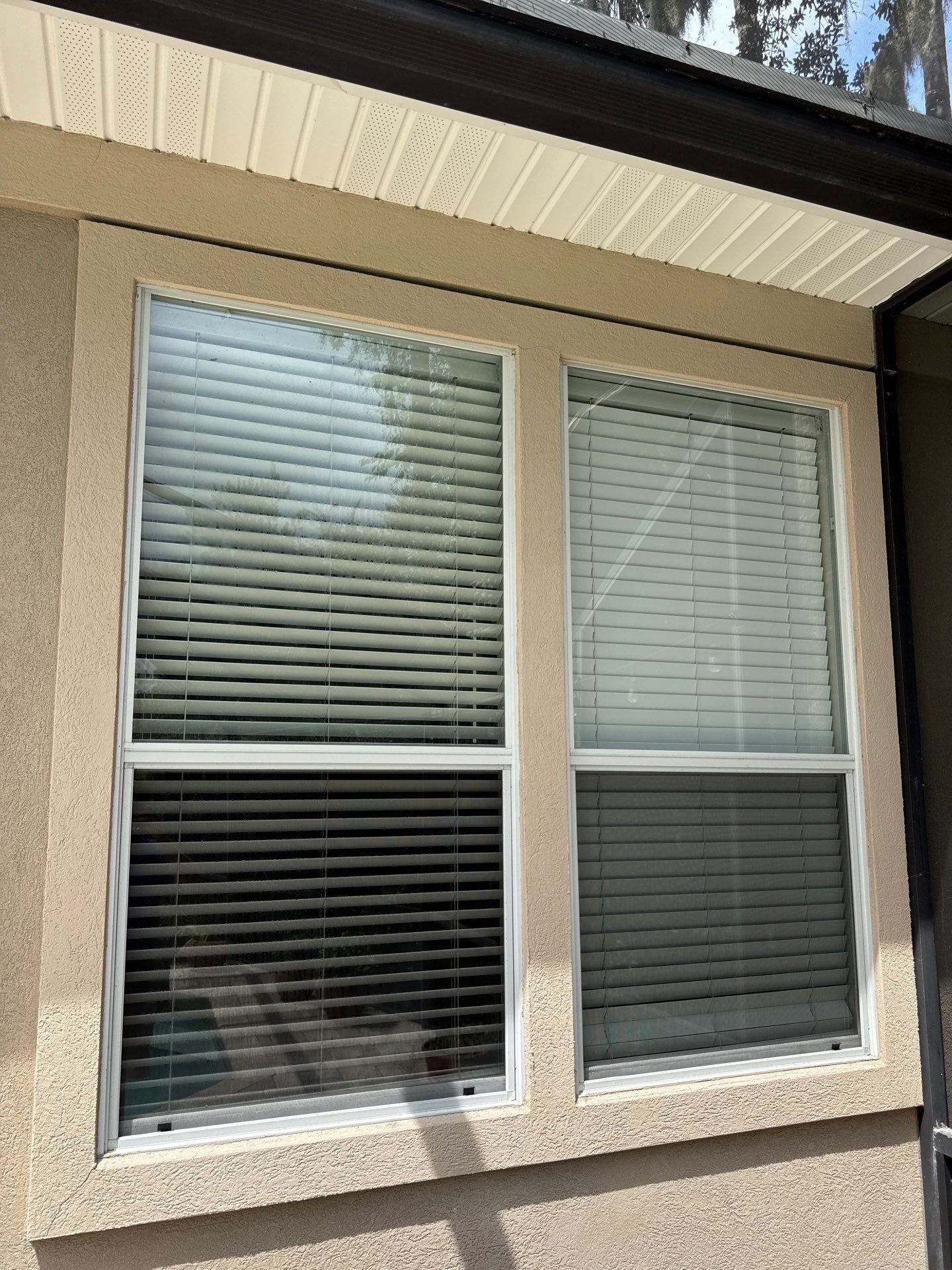
Are Cracks Around Windows and Doors in Stucco a Problem?
You noticed it on the way to the mailbox — a thin diagonal line running out from the upper corner of a window. Or a hairline gap where the stucco meets the frame. Or a faint streak of staining running down beneath the sill that wasn’t there last year.
The question that follows is always the same: is this cosmetic, or is water getting behind the stucco?
Both answers are possible, and the crack alone won’t settle it. Stucco is everywhere in Jacksonville and Northeast Florida, and exterior walls here are routinely exposed to intense UV, sustained heat, high humidity, heavy rainfall, and wind-driven rain. Sealants and transitions around windows and doors are especially important because these openings interrupt the wall assembly and create locations where different materials meet.
Our Jacksonville exterior house painting crews regularly work on stucco homes across Duval, St. Johns, and Clay counties, and cracks around windows and doors are a common condition we encounter during exterior evaluations. Some are minor, stable cracks that require relatively straightforward preparation. Others may involve failed sealant, deteriorated stucco, recurring movement, or conditions that warrant more extensive stucco crack repair before painting — and signs of possible water intrusion may need further evaluation before the wall is repaired and recoated.
Openings deserve this attention for a specific reason. A window or door interrupts an otherwise continuous wall. That interruption can concentrate stress at corners, creates transitions between materials that may move differently, and relies on properly functioning sealants, flashing, and other water-management details to help protect the opening. That’s why the location, direction, history, and surrounding conditions of a crack can matter just as much as its width.
A quick note on scope before we get into it. Much of what causes cracking around an opening is visible from the outside, and much of it falls within normal stucco repair and exterior painting work. Some of it doesn’t. Flashing, window installation details, and what’s happening inside a wall assembly can’t be confirmed by looking at the exterior — and when the signs point that direction, the right move is another specialist before anyone paints. We’ll come back to where that line sits.
What Are You Seeing Around the Window or Door?
Jump to what looks closest to your situation:
- Diagonal crack from a corner — angled line running out from the opening
- Crack above the opening — running across or up from the head
- Crack below the window — at or under the sill
- Separation at the frame — a gap where stucco meets the window
- Failed caulk or sealant — hardened, split, or pulled away
- Water staining — streaks, deposits, or discoloration below the opening
- Recurring crack — returns in the same place after repair
- Peeling or bubbling paint — localized around the opening
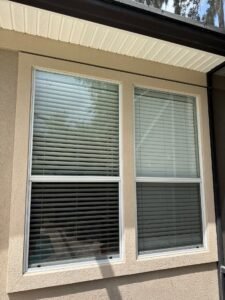
Why Does Stucco Crack Around Windows and Doors?
Several mechanisms are usually at work together.
Stress Concentration
This is the primary one. A continuous wall distributes stress across its surface. Cut a rectangular hole in it and that stress has to route around the opening, concentrating at the corners. When it exceeds what the stucco can resist, the finish relieves it — and the corner is where it starts.
Industry guidance is direct about this: minor cracking at the corners of doors, windows, and other stress points is considered reasonable and should be anticipated. A short diagonal at one window corner is among the most common conditions on any stucco home, and by itself it doesn’t mean the wall is failing.
Building Movement
Ordinary settlement, framing movement, thermal expansion and contraction, and differential movement between the window or door assembly and the surrounding stucco all transfer stress into the finish. In frame construction, framing members twisting and bowing as they dry add another source.
Shrinkage
As excess water leaves the cement mix, stucco shrinks. That shrinkage has to relieve somewhere, and openings become natural release points because they’re already the weakest geometry in the wall.
Material Transitions
Stucco, aluminum or vinyl frames, wood trim, concrete, and sealant all expand and contract at different rates. Where they meet, that difference eventually shows — usually as separation along the joint rather than a crack through the stucco field.
Installation and Detailing
Lath termination, flashing, sealant joint design, and how the stucco was terminated against the frame all affect what happens at an opening over decades. So do previous repairs.
None of these can be diagnosed from crack appearance alone. What crack appearance does is narrow the possibilities.
Common Crack Patterns Around Openings
Diagonal Cracks From Window Corners
What it looks like: A crack running at roughly 45 degrees outward from a corner of the opening, most often the upper corners.
What can cause it: Stress concentration, shrinkage relieving at the weakest point, or movement in the wall or the opening.
What else to inspect: Whether other openings on the same elevation show the same pattern in the same direction. Whether the crack has displacement — one side sitting proud of the other. Whether there’s staining below it. Whether it’s been patched before.
Generally warrants: One short, narrow, stable diagonal is usually a monitoring item that can be addressed during a repaint. Several long diagonals pointing the same direction across multiple openings, or one that’s widening, is a different conversation. Our guide on types of stucco cracks covers how these patterns compare across a whole wall.
Cracks Above Windows or Doors
What it looks like: Cracking running horizontally across the head of the opening, or angling up from the upper corners.
What can cause it: Stress at the upper corners, movement across the head of the opening, transitions where the stucco terminates, or — in some assemblies — movement in the structural element spanning the opening.
What else to inspect: Whether the crack extends the full width of the opening or only near the corners. Whether the window or door has become difficult to operate. Whether there’s staining below the head. Whether the same pattern appears at other openings of similar size.
Generally warrants: A crack above a window does not automatically mean lintel failure, and that claim gets made far too casually. What would make it worth closer evaluation is a combination — a full-width crack with displacement, an opening that’s binding, or the same pattern repeating at several similar spans.
Head details matter here for a water reason too. Water running down a wall above an opening has to be shed away from the frame; where it isn’t, it can track behind the top of the window.
Cracks Below Windows
What it looks like: Cracking at or under the sill, sometimes running downward from the lower corners.
What can cause it: Stress at the lower corners, movement, or deterioration related to water that has been concentrating at the sill.
What else to inspect: This is the location where staining most often accompanies cracking. Look for streaking, white deposits, or coating failure in the area below the opening.
Generally warrants: A key point about anything below a window — water appearing below an opening does not prove the entry point is directly above it. Water travels within a wall assembly along framing, lath, and drainage planes before it emerges. Staining beneath a sill can originate at the head, at a jamb, or somewhere else entirely.
Separation Between Stucco and the Frame
This one is worth understanding clearly, because it’s frequently misidentified as a stucco crack when it isn’t one.
What it looks like: A thin gap running along where the stucco meets the window or door frame. Sealant pulled away from one side. Hardened, split, or missing caulk. Visible separation at trim or a stucco return.
What can cause it: Differential movement between two materials that expand and contract at different rates, plus sealant that has reached the end of its service life. Exterior sealants age, lose elasticity, and eventually stop adhering.
What else to inspect: How much of the perimeter is affected. Whether the separation is at the head, the jambs, the sill, or all around. Whether there’s staining or coating failure adjacent to it.
Generally warrants: Removal and proper resealing with an appropriate exterior sealant rather than a rigid patch. This is a designed movement location — the stucco and the frame are supposed to move relative to each other. Packing a rigid stucco patch compound into that joint removes the relief and the crack reopens, usually within a season or two.

Failed Caulk or Sealant
What it looks like: Sealant that has hardened and cracked, split down its length, pulled cleanly away from one substrate, shrunk back, or gone missing in sections.
What can cause it: Age and UV exposure primarily, sometimes compounded by an original product that wasn’t suited to the joint’s movement, or a joint that was tooled without enough depth to flex.
What else to inspect: Whether the failure is isolated to one run or general around the opening. Whether it coincides with staining below.
Generally warrants: Replacement, and this is normal maintenance rather than a defect. Worth knowing, though: exterior sealant is a maintenance layer, not the wall’s waterproofing. Building Science Corporation makes the point plainly — most exterior cladding systems leak to some degree, wind pressure and capillary action drive water through small gaps, and caulk applied to the outside of a wall is not a long-term water-control strategy. It has to be reapplied periodically, and it works alongside concealed flashing rather than in place of it.
Water Staining Around an Opening
Different stains mean different things, and they need to be read together rather than individually.
Dark streaks. Often ordinary runoff, dirt accumulation, or biological growth following a drainage path down the wall. Sometimes moisture-related. Position and persistence matter more than color.
White powdery deposits. Possible efflorescence — salts carried to the surface as moisture moves through the masonry and evaporates. This is evidence that water has been moving through the wall.
Rust-colored staining. Possible corrosion of metal components behind the finish — lath, fasteners, accessories, or window components. Worth investigating rather than coating over.
Peeling or bubbling paint. Could be adhesion failure, trapped moisture, or another coating condition. Our exterior paint failure guide covers how to distinguish them.
Peeling or Bubbling Paint Localized Around an Opening
What it looks like: Coating failure concentrated in a band around the window or door while the rest of the elevation looks sound.
What can cause it: Moisture behind the film in that specific area, which points toward the opening as a source. Occasionally a preparation issue confined to that area, or a previous repair that was coated before it was ready.
Generally warrants: Localized failure with a clear geographic center is one of the more useful signals available. A wall that’s failing evenly across an elevation has a different explanation than a wall that’s failing in a ring around one window.
Recurring Cracks Around the Same Window
A crack that returns in the exact same location after repair is useful information.
Possible reasons:
- The movement causing it hasn’t stopped
- Rigid patch material was used in a location that needs to move
- The transition should have been treated as a sealant joint, not a stucco repair
- The crack wasn’t properly opened and prepared before filling
- The repair was surface-only
- Water is still entering and continuing to work on the assembly
- There’s a substrate or lath condition the repair never reached
- The opening itself is moving
Is the Crack in the Stucco — or in the Sealant Joint?
This distinction determines the repair, and getting it wrong is why so many window-area repairs fail twice.
A stucco crack is a fracture running through the cementitious finish itself. It’s in the field of the wall, or extends from a corner into the field. The stucco is a rigid material, and a crack in it is a rigid defect.
A failed sealant joint is separation at a transition — where stucco meets a window frame, a door frame, trim, or another material. Nothing is fractured. Two materials that were joined have come apart at the seam because they move at different rates.
Sealant selection for wall-envelope joints isn’t the same decision as picking a tube of painter’s caulk. These joints have movement capability requirements, adhesion requirements for the specific substrates involved, and joint geometry considerations. That’s worth specifying rather than defaulting.
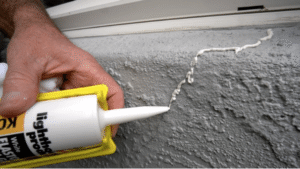
Can Water Get In Around a Cracked Stucco Window?
It can, and this is where Jacksonville conditions raise the stakes.
Openings are part of a wall’s water-management system rather than solid barriers. Building Science Corporation notes that flashings are needed wherever a drainage plane is interrupted — which openings, by definition, do — and that pan flashing below a window or door exists specifically to collect water that leaks through or around the opening and direct it back out.
That’s the design intent. Where it isn’t present or isn’t working, cracks, failed sealant, and open transitions become pathways.
Northeast Florida makes this more consequential than it would be in a drier climate. Heavy rainfall and wind-driven rain don’t just fall on a wall — pressure pushes water against and into openings that would shed it under gentler conditions.
There’s a Florida-specific finding worth knowing. A building enclosure conference paper examining stucco failures reported that windows in many Florida buildings were found set into masonry openings without sill, head, or jamb flashing, with sealant applied over the intersection instead — and that in the installations examined, this arrangement was largely unsuccessful at preventing water intrusion once the sealants had aged several years.
That’s an observation about a pattern, not a statement about your house. Whether flashing exists behind your stucco can’t be determined by looking at the exterior — it’s concealed by definition. What it does mean is that if your home was built this way, the sealant around your windows is carrying more responsibility than sealant is designed to carry alone, and letting it fail has consequences beyond appearance.
Symptoms worth noticing:
- Staining below window corners
- Efflorescence near the opening
- Peeling or bubbling paint concentrated around the frame
- Rust staining
- Cracks that reopen after repair
- Musty or damp interior areas on the same wall
- Soft or deteriorated trim, sill, or interior finish materials
- Hollow-sounding stucco near the opening
To be clear: not every exterior stain means active leakage. Streaking below a window is often just dirt following the same path water takes. Interpretation comes from combinations, not single observations.
Can I Just Caulk the Crack Around My Window?
Sometimes. Not always.
Sealant is often the right answer when:
- The condition is at the perimeter joint between stucco and the frame
- It’s a transition between dissimilar materials
- Existing sealant has failed and needs replacement
- The location is designed to accommodate movement
Sealant is likely not the full answer when:
- The crack runs through the stucco field rather than along a joint
- Stucco near the opening is bulging or sounds hollow
- There’s a long diagonal crack with displacement
- Staining, efflorescence, or rust accompanies the crack
- The same area has failed repeatedly
- There’s reason to suspect a flashing or substrate condition
The failure mode to avoid: using sealant to close a symptom while the actual water path stays open. Exterior sealant maintains exposed joints. It doesn’t substitute for concealed flashing, and it can’t correct a drainage problem behind the finish.
Why Do Window-Corner Cracks Keep Coming Back?
Because something is still happening, and the last repair addressed the visible part of it.
A version we frequently encounter is a transition that was treated as a stucco defect. Rigid compound packed into a joint that needs to move gives the movement nowhere to go, so it cracks again along the same line. The repair was executed competently — it was just the wrong repair for that location.
Another possibility is that the crack was filled at the surface without being opened and prepared, leaving the patch nothing to key into.
A third is that water is still getting in, and it’s continuing to work on the lath, fasteners, or substrate behind the finish while the surface gets patched every few years.
When Is a Crack Around a Window Probably Cosmetic?
Conditions that generally make a cosmetic or stable explanation more plausible:
- Very narrow, and visible mainly in angled light
- Isolated to one corner of one opening
- Unchanged for years
- No staining anywhere around or below the opening
- No displacement across the crack
- Sealant around the frame is still intact and flexible
- No loose or hollow-sounding stucco
- No interior symptoms on that wall
- No history of the same repair failing
That combination doesn’t guarantee anything — but it’s the profile of the most common and least consequential version of this condition, and it describes a great many Jacksonville stucco homes.

When Should a Crack Around an Opening Get Closer Evaluation?
Combinations matter more than any single item:
- The crack is growing in length or width
- It reopens after being properly repaired
- Significant diagonal cracking, particularly long runs
- Displacement across the crack
- Multiple openings showing the same pattern in the same direction
- Sealant failed around much or all of the frame
- Staining beneath the opening
- Efflorescence or rust staining
- Peeling or bubbling paint concentrated around the opening
- Interior staining, dampness, or musty odor on the same wall
- Loose or hollow-sounding stucco near the opening
- Visible movement in the window or door itself
- The window or door has become difficult to operate
- Visible flashing or drainage concerns at the head or sill
Should Cracks Around Windows Be Repaired Before Painting?
Generally yes when the condition is open or active — with nuance by type:
- Stable minor cracking can often be handled within proper surface preparation and the coating system
- Failed sealant joints should be removed, prepared, and resealed with an appropriate product
- Open or recurring cracks need proper repair, and recurring ones need the reason understood first
- Loose or hollow stucco has to be addressed — a coating over unbonded material fails with the material
- Moisture-related conditions need the source found before anything is applied
- Significant movement may warrant evaluation outside a painting contractor’s scope
Our guide on why surface preparation matters covers how prep quality drives coating life generally.
Can Elastomeric Paint Fix Cracks Around Windows?
Elastomeric coatings can bridge certain small, stable surface cracks depending on the specific product and how it’s specified. That’s a real capability within a correctly designed system.
What they cannot do: repair a failed perimeter sealant joint, correct flashing, stop structural movement, reattach delaminated stucco, resolve an active water entry point, or permanently conceal a crack that’s still opening.
Around an opening in particular, a high-build coating applied over a failed sealant joint tends to produce a worse outcome than doing nothing — it bridges the gap visually while the joint underneath keeps moving and keeps admitting water. Our comparison of elastomeric vs. acrylic paint for stucco covers when each system genuinely fits.
When Is a Painter the Right Professional?
Normal painting and stucco repair scope
- Stable surface cracking
- Isolated stucco patching and texture repair
- Failed or failing coatings
- Perimeter sealant replacement where appropriate
- Preparation and priming
- Exterior repainting
Conditions where additional evaluation may be appropriate
- Suspected window installation or flashing failure
- Persistent water intrusion the exterior can’t explain
- Significant structural movement
- Extensive stucco delamination
- Large-scale wall-system problems
Depending on what’s present, the right professional may be a window contractor, a building-envelope consultant, a waterproofing professional, a specialized stucco contractor, or a structural engineer.
We inspect what’s visible from the exterior. We don’t perform engineering analysis or invasive wall diagnostics, and we’d rather tell you when something is outside what a visual exterior inspection can answer than guess at it.
How A New Leaf Evaluates Stucco Cracks Around Windows & Doors
The crack you called about is where we start, not where we stop. What tells us more is the rest of the opening and what the neighboring openings look like.
- Look at the entire opening — head, both jambs, and sill — rather than the one crack that got your attention
- Inspect the surrounding stucco for the wider crack pattern, texture differences, and evidence of previous repair
- Check perimeter sealant condition on all four sides, since failure is often partial
- Look for staining, efflorescence, rust bleed, coating failure, and areas that sound hollow when tapped
- Check the other openings on the same elevation for the same pattern, which distinguishes a localized condition from a wall-wide one
- Determine whether what’s visible falls within normal stucco repair and painting scope
- Flag anything that should be evaluated by another trade before we proceed
- Repair suitable stucco defects, and treat movement joints as joints rather than as defects
- Prime repairs appropriately for the coating system going over them
- Apply the system suited to the wall’s condition
The step homeowners find most useful is the fifth one. A single window with cracking and failed sealant is usually a maintenance conversation. The same pattern repeating at four openings on one elevation is telling us something about that elevation, and it changes what we recommend.
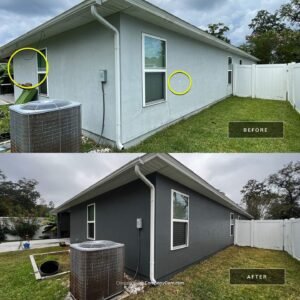
What We Commonly Find on Jacksonville Stucco Homes
- Stable hairline cracking at corners — narrow, unchanged for years, no staining. Usually handled within preparation and the coating system.
- Failed perimeter sealant — hardened, split, or pulled away, often on only one or two sides of the frame. Normal maintenance, and one of the more consequential things to keep current.
- Previous repairs that have reopened — a crack running along an old patch line, frequently because a movement joint was repaired as though it were a rigid defect.
- Localized coating failure — peeling or bubbling in a band around one opening while the rest of the elevation holds. A geographic center like that is a useful signal.
- Conditions warranting further evaluation — displacement across a crack, hollow-sounding stucco, staining with efflorescence or rust, interior symptoms, or the same pattern at several openings.
For substrate specifics, see our Jacksonville stucco painting guide.
Frequently Asked Questions
Are cracks around windows in stucco normal?
Minor cracking at the corners of windows and doors is considered reasonable in cement-based finishes and is specifically identified by industry guidance as something to anticipate. That doesn’t make every crack around an opening insignificant — behavior over time and accompanying symptoms matter more than the crack’s existence.
Why do stucco cracks start at window corners?
Openings interrupt the wall, and stress that would otherwise distribute across a continuous surface concentrates at the corners instead. When it exceeds what the stucco can resist, the corner is where the finish gives first.
Are diagonal cracks from windows serious?
Usually not on their own. A short, narrow, stable diagonal from one corner is among the most common conditions on stucco homes. Long diagonals, displacement across the crack, the same pattern at multiple openings, or cracking with staining are the versions worth evaluating further.
Can water leak through cracks around stucco windows?
It can. Openings are the point where a wall’s drainage plane is interrupted, which is why flashing details exist there. Cracks, failed sealant, and open transitions can all provide pathways — and wind-driven rain makes small openings more consequential here than in drier climates.
Should I caulk cracks around a window?
Appropriate for perimeter joints between stucco and the frame, and for replacing sealant that has failed. Not appropriate for a crack running through the stucco field, for loose or hollow stucco, or where the crack is a symptom of water entering somewhere else.
Why is the caulk pulling away from my window frame?
Exterior sealants age, lose elasticity, and eventually stop adhering — particularly under Florida UV. It can also indicate that the original product wasn’t suited to the movement at that joint, or that the joint geometry didn’t allow it to flex properly.
Why does the crack around my window keep coming back?
Most often because a transition that needs to move was repaired with rigid material. Also common: the crack was filled at the surface without preparation, or water is still entering and continuing to work behind the finish.
Can I paint over cracks around windows?
Stable hairline cracking can often be addressed within proper preparation and the coating system. Open cracks, failed sealant joints, loose stucco, and anything with moisture signs should be repaired first — paint over an active condition conceals it without correcting it.
Will elastomeric paint fix window-corner cracks?
It may bridge small, stable surface cracks depending on the product and specification. It cannot repair a failed sealant joint, correct flashing, stop movement, or resolve water entry. Around openings specifically, a high-build coating over a failed joint can make the situation harder to diagnose later.
Who should inspect cracking around a stucco window?
A painting or stucco repair contractor can assess what’s visible and tell you whether it’s within normal repair scope. Suspected flashing or window installation failure points toward a window contractor or building-envelope consultant; persistent unexplained moisture toward a waterproofing professional; significant movement toward a structural engineer.
Related Exterior Painting Resources
- Exterior Painting Services
What our exterior process covers, including stucco preparation, repairs, and sealant work. - Exterior Painting Resource Center
Our full library of exterior guides on Florida conditions, coatings, preparation, and maintenance. - Painting Stucco Homes in Jacksonville
How wall condition, porosity, and previous coatings drive the specification for a stucco repaint. - Elastomeric vs. Acrylic Paint for Stucco
When a high-build system genuinely earns its cost, and when a masonry acrylic is the better fit. - Why Exterior Paint Fails
What peeling, bubbling, and staining indicate, and how to trace a failure to its actual cause. - Why Surface Preparation Matters
Why prep quality determines coating life more than the product on the can does.
Not Sure What You’re Looking At?
Before you call anyone, spend five minutes gathering better information than a description can provide:
- Photograph the crack with something for scale beside it — a ruler, a quarter, a pen
- Photograph the entire opening, not just the crack, so the pattern is visible
- Get a shot of the wall below the opening, whether or not you see staining
- Note the condition of the sealant on all four sides
- Date the photos, and take another set in a few months
That gives whoever looks at it — us or someone else — far more to work with than a phone call ever will.
We can evaluate visible exterior conditions as part of normal stucco repair and exterior painting scope, tell you what appears to be within that scope, and tell you plainly when something looks like it needs another specialist before painting. Sometimes the answer is that the crack has been stable for years and can simply be handled during your next repaint.
A New Leaf Painting Contractors has served Jacksonville and Northeast Florida since 2001.
Call or text 904-615-6599 for an exterior inspection.