
Why Is My Stucco Cracking? Types of Stucco Cracks Jacksonville Homeowners Should Know
You walked around the side of the house and there it was — a crack in the stucco that may have been there for months. Maybe longer. Now you’re standing in front of it wondering whether it’s nothing, or whether it’s the kind of thing that gets expensive if you ignore it.
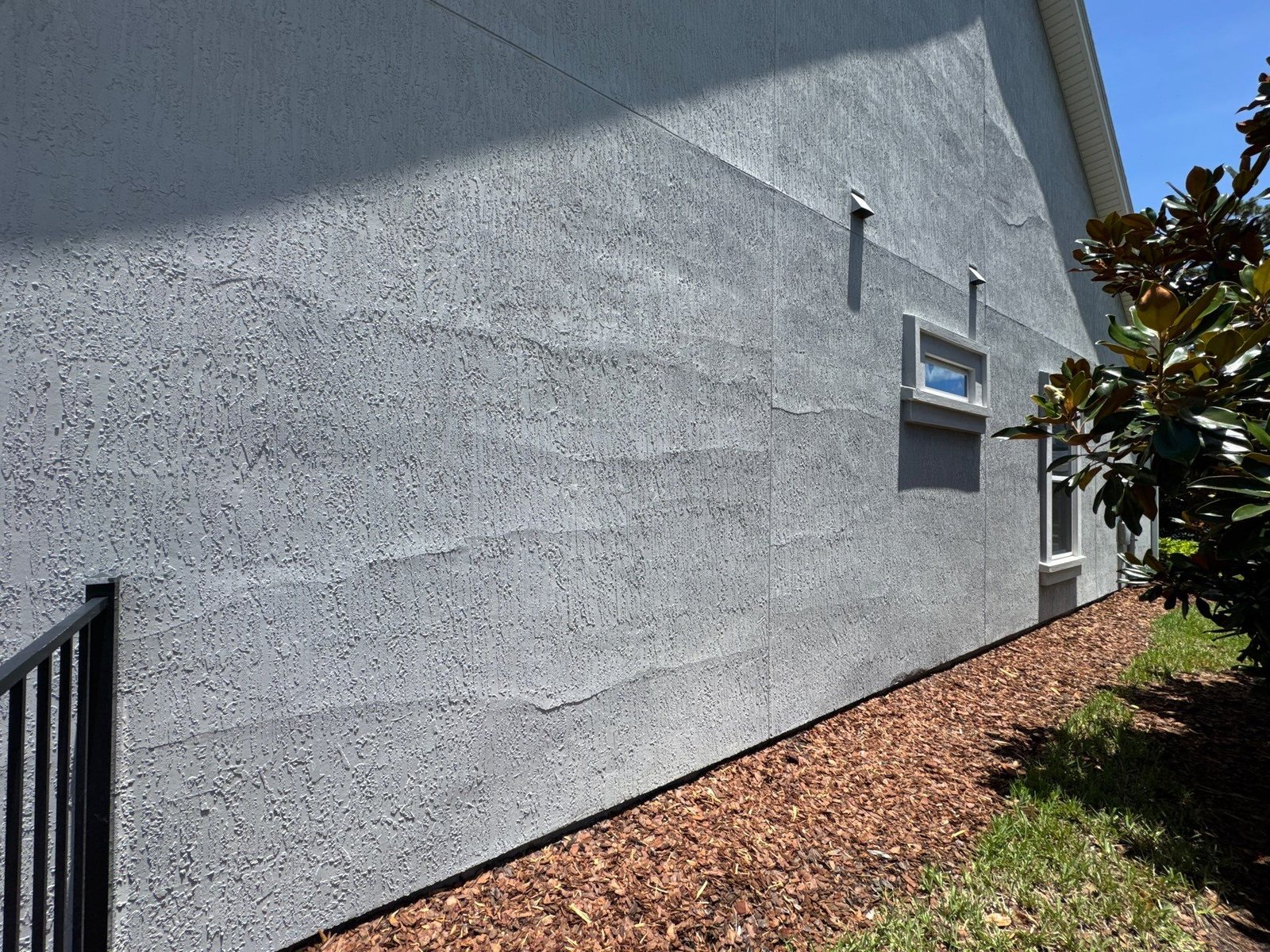
Both are possible, and the crack itself won’t tell you which. What will tell you more is the pattern: its shape, width, direction, where it sits on the wall, whether it’s changing, and whether it’s been repaired before. As exterior house painters in Jacksonville, FL, we regularly evaluate stucco homes across Duval, St. Johns, and Clay counties before repainting. We see cracking that ranges from minor surface conditions to areas that deserve closer evaluation or stucco crack repair before painting.
Some cracks in Jacksonville stucco homes are cosmetic surface conditions that have remained stable for years. Others reopen after previous repairs, extend from window or door corners, appear alongside staining or other signs of moisture, or may reflect movement occurring behind the finish.
Understanding which condition you’re looking at matters more than simply knowing how to fill the crack — because one of the biggest mistakes with stucco repair is treating the visible crack without first considering why it formed, whether it is changing, and what is happening around it. Painting should come after that determination, not before it.
Are Cracks in Stucco Normal?
Some cracking is expected in cement-based exterior finishes. That’s not a contractor excuse — it’s the material’s documented behavior. The Stucco Manufacturers Association states plainly that minor cracking at the corners of doors, windows, and other stress points is reasonable and should be anticipated.
Stucco is essentially a thin, relatively brittle cementitious shell applied over a structure. It was never intended to be a structural material. When the building beneath it moves — and every building moves — that stress transfers into the stucco, and the stucco relieves it the only way it can.
But “some cracking is normal” is not the same as “every crack is fine.” What separates the two is usually behavior over time.
Stable Cracks
A stable crack has stayed essentially unchanged. Same length, same width, no staining developing around it, no new cracks joining it. A hairline that’s looked the same since you bought the house in 2014 is telling you something different than one that appeared last spring.
Active or Recurring Cracks
An active crack is still moving — widening, lengthening, or reopening after it’s been repaired. This is the category worth paying attention to, because a crack that returns in the same place after a proper repair is giving you real information: whatever caused it hasn’t stopped.
One crack by itself tells us less than the pattern around it.

What Causes Stucco to Crack?
There’s rarely one answer. Common contributors include:
- Drying shrinkage. As excess water leaves the cement mix, the material shrinks. The outer face shrinks more than the inner portion, which is bonded to the substrate and restrained — and that tension produces cracking near the surface.
- Curing conditions. Rapid moisture loss during curing, common on hot, windy days, produces its own cracking pattern.
- Mix and application issues. Excessive thickness applied in a single pass, poor proportioning, or insufficient bond between coats.
- Building settlement and movement. Ordinary, ongoing, and unavoidable.
- Differential movement between materials. Stucco, wood, concrete, and metal all expand and contract at different rates.
- Control joint problems. Missing joints, too few, or joints placed at intervals the stucco can’t accommodate.
- Lath or substrate movement. In frame construction, framing members twisting, warping, or bowing as they dry transfer stress into the finish.
- Openings. Windows, doors, and garage openings interrupt the wall and concentrate stress at their corners.
- Failed sealant joints. Perimeter sealant that has hardened or pulled away.
- Impact damage. Ladders, equipment, storm debris.
- Moisture in the assembly. Water behind the finish can rot wood lath, corrode metal lath and fasteners, and cause the stucco to lose its bond to the substrate.
- Previous repairs. A rigid patch over a moving crack, incompatible materials, or a surface-only fill.
What Kind of Stucco Crack Are You Seeing?
Jump to the crack type that looks closest to what’s on your wall:
- Hairline cracks — very narrow, hard to see except in angled light
- Spider / map cracking — a web of fine interconnected lines
- Vertical cracks — running up and down the wall
- Horizontal cracks — running side to side
- Diagonal cracks — angled, often from an opening
- Cracks around windows and doors — at corners or along frames
- Cracks where materials meet — along a seam between two surfaces
- Recurring cracks — returning in the same line after repair
Common Types of Stucco Cracks
A crack’s appearance narrows the possibilities. It doesn’t confirm the cause — that takes looking at the wall as a whole.
Hairline Cracks
What it looks like: Very narrow, often barely visible until light hits it at an angle. Frequently only detectable up close.
Where you see it: Almost anywhere on a stucco wall, often distributed rather than concentrated.
Possible causes: Drying shrinkage, minor building movement, ordinary aging of the finish.
How concerning: Generally the least concerning category — but not automatically dismissible. A hairline deserves closer attention if it’s widening, repeatedly returning after repair, developing staining, appearing at an opening, or joining into a larger pattern.
What normally happens next: Stable hairline cracking is often addressed as part of surface preparation and the coating system. What isn’t a proper repair is simply loading paint into the crack and moving on — that fills the visible gap without addressing anything below it.
Spider Cracks and Map Cracking
What it looks like: A dense network of interconnected fine cracks, resembling a spider web, a road map, or dried mud. Sometimes called crazing or checking.
Where you see it: Across a broad area of finish rather than in one line. Often more visible on certain elevations than others.
Possible causes: Typically associated with the finish coat rather than the structure — rapid moisture loss during curing, an overly rich finish mix, or application conditions. It’s commonly a surface-level pattern.
How concerning: Usually less concerning structurally, but it changes how the wall should be prepared and coated.
What normally happens next: Widespread crazing should be evaluated as a pattern and addressed with an appropriate preparation and coating approach. Nobody is patching a hundred individual crazing lines — and attempting to would produce a worse-looking wall than leaving them.
Vertical Cracks
What it looks like: A crack running roughly up and down, sometimes following a straight line, sometimes wandering.
Where you see it: Often at or near where control joints should be, at material transitions, or in longer wall runs.
Possible causes: Shrinkage relieving itself, control joint placement or absence, substrate conditions, differential movement, or settlement depending on the broader context.
How concerning: Highly variable. A short vertical hairline in the middle of a wall field is a different condition from a long vertical crack running most of a wall’s height with displacement across it.
What normally happens next: Location and progression drive the answer. Vertical cracking does not automatically mean foundation damage — that’s a claim made far too casually in this industry — but a long, widening, or displaced vertical crack warrants more than a patch.
Horizontal Cracks
What it looks like: A crack running roughly side to side, sometimes extending a considerable distance.
Where you see it: Often at floor lines, at transitions between wall components, or where lath terminates.
Possible causes: Movement between wall components, lath or substrate conditions, joint placement, water-related deterioration behind the finish, or building movement.
How concerning: Horizontal cracking generally warrants closer attention than an equivalent hairline elsewhere. That’s not a diagnosis — it’s a reflection of what tends to produce it.
What normally happens next: A long horizontal crack, particularly one accompanied by staining, bulging, or hollow-sounding areas, deserves evaluation before anyone specifies a repair or a coating.
Diagonal Cracks
What it looks like: A crack running at an angle across the wall, frequently at roughly 45 degrees.
Where you see it: Most commonly extending outward from the corner of a window, door, or garage opening.
Possible causes: Stress concentration at openings. When a wall is interrupted by a penetration, the corners become the points where stress concentrates, and that’s where the finish gives.
How concerning: A short diagonal from a window corner is among the most common cracks on any stucco home and is specifically identified by the industry as anticipated. Long diagonal cracking, cracking from multiple openings in a consistent direction, or diagonal cracking with displacement is a different conversation.
What normally happens next: Look at whether it’s one opening or several, whether the pattern is consistent across the elevation, and whether there’s any sign of moisture or movement accompanying it.
Cracks Around Windows and Doors
This deserves its own attention, because openings are where the most consequential stucco problems tend to start.
What it looks like: Diagonal cracks from corners, separation running along the frame perimeter, gaps where sealant has hardened or pulled away, sometimes accompanied by staining below.
Possible causes: Stress concentration, failed perimeter sealant, flashing or transition detailing, movement of the opening itself, or water that has been entering at the transition and working on the assembly behind.
How concerning: Genuinely variable, and this is where a visible crack is most likely to be only part of the problem. Water entering at a window transition doesn’t always show up at the point of entry — it travels, and the visible symptom can appear well below or beside where it actually got in.
What normally happens next: Sealant condition, flashing where visible, staining patterns, interior conditions near the same location, and whether the crack has been repaired before. Caulking a crack at a window is sometimes appropriate and sometimes just concealing an assembly problem — which of those it is depends on what else is going on.
Cracks Where Two Materials Meet
What it looks like: Cracking or separation following the line where stucco meets something else.
Where you see it: Stucco to concrete, stucco to wood trim, stucco to siding, at additions, around columns, at masonry transitions, along decorative bands.
Possible causes: Differential movement. Two materials with different expansion rates, bonded together, will eventually separate at the seam. This isn’t a defect so much as physics.
How concerning: Usually more a maintenance condition than a structural one — but a persistent water path if left open.
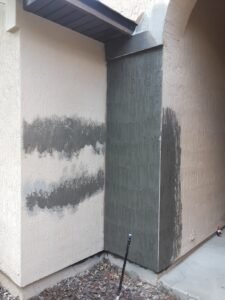
What normally happens next: This is the clearest example of why rigid patch material fails repeatedly. Filling a moving transition with a hard compound gives the movement nowhere to go, and it cracks again in the same line within a season or two. These locations typically call for appropriate flexible sealant and periodic maintenance rather than a rigid repair.
Cracks That Keep Coming Back After Repair
A crack returning in the exact same location is one of the more useful pieces of information a wall can give you.
Possible reasons:
- The movement causing it never stopped
- The patch material was too rigid for what that location does
- The crack wasn’t properly opened and prepared before filling
- The repair was surface-only, sitting on top rather than keying in
- The location is a material transition that will always move
- Water is still entering and continuing to work on the assembly
- There’s a substrate condition below the finish that the repair never touched
A crack that keeps returning after patching is giving you useful information. The productive question isn’t how to fill it again — it’s why the last two attempts didn’t hold.
How Can I Tell if a Stucco Crack Is Serious?
Not from a photograph, and not from width alone. What’s useful is looking for combinations of symptoms, because a crack accompanied by other signs means something different than the same crack in isolation.
Conditions that warrant closer evaluation:
- The crack is getting wider or longer over time
- Multiple cracks form a consistent pattern across an elevation
- Large diagonal cracking, particularly from several openings
- Significant horizontal cracking
- Cracks reopening after they’ve been properly repaired
- Bulging or wavy areas in the stucco surface
- Areas that sound hollow when tapped
- Rust staining bleeding from or near the crack
- Efflorescence — white powdery mineral deposits
- Moisture staining running below the crack
- Damp interior surfaces or staining on the inside of the same wall
- Pieces of stucco becoming loose or falling away
- Visible displacement, where one side of the crack sits proud of the other
We pay close attention when cracking comes with staining, rust, efflorescence, or loose material. Those conditions can indicate that moisture, corrosion, loss of bond, or another underlying wall condition may also be involved — which makes the crack part of a larger picture rather than the whole of it.
Does the Width of a Stucco Crack Matter?
It’s one input, not the answer. A narrow crack that has been growing steadily for two years may matter considerably more than a wider one that’s been unchanged since the house was built.
What’s more useful than width is tracking. If you’re unsure about a crack:
- Photograph it with something for scale — a ruler, a quarter, a pen — held right beside it
- Date the photo so you have a reference point
- Mark the ends lightly in pencil so you can see whether it’s lengthening
- Re-photograph every few months, and after any significant storm season
That five-minute habit gives a contractor or engineer far better information than a description ever will. It also frequently produces the reassuring answer: nothing has changed in eighteen months.
We’d rather a homeowner have documentation than a number. Universal thresholds — “anything over a certain width is structural” — get repeated constantly in this industry without the context that makes them meaningful.
Can Water Get Through Stucco Cracks?
Yes, and this is where Jacksonville conditions matter more than anywhere else in this article.
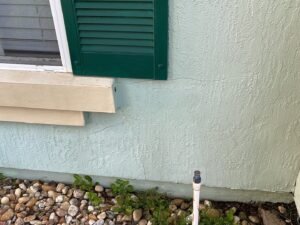
Stucco isn’t a standalone waterproof barrier. It’s one component of an exterior wall assembly designed to manage water, and cracks can provide a pathway past the finish into the layers behind it. Northeast Florida’s heavy rainfall and wind-driven rain make that pathway more consequential than it would be in a drier climate — driving rain doesn’t just fall on a wall, it’s pushed against and into it.
The Portland Cement Association notes that much of the damage to portland cement plaster results from water infiltration through cracks, roofs, chimneys, and window and door openings. Water that gets behind the plaster can rot wood lath, rust metal lath and fasteners, and cause the plaster to delaminate from its substrate.
That’s the real risk with an ignored crack — not the crack, but what the water reaching through it does over several years.
Symptoms worth noticing:
- Efflorescence — white powdery deposits, which indicate moisture has been moving through the masonry and depositing salts at the surface
- Staining running below a crack, opening, or transition
- Peeling or bubbling paint near the crack while the surrounding wall holds fine
- Rust bleed from fasteners or lath behind the finish
- Damp interior surfaces on the same wall
- Recurring deterioration in one location no matter how often it’s addressed
One thing worth understanding: the visible crack is not always where the water got in. Water travels along framing, lath, and drainage planes before it appears. That’s exactly why tracing the source matters more than sealing the symptom.
Should Stucco Cracks Be Repaired Before Painting?
The governing principle: don’t use new paint as a substitute for determining why a crack exists.
What that means in practice varies by what’s there:
- Stable hairline cracking can often be addressed within a properly selected preparation and coating system
- Larger or open cracks should be prepared and repaired with materials appropriate to the location’s behavior
- Recurring cracks need the reason identified before another repair is attempted
- Loose or delaminated stucco has to be addressed — a coating over material that isn’t bonded fails with the material
- Failed sealant joints get removed and replaced, not painted over
- Moisture-related problems need the source found first, full stop
- Bare repairs and fresh patches require appropriate priming before the finish system
A coating may bridge certain very small, stable cracks depending on the product and specification. It cannot stop continued building movement, repair loose stucco underneath, or dry out a wall that’s still getting wet.
Can Elastomeric Paint Fix Stucco Cracks?
This is probably the single most common misconception we encounter, and it costs Jacksonville homeowners real money.
What elastomeric coatings can do: provide a flexible, high-build coating film; bridge certain small, stable surface cracks depending on the specific product and how it’s specified; and improve weather resistance when used within a correctly designed system.
What they cannot do: stabilize a moving wall, repair failed stucco, reattach delaminated material, correct structural movement, resolve an active moisture source, or permanently conceal a crack that’s still opening.
These are legitimate products with real applications. The problem isn’t elastomeric coatings — it’s specifying them as a universal answer to cracking, which adds cost without adding performance when the wall’s condition doesn’t call for it, and can mask a problem that needed attention. Our stucco painting guide covers coating selection in more depth.
When Is a Painter the Right Professional — and When Is Someone Else?
Being clear about this is more useful to you than pretending we can handle everything.
A painting and stucco repair contractor commonly handles
- Minor and stable cracking
- Surface preparation and coating removal
- Isolated stucco repairs and patching
- Failed or failing coatings
- Cosmetic damage
- Texture matching on repaired areas
- Sealant replacement where appropriate
- Priming and repainting
Additional evaluation is worth considering when there’s
- Major displacement across a crack
- Cracking that’s progressing noticeably over months
- Signs of significant structural movement — binding doors, out-of-level floors, interior separation at corners
- Extensive delamination or large hollow-sounding areas
- Persistent moisture with no explanation the exterior can account for
- Suspected foundation movement
- Significant window or flashing failure
- Wall-system failure across a large area
Depending on what’s present, the right professional may be a structural engineer, a building-envelope consultant, a specialized stucco contractor, a window or flashing professional, or a waterproofing contractor.
Sometimes the correct recommendation is not to paint an area until something underlying gets evaluated. We’d rather say that than take a deposit on a job that’s going to fail.
How We Approach Stucco Cracks Before Exterior Painting
Conceptually, the sequence looks like this:
- Inspect the visible crack patterns across every elevation, not just the one you called about
- Look for associated conditions — staining, coating failure, loose or hollow material, rust, efflorescence, moisture indicators
- Determine whether the conditions appear suitable for normal repair and painting
- Identify anything that should be evaluated outside our scope before we proceed
- Repair the stucco defects that are appropriate for us to address, with materials matched to the location’s behavior
- Match texture as closely as practical
- Prime repairs and bare masonry appropriately
- Apply the coating system suited to the wall’s condition
On projects where conditions warrant it, we specify our Stucco-Armor Hybrid System — a Sherwin-Williams Loxon XP masonry base with an Emerald Rain Refresh topcoat. That’s a system we use where it fits, not a default. Plenty of sound stucco homes are properly served by a quality masonry acrylic, and we’ll tell you when that’s the case. See our stucco repair services and exterior painting services for scope.
Stucco Crack Identification Quick Guide
These are starting points for a conversation, not remote diagnoses.
| Crack or Symptom | What It Looks Like | Possible Cause | Recommended Next Step |
|---|---|---|---|
| Hairline | Very narrow, often hard to see except in raking light | Shrinkage, minor movement, aging | Note location; address in prep if stable |
| Spider / map | Interconnected web across a broad area | Curing or application conditions; finish-coat related | Evaluate as a pattern, not individually |
| Vertical | Runs up and down, may follow a line | Shrinkage, joint placement, movement | Check length, displacement, progression |
| Horizontal | Runs side to side, sometimes long | Component movement, substrate or moisture conditions | Warrants closer evaluation, especially if long |
| Diagonal | Angled, often from an opening corner | Stress concentration at penetrations | Assess how many openings and whether consistent |
| Window / door crack | At corners or along frame perimeter | Stress, failed sealant, flashing or transition issue | Check sealant, staining, interior conditions |
| Recurring crack | Returns in the same line after repair | Continued movement or wrong repair approach | Understand why before repairing again |
| Crack with rust staining | Orange-brown bleed at or below the crack | Corrosion of lath or fasteners behind the finish | Investigate moisture; don’t coat over |
| Crack with white deposits | Powdery white residue at or near the crack | Efflorescence — moisture moving through the masonry | Identify moisture source before any coating |
| Bulging or hollow areas | Wavy surface; sounds hollow when tapped | Possible delamination from the substrate | Evaluate before repair or coating |
Frequently Asked Questions
Are small cracks in stucco normal?
Some cracking is expected in cement-based finishes, and industry guidance specifically identifies minor cracking at window and door corners and other stress points as anticipated. That doesn’t mean every crack should be ignored — behavior over time matters more than the crack’s existence.
Should I worry about hairline stucco cracks?
Usually not, if they’re stable and not accompanied by staining, rust, efflorescence, or loose material. Worth attention if a hairline is widening, lengthening, repeatedly reopening after repair, or clustered around an opening.
Why does stucco crack around windows?
Openings interrupt the wall and concentrate stress at their corners, so that’s where the finish gives first. Failed perimeter sealant and water entering at the transition can compound it. This is the most common crack location on stucco homes.
Can I just caulk a stucco crack?
Sometimes appropriate, sometimes concealment. Sealant is the right answer at material transitions and movement joints. It’s the wrong answer for a crack in an open wall field, for delaminated stucco, or for a crack that’s a symptom of water getting in somewhere else.
Will exterior paint cover stucco cracks?
Paint may hide a very fine, stable crack temporarily. It won’t stop movement, close an open crack, or address moisture — and a crack that’s still working will telegraph back through, usually within a season or two.
Can elastomeric paint stop stucco cracks?
No. Elastomeric coatings can bridge certain small, stable surface cracks depending on product and specification, but they can’t stabilize a moving wall, repair failed stucco, or resolve an active moisture source. They’re one tool used in the right application, not a repair.
Why does my repaired stucco crack keep coming back?
Commonly because whatever caused it hasn’t stopped, or the repair didn’t match the location’s behavior — a rigid material over a moving crack, a surface-only fill, or a transition that will always move. A returning crack means the last repair addressed the symptom.
Can stucco cracks cause water damage?
They can provide a pathway past the finish. Water that reaches behind stucco can rot wood lath, corrode metal lath and fasteners, and cause the stucco to lose bond with its substrate. Wind-driven rain makes this more consequential in Northeast Florida than in drier regions.
Should stucco cracks be repaired before painting?
Cracks that are open, recurring, accompanied by moisture signs, or wide enough to show through a finish should be evaluated and repaired first. Stable hairline cracking can often be handled within the preparation and coating system.
Who should inspect a serious stucco crack?
Depending on what’s present: a structural engineer for suspected movement, a building-envelope consultant for wall-system or moisture questions, a window or flashing professional for opening-related issues, or a qualified stucco contractor for extensive delamination. A painting contractor can tell you what’s visible and whether it’s within normal repair scope.
Related Exterior Painting Resources
- Exterior Painting Services
What our exterior process covers, including stucco preparation, repairs, and coating selection. - Exterior Painting Resource Center
Our full library of exterior guides on Florida conditions, coatings, preparation, and maintenance. - Painting Stucco Homes in Jacksonville
How stucco condition, porosity, and previous coatings drive the specification for a repaint. - Elastomeric vs. Acrylic Paint for Stucco
When a high-build system genuinely earns its cost, and when a masonry acrylic is the better fit. - Why Exterior Paint Fails
What peeling, bubbling, and chalking indicate, and how to trace a failure to its actual cause. - Why Surface Preparation Matters
Why prep quality determines how long a coating lasts more than the product on the can does.
Not Sure What You’re Looking At?
Photograph the crack with something for scale, note the date, and give us a call. We’ll walk your exterior, look at the pattern rather than the single crack you noticed, check for the conditions that change the answer, and tell you honestly what we see — including when the right recommendation is to have someone else look at it first.
Sometimes the answer is that it’s been stable for years and can be handled during your next repaint. That’s a real outcome and we’d rather tell you that than sell you a repair you don’t need.
A New Leaf Painting Contractors has served Jacksonville and Northeast Florida since 2001, working on stucco homes across Duval, St. Johns, and Clay counties.
Call or text 904-615-6599 for an exterior inspection.