How to Secure First-Time ARB Approval: The Jacksonville Homeowner’s Step-by-Step Framework
The Short Answer Submitting paint colors to your HOA’s Architectural Review Board (ARB) in Jacksonville requires a complete written packet that includes the manufacturer (Sherwin-Williams or Benjamin Moore), product line (Duration, Emerald, Regal, or Aura), color names, manufacturer codes, sheen, Light Reflectance Value (LRV), prep specifications, and contractor licensing information. The full process takes 4 to 6 weeks from submission to written approval in most Northeast Florida communities. Following the right framework on the first submission means approval on the first review cycle. Following the wrong framework means another 4 weeks added to your project timeline. Here’s the exact 8-step framework that’s worked across 5,000+ projects in 99+ Northeast Florida HOA-governed communities.
Why most ARB submissions get rejected on the first try
Roughly 72% of HOA architectural review boards automatically reject incomplete applications. That’s the single most important statistic in this entire guide, and it explains why so many Jacksonville homeowners describe their ARB experience as “weeks of waiting followed by a vague rejection.” The applications weren’t denied for substantive reasons. They were rejected for completeness reasons — and that resets the entire review clock.
The good news is that “incomplete” is fixable. Every Jacksonville ARB — whether it’s Marsh Landing, Eagle Harbor, Sawgrass, Julington Creek Plantation, Palencia, eTown, RiverTown, Nocatee, Deerwood, Queens Harbour, or any other Northeast Florida community — wants to see the same core elements in a paint application. The communities differ in details (specific palette restrictions, meeting schedules, submission deadlines), but the framework that produces a complete, professional packet is consistent across all of them.
This guide walks through that framework step by step, with the specific elements every Northeast Florida ARB requires. Follow it and your application approves on the first cycle. Skip steps and your project timeline doubles.
Architectural Review Board Secrets: Getting Your Colors Approved in 2026
The 8-step ARB submission framework that works across Northeast Florida
Pull your CC&Rs and current architectural guidelines
Your covenants, conditions, and restrictions (CC&Rs) plus your community’s current published architectural standards are the authoritative documents for everything you’re about to submit. Get the most recent versions from your management company or the community website — guidelines update over time and the version you received at closing may be outdated by years.
Read the paint and exterior finish sections carefully. You’re looking for:
- Approved color palettes (specific manufacturer codes, not just descriptions)
- LRV requirements (minimums and maximums for body, trim, and accent)
- Required sheen specifications by surface type
- Prohibited colors or color families
- Trim and accent rules (what percentage of elevation can be accent color)
- Whether painting in the existing color requires a new approval
- The application form, submission deadline, and meeting schedule
This is the only step that doesn’t require any contractor involvement. Read the documents yourself first. You’ll save time by knowing what you’re working with before you start getting estimates.
Identify your specific sub-association if your community has one
Many of Jacksonville’s largest master-planned communities operate two-tier governance: a master HOA that governs roads, gates, common areas, and amenities, plus a sub-association that governs your specific village or neighborhood. The sub-association almost always has paint authority, not the master.
Communities operating on this two-tier structure include:
- Eagle Harbor — Stone Creek (RealManage), Pine Lake, Black Creek, and others
- Julington Creek Plantation — 47+ neighborhoods within the master CDD
- Fleming Island Plantation — Margarets Walk, Pace Island, and others
- Sawgrass — Players Club versus Country Club
- Nocatee — Twenty Mile, Coastal Oaks, Crosswater Village, Del Webb Ponte Vedra
- World Golf Village — King & Bear, Slammer & Squire, Laterra
Submitting your application to the wrong body is a common, costly mistake. Pull both sets of governing documents and confirm with your management company which body has paint authority for your specific home before you submit anything.
Confirm the approved palette before you fall in love with a color
Most Jacksonville HOA communities maintain a list of pre-approved paint colors with specific manufacturer codes — typically Sherwin-Williams or Benjamin Moore. Some communities specify exact body, trim, and accent combinations. Selecting from the approved palette dramatically increases approval speed and reduces rejection risk.
If you want a color outside the approved palette, you can submit a formal variance request alongside your standard application — but expect a longer review cycle (often 6 to 8 weeks instead of 3 to 4) and a higher rejection rate. The 2024 Florida ARB transparency law requires denials to reference specific written standards, but ARBs are still legally allowed to enforce their published palette.
Walk your community before finalizing your color selection. Look at homes you find attractive and ask those neighbors what colors they used. The approved palette will become much clearer when you see how it shows up in real Florida sun on real Northeast Florida exteriors.
Get a complete written estimate from a licensed and insured contractor
The estimate from your painting contractor becomes the technical foundation of your ARB packet. Vague estimates produce vague applications, which trigger rejections. Your estimate should specify:
- Manufacturer — Sherwin-Williams or Benjamin Moore
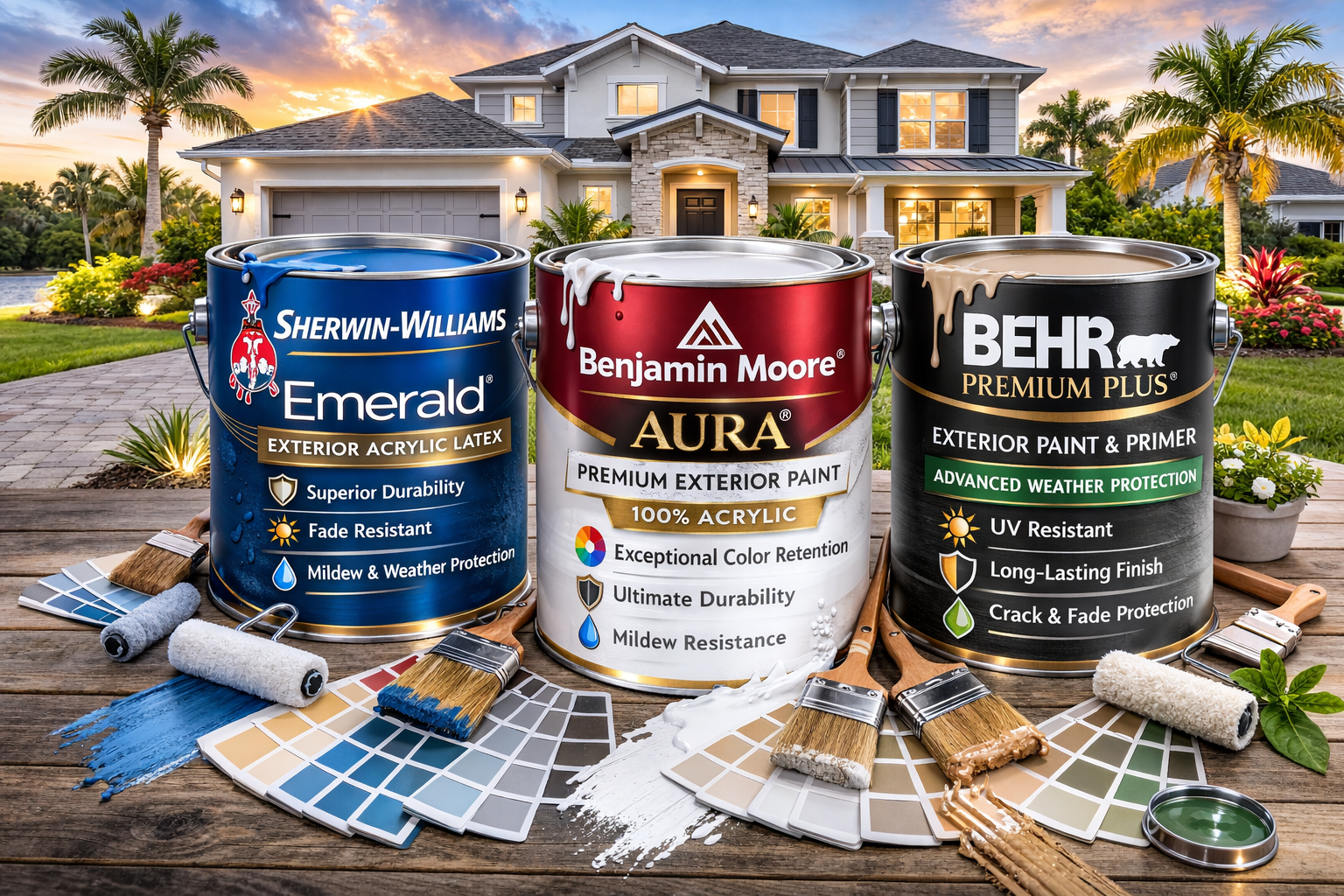
- Product line — Sherwin-Williams Duration, Sherwin-Williams Emerald, Benjamin Moore Regal Select, or Benjamin Moore Aura (not just a brand name) — all four are weather-resistant premium-tier products formulated for Florida exposure
- Color names with manufacturer codes for body, trim, and accent
- Sheen — flat, satin, low lustre, or semi-gloss
- LRV — Light Reflectance Value for each color
- Prep scope — pressure washing PSI, scraping, caulking, masking, and any required carpentry work
- Primer specifications — bonding primer for stucco, oil-based for bare wood
- Surface preparation — wood rot repair, stucco patching, metal corrosion treatment
- Two-coat application — premium products are warranted on two-coat application, not single-coat
- Project timeline — realistic start and completion dates
- Florida license number and current insurance certificates
If a contractor’s estimate doesn’t include these specifications by default, that’s a signal they don’t typically work in HOA-governed communities. Find a contractor who handles ARB submissions as part of their standard workflow.
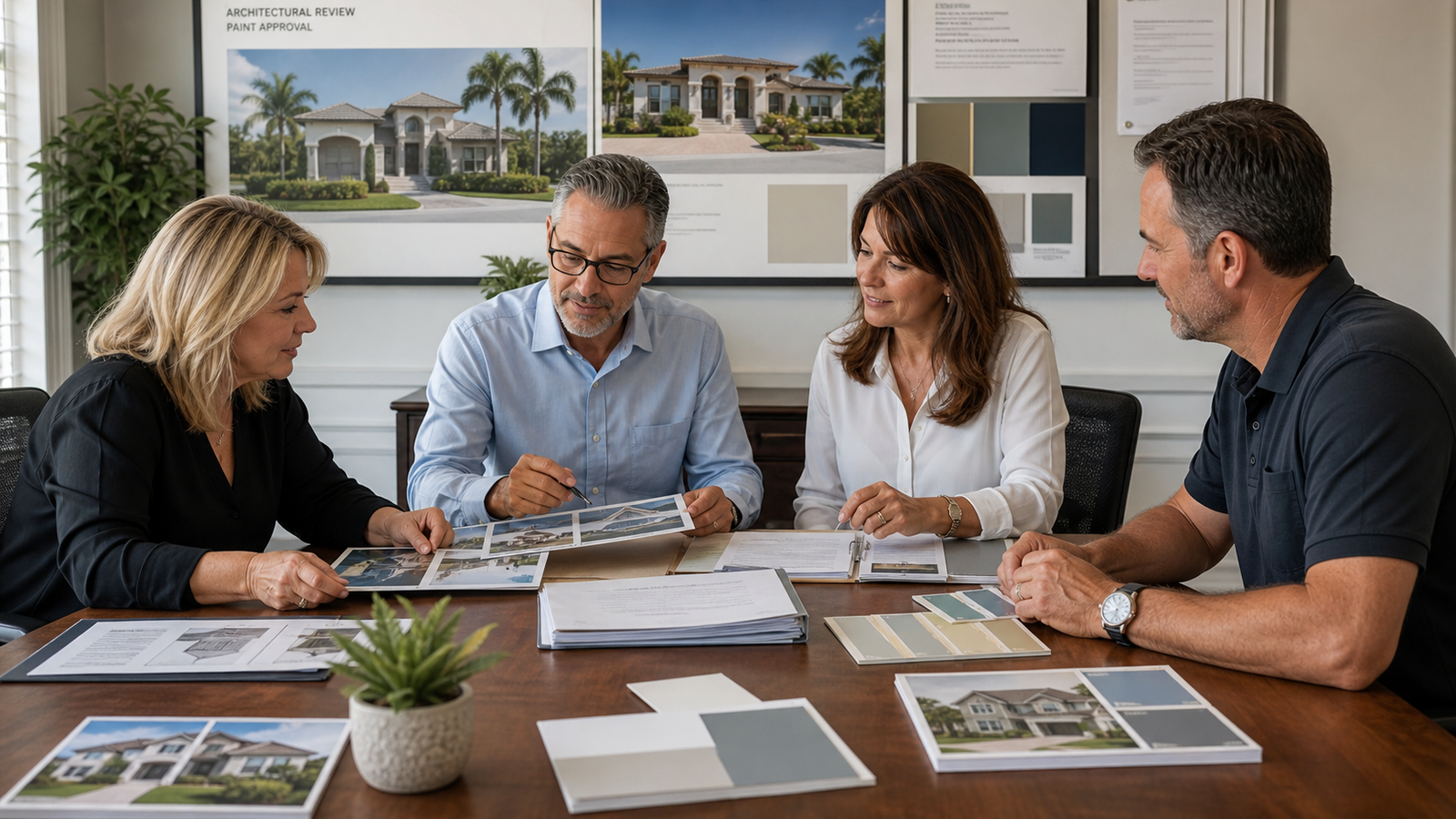
Build the complete submission packet
The contractor should assemble the ARB packet on your behalf as a normal part of the project, not as an upcharge. A complete Northeast Florida ARB packet typically includes:
- The current architectural change application form, completed and signed by the homeowner
- Color samples or chips for body, trim, and accent (some communities require painted sample boards)
- Manufacturer specifications and product data sheets for each paint product
- Written color placement plan describing where each color is applied
- 4 to 8 photos of the home from front, sides, and rear elevations
- Written prep scope and materials list
- Contractor licensing and insurance documentation
- Project timeline with proposed start and completion dates
- Variance request (if any colors fall outside the approved palette)
The homeowner reviews and signs the application. The contractor delivers the complete packet to the management company on the homeowner’s behalf, or the homeowner submits it directly through the community portal — depending on the community’s preferred process.
Submit before the application deadline for the next ARB meeting
Most Northeast Florida ARBs meet monthly or twice monthly with specific submission deadlines, often 7 to 14 days before the meeting. Missing the deadline pushes your application to the following meeting, which can add 2 to 4 weeks to your timeline.
Confirm the submission deadline directly with your management company before submitting. Some communities use online portals; others require email submissions; a few still accept paper packets. The format matters less than hitting the deadline. Always request a written confirmation of receipt from the management company — this protects you under Florida’s 30-day response rule. If the ARB doesn’t respond within the timeline specified in your governing documents (typically 30 to 60 days), the application may be considered automatically approved under Florida Statute 720.3035.
Track your application and respond promptly to any modification requests
An application returned with conditions is not a rejection. It’s the most common outcome and represents a collaborative step toward final approval. The ARB has identified specific addressable items — usually a slight color modification, a sheen change, or a clarification on prep scope — that need resolution before they grant final approval.
Respond to modification requests quickly and in writing. Clarify any points you don’t understand immediately. Most communities allow re-submission of modified applications without restarting the full review clock — the ARB simply confirms the modifications and issues final approval.
If your application is fully denied, request a detailed explanation in writing. Under the 2024 Florida ARB transparency updates, denials must reference specific written standards in the governing documents. If the denial is based on subjective taste or unclear standards, you have legal grounds to appeal.
Wait for written approval before any work begins
Do not allow your contractor to start prep work, pressure washing, or paint application until you have written ARB approval in hand. This is the rule that catches more Jacksonville homeowners than any other.
The temptation is real — you’ve waited 4 to 6 weeks, the contractor is ready to start, and the approval feels like a formality. But starting work before written approval — even prep work that doesn’t change the home’s appearance — can trigger violation notices, and any work that doesn’t match the eventual final approval becomes an unauthorized modification subject to forced correction at your expense.
Once written approval arrives, read it carefully. Some approvals come with conditions: a specific trim treatment, a slightly modified color, a required completion date. The contractor’s scope must match the approved scope exactly. If the approval differs from your original application in any way, update the contractor’s contract before work begins.
What a complete submission packet actually contains
The 8-step framework above outlines the process. Here’s the detailed checklist of what belongs in the packet itself — the document you hand to the management company. Every Northeast Florida ARB expects the same core elements, regardless of which community you’re in.
| Component | What to include | Why it matters |
|---|---|---|
| Application form | Current architectural change form, fully completed and signed by the homeowner of record | Some communities reject applications signed by a non-owner (spouse not on the deed, contractor signing for owner) |
| Manufacturer | Sherwin-Williams or Benjamin Moore explicitly named | Generic brand names (“premium paint”) trigger rejection |
| Product line | Duration, Emerald, Regal Select, or Aura | The product line determines warranty coverage and durability — the ARB knows the difference |
| Color names + codes | Both name (e.g. “Alabaster”) and code (e.g. “SW 7008”) for body, trim, and accent | Names alone are ambiguous because manufacturers reuse names across products; codes are unique |
| Sheen | Flat, satin, low lustre, semi-gloss, or gloss for each surface | Some communities require specific sheens by surface type (flat for stucco, satin for trim, etc.) |
| LRV | Light Reflectance Value for each color | Many communities specify LRV minimums or maximums; missing LRV triggers automatic rejection in stricter communities |
| Color samples | Physical paint chips or printed color cards; some require painted sample boards | Color renders differently on screen, on chip, and on a wall — boards eliminate ambiguity |
| Property photos | 4 to 8 photos showing all elevations being repainted | The ARB needs context for how colors will look on your specific home |
| Color placement plan | Written description of where each color is applied — body, trim, fascia, soffits, garage door, accent | Submitting three colors without explaining placement is the most common cause of conditional approval |
| Surface prep | Pressure washing, scraping, caulking, primer, wood repair, stucco patching | The ARB knows good prep makes paint last; vague prep scopes signal cut corners |
| Contractor info | FL license number, general liability certificate, workers’ comp certificate | Some communities verify licensing before review even begins |
| Project timeline | Estimated start and completion dates | The community needs to know when work will be visible |
The single biggest difference between approved and rejected packets: Approved packets read like professional construction documents. Rejected packets read like vague homeowner descriptions. The ARB members reviewing your application are usually homeowners themselves — they know what real prep looks like, what real product specs look like, and what a real contractor does versus what a weekend operation does. Specificity signals professionalism. Vagueness signals risk.
The five most common rejection reasons and how to prevent each one
1. Vague color descriptions without manufacturer codes
“Tan” or “beige” without manufacturer codes is the single most common reason for first-pass rejection across Northeast Florida ARBs. Every color in your application needs a manufacturer (Sherwin-Williams or Benjamin Moore), product line (Duration, Emerald, Regal, Aura), exact name (Accessible Beige, Edgecomb Gray), and code (SW 7036, BM HC-173). Always include LRV. Always specify sheen.
2. Selecting outside the approved palette without a variance request
Most Jacksonville HOA communities maintain pre-approved palettes. Submitting a non-palette color without a formal variance request triggers near-automatic rejection. If you want a non-palette color, file a variance request alongside your standard application, attach reference photos showing the color in similar Florida homes, and accept that the review cycle will be longer.
3. Missing or vague prep specifications
“We will paint the exterior” without prep details suggests the contractor will skip prep. Every successful packet specifies pressure washing PSI and dry time, scraping, caulking, priming (with primer brand and type), and any wood or stucco repair scope. Two-coat application of premium product over properly primed substrate is the standard the ARB expects to see described.
4. Inconsistent color placement plans
Submitting body, trim, and accent colors without specifying where each goes is a frequent rejection trigger. The packet should include a written description like: “Body color (Sherwin-Williams Accessible Beige SW 7036) on stucco walls. Trim color (Sherwin-Williams Alabaster SW 7008) on fascia, soffits, and window casings. Accent color (Sherwin-Williams Hale Navy) on front door and shutters. Garage door painted to match body.”
5. Application signed by someone other than the homeowner of record
This catches a surprising number of applications. The homeowner whose name is on the deed must sign — not their spouse (if not on the deed), not the contractor, not a property manager. If two names are on the deed, both signatures are typically required. The application form’s signature line is a legal record, and ARBs do reject applications with the wrong signatures.
Realistic timelines by Northeast Florida community
Florida law requires ARBs to respond within roughly 30 days, and the May 2024 statutory updates strengthened this timeline. In practice, most Jacksonville HOA communities operate on 3 to 6-week review cycles for paint applications, with specific timing varying by how often the ARB meets and how complete the submission packet is.
| Community | Typical review cycle | ARB meeting frequency | Submission deadline |
|---|---|---|---|
| Marsh Landing Country Club | 4-6 weeks | 2nd & 4th Mondays | 7 days before meeting |
| Sawgrass Players Club | 4-6 weeks | Twice monthly | 10 days before meeting |
| Sawgrass Country Club | 4-6 weeks | Monthly | 2 weeks before meeting |
| Eagle Harbor (master) | 3-5 weeks | Monthly | 10 days before meeting |
| Eagle Harbor — Stone Creek | 3-5 weeks | Monthly (managed by RealManage) | 2 weeks before meeting |
| Julington Creek Plantation | 3-5 weeks | Monthly | 10 days before meeting |
| Palencia | 3-4 weeks | Monthly | 10 days before meeting |
| eTown | 2-4 weeks | Monthly | 1 week before meeting |
| RiverTown | 3-4 weeks | Monthly | 10 days before meeting |
| Nocatee sub-HOAs | 3-6 weeks | Varies by village | Varies by village |
| Deerwood | 3-5 weeks | Monthly | 2 weeks before meeting |
| Queens Harbour | 3-5 weeks | Monthly | 10 days before meeting |
| Glen Kernan | 3-5 weeks | Monthly | 10 days before meeting |
| Cimarrone | 4-6 weeks | Monthly | 2 weeks before meeting |
| Amelia Island Plantation | 4-6 weeks | Monthly | 10 days before meeting |
Always confirm the current submission deadline directly with your community’s management company before submitting. Boards and management companies change, meeting schedules shift, and a single missed deadline adds a full review cycle to your timeline. Our Jacksonville HOA Master Directory lists verified management contacts and ARB coordinators for nearly 100 Northeast Florida communities.
What to do if your application is denied or stalled
Denials and delays happen. The 2024 Florida ARB transparency law gives Jacksonville homeowners more protection than ever before, but knowing your options matters when an application doesn’t go smoothly.
If your application is conditionally approved
Conditional approval is not a denial. The ARB has identified specific addressable items — typically a sheen change, a slight color modification, or a prep clarification. Respond to the conditions in writing within the response window specified by the community (often 14 days). Most communities allow modified resubmission without restarting the full review clock.
If your application is fully denied
Request the denial reason in writing, citing specific written architectural standards. Under Florida Statute 720.3035 as updated in 2024, ARBs cannot deny applications based on subjective taste — denials must reference specific written standards in the governing documents. If the cited standards are unclear or inconsistent with how similar applications have been treated, you have grounds to appeal.
If the ARB doesn’t respond within the timeline
Florida law requires ARBs to respond within a “reasonable” period, which courts have interpreted as approximately 30 days unless the governing documents specify a different timeframe. If the ARB exceeds this timeline without responding, the application may be considered automatically approved under Florida law. Document your submission date, document the lack of response, and consult with a Florida HOA attorney before proceeding with work.
If the denial appears arbitrary or selective
Florida law prohibits selective enforcement. If your blue paint application is denied while three other homes in the community already have similar blue paint approved, you have a strong argument that the restriction is being selectively enforced. Florida courts have consistently upheld homeowner challenges in cases of inconsistent ARB enforcement.
Real Project Example
A Marsh Landing application that was approved on the first review cycle
A homeowner in Marsh Landing called us in March 2026 wanting to repaint their two-story home. Previous estimates from two other contractors had quoted vague packets — “premium Sherwin-Williams paint, full prep, two coats” — and the homeowner had heard from neighbors that incomplete packets routinely got bounced back from the Marsh Landing Architectural Review Committee.
Our submission packet specified: Sherwin-Williams Emerald in Accessible Beige (SW 7036, LRV 58) on stucco body walls, Sherwin-Williams Emerald in Alabaster (SW 7008, LRV 82) on fascia, soffits, and window casings, and Benjamin Moore Hale Navy (HC-154, LRV 6) on the front door. Sheen specifications by surface. LRV values for each color. Full prep scope including pressure washing at 2,500 PSI with 48-hour dry time, elastomeric crack repair on stucco transitions, oil-based stain-blocking primer on bare wood, and two coats of Emerald topcoat. Photos of all four elevations. Florida license number and current insurance certificates.
The Marsh Landing Architectural Review Committee approved the application at the next scheduled meeting (the 4th Monday of the month) with no conditions and no modifications requested. The homeowner had written approval in hand 18 days after submission. The total project from first call to final walk-through took 7 weeks.
Frequently asked questions about HOA paint submissions in Jacksonville
Do I need to hire a contractor before I submit my ARB application?
Most Jacksonville HOA communities require contractor licensing and insurance information as part of the submission packet, which means yes — you need a contractor lined up before you can submit a complete application. The good news is that hiring the contractor first lets you build the packet collaboratively. The contractor specifies the paint products, prep scope, and timeline; you handle the homeowner-side documentation; the packet goes in complete on the first try.
How early should I start the ARB process before I want my home painted?
Plan to submit your ARB application 6 to 10 weeks before your preferred painting start date. That breaks down as roughly 1 week for document review and contractor selection, 1 to 2 weeks for estimate and packet preparation, 1 week to submit and confirm receipt, 3 to 6 weeks for ARB review, and a buffer for any conditional modifications. Submitting earlier is always better — submitting later means waiting another full review cycle if anything goes wrong.
What if my contractor doesn’t do ARB submissions?
Find a different contractor. Painting contractors who don’t handle ARB packets as part of standard service are signaling that they don’t typically work in HOA-governed communities — which means they probably don’t know which products satisfy ARB review, which prep scopes get rejected, or which palettes are pre-approved in your community. In Northeast Florida, where the majority of master-planned communities are HOA-governed, ARB-fluency is a basic requirement for any professional painting contractor.
Can I submit my ARB application online or do I need to submit on paper?
It depends on the community. Larger Jacksonville master-planned communities like eTown, RiverTown, Nocatee, and Palencia typically use online portals for architectural submissions. Smaller and older communities sometimes still require email or paper submission to the management company. Always confirm the preferred submission format with your management company before assembling the packet — converting a paper-format packet to an online portal can require time-consuming reformatting.
What’s the difference between Sherwin-Williams Duration and Sherwin-Williams Emerald for HOA submissions?
Both are premium 100% acrylic latex topcoats from Sherwin-Williams, and both will satisfy nearly any Northeast Florida ARB. Duration is the standard premium choice for inland Jacksonville exteriors with strong UV protection and a lifetime limited residential warranty. Emerald is the top-tier product with higher solids content, advanced acrylic resin technology, and superior salt resistance — making it the right choice for any home within two miles of the coast (Marsh Landing, Sawgrass, Ponte Vedra Beach, Atlantic Beach, Amelia Island). Specifying the correct product line in your application matters because the ARB knows the difference.
How do I find LRV values for the colors I’m considering?
LRV values are typically printed on the back of paint chips, in manufacturer fan decks, and on the manufacturer’s color search website. Sherwin-Williams and Benjamin Moore both publish LRV for every color in their lines. If you can’t find a specific color’s LRV, ask your painting contractor — any professional working in HOA-governed communities should know how to look up LRV values quickly. For background on LRV, see our guide on determining a paint color’s LRV.
Can my HOA require painted sample boards instead of paint chips?
Yes, and some Jacksonville communities do. Painted sample boards (typically 12″ x 12″ or 18″ x 18″) show the color rendered on a real surface in real Florida sun, which provides a much more accurate preview than a paint chip. Communities that require sample boards usually allow the contractor to prepare them as part of the project. This adds a small amount of cost but eliminates ambiguity and reduces the chance of conditional approval.
What if I want to repaint in the exact same color my home already is?
Most Jacksonville HOA communities still require ARB approval for same-color repaints because the application creates a documented record of what’s on the home. Some communities offer expedited review (often 1 to 2 weeks) for genuine same-color repaints with simplified documentation. Confirm your community’s specific process with the management company. Repainting without approval — even in the existing color — can trigger violations in the majority of Jacksonville HOA communities.
Does my contractor need to be on a “preferred contractor” list to do my project?
The vast majority of Northeast Florida HOA communities allow homeowners to choose their own painting contractor, provided the contractor is properly licensed and insured. A small number of communities maintain “preferred contractor” lists or require pre-approval, but this is uncommon for paint projects. Always confirm with your management company before signing a contract. A New Leaf Painting Contractors has documented project history in nearly every major Jacksonville HOA community.
What if the ARB approves with conditions I can’t agree to?
Conditional approvals can be negotiated. If the ARB requests a modification you don’t want to make — for example, a sheen change you disagree with or an accent color modification — you can respond in writing requesting reconsideration with supporting reasoning. Many ARBs will adjust conditions when the homeowner provides legitimate justification (manufacturer specifications, similar approved homes in the community, technical durability concerns). If reconsideration is denied, your options are to accept the conditions or appeal the decision under Florida Statute 720.3035.
Do interior paint changes require ARB approval?
No. Florida Statute 720.3035, as updated in 2024, prohibits HOAs from regulating interior changes that are not visible from the home’s frontage, adjacent parcels, common areas, or community golf courses. Interior painting, cabinet refinishing, and most interior renovations do not require ARB approval anywhere in Florida. The 2024 update specifically clarified this point because some HOAs were previously demanding approval for purely interior work.
What happens if the ARB doesn’t respond to my application at all?
Under Florida Statute 720.3035 and longstanding case law, ARBs must respond to architectural applications within a reasonable time, typically interpreted as approximately 30 days unless the governing documents specify a different timeframe. If the ARB exceeds this timeline without responding, the application may be considered automatically approved. Document your submission date, document the lack of response, and consult with a Florida HOA attorney before proceeding with any work — automatic approval is a legal protection but is best invoked with proper documentation.
Continue reading: more from our HOA painting cluster
- The Complete Guide to HOA Painting in Jacksonville (Pillar)
- Jacksonville HOA Paint Color Guide: Approved Palettes
- Jacksonville HOA Master Contact Directory
- Exterior Repainting in Ponte Vedra Beach: Why Salt Air Changes Everything
- Two-Story Exterior Painting in Marsh Landing
- Repainting a Hardie Board Exterior in Julington Creek
Ready for an HOA-compliant free estimate?
25 YEARS · 5,000+ PROJECTS · 750+ REVIEWS · IRON-CLAD GUARANTEE · HOUSE PAINTERS NEAR ME
A New Leaf Painting is Jacksonville’s most reviewed painting contractor — founded in 2001 by Thomas Drake and trusted by more than 5,000 homeowners and business owners across Greater Jacksonville, Ponte Vedra Beach, Nocatee, Fleming Island, Amelia Island, and all of Northeast Florida. Our 750+ verified five-star reviews across Google, Facebook, Angi, Yelp, BBB, Houzz, and Nextdoor reflect one thing above everything else: a painting experience that actually feels easy. From the first phone call to the final walkthrough, every project is backed by proper preparation, premium exterior house painters near me and reliable interior painting contractors near me painting products from Sherwin-Williams® and Benjamin Moore®, and our Iron-Clad Guarantee — professional results or your paint is 100% free.
When you are ready, call or text 904-615-6599 for a free, no-surprise estimate from the painting contractor Jacksonville homeowners have trusted for 25 years.