Kitchen Cabinet Painting in San Marco, Avondale, & Riverside
By Thomas Drake, Founder & Owner, A New Leaf Painting Contractors · 25 years of Northeast Florida painting experience · Updated April 2026
Cabinet refinishing in San Marco is a different job than refinishing modern cabinets — and the differences matter. Most San Marco kitchens were built between 1925 and 1945, with original cabinets made of solid wood (often oak, maple, or pine) that’s been painted, varnished, and re-coated dozens of times across nearly a century. Behind that finish is almost always lead-based paint from pre-1978 layers. Doing this work right requires EPA RRP certification, lead-safe practices, and a refinishing system designed for 80-year-old wood that’s been through everything. Here’s what 25 years of historic-home work in Jacksonville’s most beautiful neighborhood has taught us.
Why San Marco kitchens require a different approach than modern cabinets
San Marco was developed primarily in the 1920s and 1930s as Jacksonville’s first planned suburb, and most original kitchens still feature solid-wood cabinetry from that era. Unlike modern factory-built cabinets (MDF cores, thermofoil or laminate fronts, machine-applied finishes), historic San Marco cabinets are typically site-built or custom-millworked from solid hardwood — oak, maple, sometimes heart pine.
They’ve been painted and refinished many times across the decades, which means the existing finish is layered, sometimes uneven, often containing pre-1978 lead-based paint, and almost always too thick to take a new coat without aggressive prep. The work is slower, more detailed, and requires craftsmanship that modern cabinet refinishers aren’t typically trained for.
Lead paint is real in San Marco — and the EPA RRP rule applies
Any home built before 1978 is presumed to contain lead-based paint somewhere in its history, and that includes virtually every original San Marco kitchen. The federal EPA Renovation, Repair, and Painting (RRP) Rule requires any contractor working on pre-1978 housing to be RRP-certified, follow lead-safe work practices, contain dust during the project, and provide homeowners with the EPA’s lead pamphlet before work begins.
Most painting companies don’t talk about this because most aren’t certified — and homeowners hiring uncertified contractors expose themselves and their families to lead dust during the project. We are RRP-certified and follow lead-safe practices on every San Marco project. The protocol adds steps but protects everyone in the home.
How we approach 80-year-old painted wood that’s been refinished a dozen times
The first decision is whether to strip down to bare wood or work over the existing finish. Stripping is the right answer when the existing layers are too thick, peeling, or chipping; it gives the cleanest result but adds 5 to 10 days to the project and significantly more cost. Working over a sound existing finish is the right answer when the layers are stable, the surface is smooth, and the homeowner wants a faster turnaround. Either way, the surface gets thorough cleaning to remove decades of grease and cooking residue, full deglossing or sanding to break the existing finish, careful spot-priming on any bare wood revealed by sanding, and a high-quality bonding primer over the entire surface.
Topcoat is two coats of Benjamin Moore Advance (waterborne alkyd, dries hard like oil but cleans up like latex) or Sherwin-Williams Emerald Urethane Trim Enamel.
What makes the finish look right on a historic kitchen
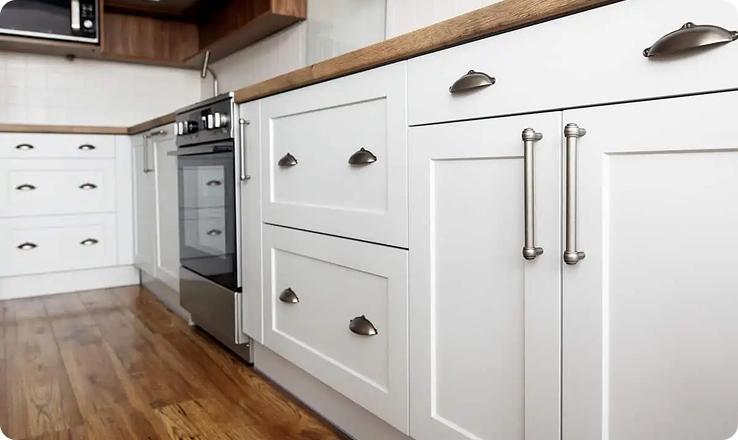
Modern cabinet refinishing aims for a uniform factory-spray look. Historic kitchen refinishing aims for something different — a finish that respects the age and character of the cabinets while looking fresh and well-maintained. We typically brush-and-roll San Marco cabinet projects rather than spraying, because spray finishes can look out of place on hand-built cabinets. Brush-and-roll with the right paint produces a soft, hand-finished appearance that complements the original craftsmanship.
Sheen choice matters too: most historic kitchens look best in a satin or semi-gloss, not the high-gloss factory finish that modern cabinets often have. The final result should look like a kitchen that’s been properly cared for across decades — not one that’s been replaced with new cabinets.
Real Project Example
Real example: a 1932 San Marco bungalow whose owner thought she needed all-new cabinets
A new homeowner on Naldo Avenue in San Marco called us because two cabinet companies had quoted her $34,000 to $42,000 for full cabinet replacement. The cabinets were original to the 1932 build — solid maple, hand-built, with beautiful detail that no modern factory cabinet could replicate. We walked the kitchen with her and showed her what was actually under the existing layers (lead-tested first), what the original wood looked like, and what a proper restoration would deliver versus what tearing them out would cost in lost character. Final scope: full lead-safe stripping on doors and drawer fronts (back to the original maple), restoration of two damaged corner cabinets, all-new soft-close hinges and modern hardware, and a brush-and-rolled finish in Benjamin Moore Advance in a soft white. Total project: $14,800. The homeowner kept the soul of her 1932 kitchen and saved over $20,000.
Frequently Asked Questions
Do San Marco kitchens have lead paint?
Almost certainly yes for any home built before 1978, and the vast majority of San Marco homes were built between 1920 and 1945. Lead-based paint was the standard for kitchen cabinets, trim, doors, and walls during that era. Even if the topmost layers are post-1978 latex, the layers underneath are typically lead-based. EPA RRP-certified contractors test before any disturbance work and follow lead-safe protocols throughout the project. Hiring an uncertified contractor on a San Marco kitchen exposes your family to lead dust during the work — the certification matters.
What is the EPA RRP rule and why does it apply to my San Marco kitchen?
The EPA Renovation, Repair, and Painting Rule (RRP) is a federal regulation requiring contractors working on pre-1978 housing to be certified, use lead-safe work practices, contain and dispose of dust properly, and provide the homeowner with the EPA’s ‘Renovate Right’ pamphlet before work begins. It applies to any project that disturbs more than six square feet of paint per room (and cabinet refinishing always exceeds that threshold). It’s federal law, not optional. Working with an RRP-certified contractor protects your family, the workers, and your future re-sale value.
Should I refinish my historic cabinets or replace them?
Almost always refinish, for three reasons. First, the original cabinets in San Marco kitchens are typically far higher quality than modern factory cabinets — solid wood, hand-built, designed for the specific room. Modern replacements look out of place in a 1930s kitchen and devalue the home’s historic character. Second, refinishing typically costs 30 to 60 percent of replacement, including hardware upgrades. Third, replacement requires demolition that often damages the surrounding historic plaster, tile, or trim. The right answer for nearly every San Marco kitchen is a quality refinish.
Can I just paint over the existing cabinet finish without sanding?
No — and any contractor offering a ‘no-sanding’ approach on historic cabinets is setting up a finish that will fail within a year. Decades of grease, cooking residue, wax, and accumulated finish layers create a surface that new paint cannot bond to. Proper prep requires thorough degreasing, full deglossing or sanding, repair of damaged areas, primer, and only then topcoat. Skipping prep is the single biggest reason cabinet refinishing fails. The prep is half the job — possibly more on a 90-year-old kitchen.
What paint products work best on historic cabinet refinishing?
Benjamin Moore Advance and Sherwin-Williams Emerald Urethane Trim Enamel are the two top-tier products for cabinet refinishing in any context, and both work especially well on historic wood. Both are waterborne alkyds — they level out smoothly like traditional oil-based paint, dry to a hard furniture-like finish, and resist the wear that kitchens demand. We typically apply two coats over a high-quality bonding primer (Sherwin-Williams ProBlock or BIN Shellac on stained wood). Lower-tier acrylic paints don’t have the hardness needed for cabinet doors that get touched, opened, and cleaned thousands of times per year.
Does the San Marco Historic District require approval for cabinet refinishing?
Cabinet refinishing inside the home generally does not require Historic District Council (HDC) approval because it’s interior work that doesn’t affect the building exterior. However, any exterior changes (painting, window replacements, door changes, roof color) do require a Certificate of Appropriateness (COA) reviewed by the Jacksonville Historic Preservation Commission at (904) 396-4734. We can help with COA submissions if your project includes any exterior component.
How long does cabinet refinishing take in a San Marco kitchen?
Most San Marco kitchen refinishing projects run 7 to 14 days from start to finish, depending on cabinet count, the prep approach (work over existing finish vs. full strip-down), and any restoration work needed on damaged doors or cabinets. A typical project: day 1-2 prep and lead-safe setup, day 3-5 sanding and primer, day 6-9 topcoat application (two coats with full cure time between), day 10-12 hardware reinstallation and touch-up, day 13-14 final inspection and walkthrough. Strip-down projects add 4 to 7 days.
How much does cabinet refinishing cost in San Marco?
Most San Marco kitchen refinishing projects fall between $4,500 and $14,000, depending on cabinet count, the prep approach, and any door restoration or hardware upgrades included. A small kitchen with 12 to 18 cabinet doors and a straightforward refinish typically runs $4,500 to $7,000. A larger kitchen with 25 to 35 doors plus drawer fronts plus a strip-down approach runs $9,000 to $14,000. Full historic restoration projects with damaged door rebuilds and custom matching can run higher. Every project is a no-surprise fixed price — the scope is documented before work begins.