
The Real Repaint Cycle for Fleming Island Homes
How heat, humidity, waterfront exposure, stucco, and previous prep affect how long your exterior paint lasts.
Most Fleming Island homeowners ask this question the same way: “It’s been about ten years — am I due?” It’s a reasonable question, and the honest answer is that the calendar is the second most useful thing to look at. The condition of what’s already on your walls is the first. Experienced exterior painters will usually look at coating condition, surface type, exposure, and previous preparation before recommending a repaint based on age alone.
Fleming Island sits inland in Clay County along the west side of the St. Johns River, wrapped by Doctors Lake to the north and Black Creek to the south. That location produces a specific set of conditions — persistent humidity, long surface-wet periods, heavy summer rain, mature tree canopy in the older neighborhoods, and year-round UV. Homeowners working with our skilled and experienced painters in Fleming Island, FL need a paint system and preparation approach that accounts for those local conditions. Those factors, plus the age and history of your home’s existing coating, drive repaint timing far more than any national average.
This guide covers what to realistically expect by surface, how to read the warning signs yourself, why some exteriors here fail earlier than they should, and when it makes sense to plan a repaint.
Reviewed by A New Leaf Painting Contractors. Serving Northeast Florida homeowners since 2001, with more than 5,000 residential painting projects completed. The observations here come from inspecting and repainting homes throughout Fleming Island and Clay County — not from national averages.
Quick Answer: How Often Should You Repaint a Fleming Island Home?
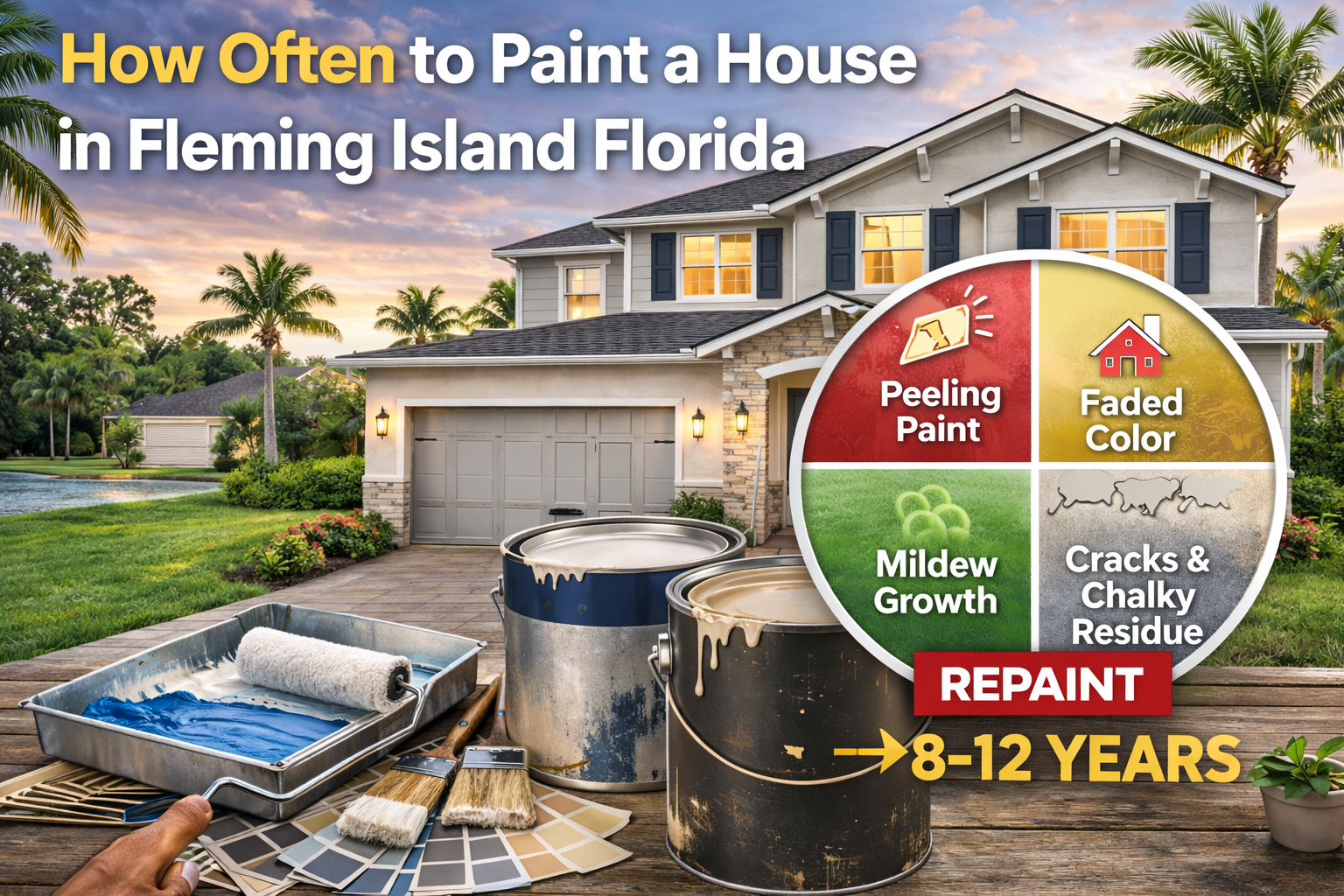
There is no single repaint schedule that fits every Fleming Island home. A properly prepared exterior using a quality coating system will often last somewhere in the range of 7 to 12 years or more. Well-maintained fiber cement can sometimes go longer. Wood trim, fascia, doors, and heavily exposed elevations frequently need attention sooner — often on a shorter cycle than the body of the house.
The more useful framing: condition tells you more than age does.
A six-year-old exterior with peeling paint, split caulk joints, and soft fascia needs attention now. A ten-year-old coating that was properly prepared, applied at full film thickness, and washed every couple of years may still have real service life left in it. We inspect homes in both categories regularly, and the difference almost always traces back to what happened during preparation on the last job — not to what the label on the can said.
Why Exterior Paint Ages Differently in Fleming Island
Fleming Island’s climate is humid subtropical, and the specific combination of factors here is worth understanding before you spend money on a repaint.
Florida UV Exposure
Ultraviolet radiation is the single most consistent stressor on exterior coatings anywhere in Florida. UV degrades pigment, which is why color fades. It also works on the binder — the component that holds the paint film together and keeps it bonded to the surface. As the binder degrades, the film becomes less flexible and more prone to chalking and cracking.
This is a large part of why premium exterior coatings are worth their cost in this market. Higher-tier exterior products are generally formulated for improved color retention, adhesion, film flexibility, and weather resistance compared with lower-tier lines, though the specifics vary by product and manufacturer. South- and west-facing elevations take the brunt of it and will almost always show their age first.
Humidity, Rain, and Long Surface-Wet Periods
Clay County holds high relative humidity through much of the year, with the heaviest stretch running from late spring into early fall. Northeast Florida typically sees over 50 inches of rain annually, concentrated in the summer storm season, and the familiar pattern of clear mornings building into fast, heavy afternoon storms.
Two things follow from that. First, surfaces here stay wet longer than they do in drier climates — heavy morning dew, slow evaporation, repeated wetting. That extends the window in which biological growth can establish. Second, any coating that has developed cracks, pinholes, or areas of weak adhesion will admit water during heavy rain, and that water has no easy path back out. Over time it works against the bond between the coating and the substrate.
Humidity also affects the work itself. Application windows are narrower here, and surface drying after washing takes longer than it does inland. That’s a scheduling reality, not a reason to avoid painting.
Mature Trees, Shade, and Biological Growth
This is one of the most genuinely Fleming Island–specific factors, and it’s underappreciated. Many established neighborhoods here have significant mature canopy and heavily landscaped lots. That’s part of what makes the area attractive. It also changes how the exterior ages.
Shaded elevations — usually north-facing, and anything under heavy tree cover — stay damp longer after rain and morning dew. They accumulate organic debris and staining. They develop mildew and algae sooner than the sunny sides of the same house. In practice this means one home can have two very different aging patterns: a west wall that’s chalking and faded, and a north wall that looks fine in color but carries dark biological staining.
Recurring growth on a shaded elevation is not automatically a sign that the coating has failed. It can be influenced by shade, drainage, irrigation spray, nearby landscaping, dirt accumulation, and surface orientation. Sometimes the answer is a cleaning and a landscaping adjustment — not a repaint. We’d rather tell you that than sell you a job you don’t need yet.
Waterfront and Highly Exposed Properties
Homes along Doctors Lake, the St. Johns River, or Black Creek can experience conditions the interior neighborhoods don’t. Open water exposure means more wind-driven rain against the water-facing elevation, more reflected sunlight, higher sustained ambient moisture, and slower drying.
The practical difference usually shows up on metal components first — railings, fasteners, light fixtures, hardware near docks and seawalls. These deserve their own look during an inspection and often need a rust-inhibitive primer rather than a straight topcoat.
Worth being clear about what this is not: Fleming Island is an inland Clay County community, and it does not see the direct marine salt exposure that affects oceanfront homes in Jacksonville Beach, Atlantic Beach, Neptune Beach, or coastal Ponte Vedra. The story here is moisture, shade, and biological growth — not salt corrosion. Any contractor telling you salt air is destroying your Fleming Island exterior is selling you something.
How Long Exterior Paint May Last by Surface
Repaint intervals vary considerably by substrate and exposure. Treat the ranges below as planning ranges for budgeting purposes, not as guarantees or service intervals. Actual performance depends on preparation quality, coating selection, number of coats and film thickness, substrate condition, exposure, drainage, vegetation, the condition of previous coatings, color, and ongoing maintenance.
| Surface | Typical Planning Range | What Moves the Number Most |
| Stucco | 8–12 years | Crack repair quality; coating matched to substrate condition |
| Fiber cement (James Hardie®) | 10–15 years | Condition of sealant joints and trim transitions; edge sealing |
| Wood siding | 7–10 years | Priming of bare wood; moisture management; rot addressed first |
| Trim, fascia, and soffits | 5–8 years | Exposure and roofline drainage; substrate condition |
| Painted masonry and brick | 8–12 years | Permeability of the coating; efflorescence handled in prep |
| Doors, shutters, garage doors | 5–8 years | Direct sun exposure; finish type; color depth |
Stucco
Stucco is very common on Fleming Island homes, particularly those built during the heavy development years of the 1990s and 2000s. Stucco develops hairline cracking over time from thermal movement and settling. Those cracks are generally too fine and too numerous to address individually, but they’re large enough to admit water during a driving rain.
There’s a persistent myth in this market that every stucco home needs an elastomeric coating. That isn’t accurate, and it can lead homeowners into an expensive system they don’t need — or, worse, into a coating that’s wrong for the wall.
Coating selection on stucco should depend on the existing coating, the condition of the stucco, the extent and behavior of any cracking, moisture conditions in the wall, previous repairs, permeability requirements, and manufacturer specifications for the system being used. A quality acrylic masonry coating is entirely appropriate for many Fleming Island stucco homes in sound condition. An elastomeric system makes sense where its crack-bridging and high-build characteristics genuinely address what the wall is doing. Depending on the substrate and conditions, systems we commonly consider include Sherwin-Williams Loxon XP, Emerald Rain Refresh, Duration, and Latitude.
The one thing that should never be skipped: proper crack preparation before any coating goes on. A high-build coating applied over unaddressed cracking hides the problem for a season and then telegraphs it right back through. If you’re seeing active or widening cracks, that’s a stucco repair conversation before it’s a painting conversation.
James Hardie® and Fiber Cement Siding
Fiber cement became increasingly common on Fleming Island homes from the early 2000s onward. It’s dimensionally stable, resists rot and insects, and generally holds coatings well — one of the more forgiving substrates in this climate.
The things that actually determine how it performs over a repaint cycle:
- Condition of the existing coating. Chalking, adhesion loss, and prior coating compatibility all need to be assessed before a new system goes on.
- Sealant joints and trim transitions. These are inspected and addressed where the installation and manufacturer requirements call for sealant. Not every seam on a fiber cement wall is meant to be caulked — some installations are designed with specific joint details, and blanket caulking can work against how the assembly is meant to shed and release moisture. This is worth getting right rather than assuming.
- Cut edges. Field-cut edges absorb moisture if left unsealed and are a common source of swelling or edge deterioration.
- Roofline and penetration details. Where siding meets trim, flashing, and penetrations is where moisture intrusion usually starts.
Our guide to painting James Hardie® siding goes deeper on the substrate specifics.
Wood Siding, Trim, Fascia, and Soffits
This is where an established Fleming Island housing stock earns special attention. Even on homes that are predominantly stucco or fiber cement, the wood components — fascia, soffits, window and door trim, decorative elements — are usually the first thing to go.
Paint does not repair rotten wood. This is the most important sentence in this article. A coating applied over deteriorated wood conceals the condition; it does not arrest it. The wood continues to break down underneath a surface that now looks fine, and by the time it shows again the repair scope has grown considerably.
Before any repaint on an older home, deterioration should be identified at fascia, soffits, window and door trim, decorative wood, siding, and roofline transitions. Where wood is soft, swollen, or spongy, it needs to be replaced — that’s carpentry and wood rot repair, and it happens before the paint.
Painted Masonry and Brick
Some Fleming Island homes have brick or concrete block exteriors. These are porous, and the coating needs to allow moisture vapor to move out of the masonry rather than trapping it. Efflorescence — the white, chalky mineral deposit that appears on masonry — has to be addressed in preparation. Coating over it leads to adhesion failure fairly quickly.
Doors, Shutters, Garage Doors, and Metal
These are the components most homeowners forget when they budget. Front doors and garage doors take direct sun and are frequently painted in deeper colors, which means they show wear on a shorter cycle than the body of the house. Metal components — railings, fixtures, hardware — need the right primer for the substrate, particularly on waterfront properties. Budgeting a refresh of these items between full repaints is usually the cheapest way to keep a home looking maintained.
8 Signs Your Fleming Island Home May Need Repainting
Your exterior gives you notice well before anything becomes urgent. Here’s what to look for on an annual walk-around.
1. Peeling or Bubbling
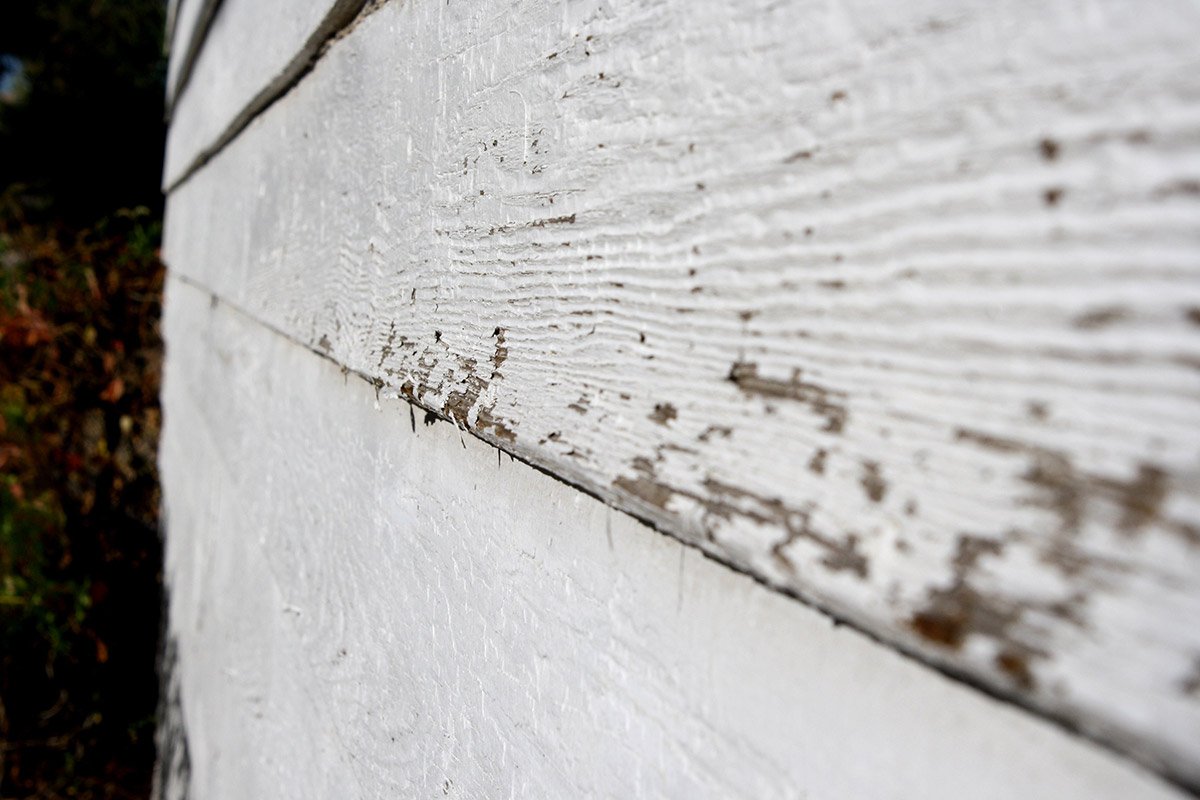
When paint lifts away in sheets, curling edges, or blisters, the bond between the coating and the substrate has broken down. In Fleming Island this usually traces back to moisture — through a crack, a failed sealant joint, or a surface that wasn’t dry enough when the last coat went on.
This one is worth acting on rather than watching. Once the film separates, water reaches the substrate directly, and the cost of the eventual repair grows with every storm season.
2. Noticeable Color Fading
Some fading is normal. What’s meaningful is uneven fading, or fading severe enough that the home no longer reads as its original color. A simple check: compare a section that’s been shielded from direct sun — under a deep eave, in a recessed corner — against a fully exposed wall. The contrast tells you how much UV exposure the coating has absorbed.
3. Chalking
Run your hand across the wall. A powdery residue on your palm means the coating is releasing pigment as the binder degrades. Light chalking late in a coating’s life is expected. Heavy chalking means the film is near the end of its useful service.
Important: chalking has to be properly removed before a new coating goes on. New paint applied over a chalked surface is bonding to loose powder, not to the substrate, and it will fail early regardless of what you spent on the product.
4. Mildew, Mold, or Algae Growth
Typically dark green, gray, or black staining in patches, most often on north-facing and shaded elevations. As noted above, this doesn’t automatically mean a repaint. Growth can be driven by shade, moisture, drainage, irrigation overspray, landscaping proximity, or dirt accumulation as much as by coating condition. Cleaning and a few environmental adjustments resolve a meaningful share of these cases.
Where it does indicate a coating issue: growth that returns quickly and broadly across multiple elevations after a proper cleaning, on a coating that’s already well into its service life.
5. Cracking or Crazing in the Film
A network of fine cracks in the paint film indicates the coating has lost flexibility and become brittle. On stucco, larger cracks may point to movement in the substrate itself, which needs to be evaluated and addressed before recoating.
6. Failed or Missing Caulk
Sealant generally has a shorter service life than the coating around it. Walk the perimeter and look at joints around windows, doors, trim intersections, and utility penetrations. Hard, cracked, shrunken, or missing sealant means water has a path in. Addressing sealant between full repaints is one of the highest-value maintenance habits available to a homeowner here.
7. Bare or Thin Spots
Southwest-facing walls, areas near the roofline, horizontal surfaces, and corner edges wear through first. These should be addressed when you find them, regardless of how the rest of the house looks.
8. Soft, Swollen, or Spongy Wood
Press on fascia, soffits, and trim. Any give means water has already penetrated and deterioration has started. This gets repaired before anything gets painted.
Make it an annual habit. Walk the full perimeter once a year, ideally in the fall after storm season. Catching a small area of failure is far less expensive than addressing it after the substrate has been damaged.
Why Some Fleming Island Paint Jobs Fail Earlier Than Expected
When we’re called out to a home where the paint is failing at year four or five, the cause is almost never the product. It’s one of these:
- Inadequate preparation. The most common cause by a wide margin. Preparation is what creates the bond; the coating is just what sits on top of it.
- Painting over chalk. A surface that wasn’t properly cleaned of chalking residue gives the new coating nothing sound to grip.
- Unresolved moisture. Painting a wall that has an active moisture source behind it guarantees the coating comes back off.
- Wood rot left in place. Covered, not corrected.
- Failed sealant not replaced. New paint over old, split caulk leaves the water path wide open.
- Incompatible coatings. A new system applied over an existing one it doesn’t bond well with — common on homes that have been repainted several times by different contractors.
- Insufficient film build. One coat, or two thin ones, won’t reach the performance the manufacturer specified.
- Poor application conditions. Applying outside the manufacturer’s temperature, surface temperature, and humidity windows.
- Wrong coating for the substrate. A film-forming product where a breathable one was needed, or the reverse.
Nearly all of these are decisions made before the first gallon is opened. That’s why the inspection matters more than the brand on the can.
Repainting Older Fleming Island Homes
A large share of Fleming Island developed through the 1990s and 2000s. That means a significant portion of the housing stock is now well past its original coating system — many of these homes are on their second, third, or later exterior repaint.
That changes the job. On a home that’s been painted three times, the question isn’t just “how old is the current paint.” It’s what’s underneath it. On these homes we commonly find:
- Deteriorated sealant, sometimes several generations of it layered up
- Accumulated paint build, especially on trim and in corners
- Chalking under a more recent coat that was applied over it
- Stucco cracks that were coated over rather than repaired
- Previous patch repairs that were never properly finished or matched
- Fascia and soffit deterioration hidden under paint
- Exposed or rusting fasteners
- Coating compatibility problems between layers
The practical takeaway: on an older Fleming Island home, the condition of the existing coating system can matter as much as the age of the most recent paint job. A thorough inspection before the estimate isn’t a formality — it’s what determines whether the next coat lasts eight years or three.
How to Extend the Life of Your Exterior Paint
Get the Preparation Right
Preparation is where paint life is won or lost. A sound process addresses cleaning, removal of loose or failing coating, crack and substrate repair, sealant replacement where needed, priming of bare and repaired areas, and application at the manufacturer’s specified film build. Skipping steps here is the most expensive savings available.
Clean the Exterior Periodically
Removing accumulated mildew, algae, pollen, and dirt every year or two keeps biological growth from working on the coating. It also lets you spot developing problems early.
Cleaning method should be matched to the substrate, the existing coating, its condition, and the type of contamination — adjusting pressure and cleaning agents accordingly. The goal is to clean thoroughly without damaging the coating or driving water into places it shouldn’t go. Aggressive high-pressure washing is not the same thing as proper preparation, and on some substrates it does real harm.
Drying time before coating depends on conditions, substrate, and the coating being used — it’s a judgment call on the day, not a fixed number of hours.
Stay on Top of Sealant
Check joints around windows, doors, trim, and penetrations every few years. Replacing failed sealant between repaints is inexpensive and prevents the water intrusion that shortens everything else.
Manage Vegetation
This matters more in Fleming Island than in most Northeast Florida communities, given how heavily landscaped the neighborhoods are. Vegetation touching the walls traps moisture, slows drying after rain, and can physically abrade the coating. Keeping shrubs and branches back from the exterior improves airflow and measurably reduces mildew pressure on shaded elevations.
Check Your Irrigation
Sprinkler heads hitting the wall are a frequent and easily fixed cause of persistent staining and coating deterioration along the lower portion of an exterior. Worth watching a full cycle once a year.
Address Small Failures Early
A few square feet of peeling caught early is a touch-up. The same spot after another year of sun and rain can be a substrate repair. Early intervention is consistently the cheapest option.
Before Changing Colors: HOA and Architectural Review Considerations
Fleming Island contains a number of HOA-governed communities, including several large master-planned neighborhoods. It also contains neighborhoods with no HOA at all — so the first step is simply knowing which applies to your property.
Where an HOA or architectural review board is in place, a substantial exterior color change may require approval before work begins. Requirements vary considerably by community: some maintain approved color palettes, some review any change, and some are concerned only with specific elements. Approval timelines vary too, which is the part that catches homeowners out — a color decision made the week before a scheduled start can push a project by a month.
If your community requires review, we can help you prepare the paint and color information needed for the request — product and color specifications, sheen, and the surfaces each applies to — so the submission is complete the first time. Approval itself rests with your board.
The practical advice: if you’re changing colors, start the approval conversation before you start scheduling.
Color and Fading: What Actually Matters
Color affects more than appearance in this climate, though the relationship is less rigid than it’s often presented.
Deeper and more saturated colors generally show visible fading sooner than lighter ones, and southern and western exposures accelerate that. But color retention depends heavily on the specific pigment system and coating formulation — modern premium exterior products hold deep colors considerably better than older generations did. A quality deep color in a well-formulated product can outperform a cheap light one.
If you’re weighing a color change, the more useful questions are how the color will read against your particular exposure, what your HOA permits, and what the manufacturer says about that specific color in that specific product line. Our color consultation covers this on-site.
When Is the Best Time to Paint in Fleming Island?
Exterior painting happens successfully in Fleming Island throughout most of the year. Weather affects daily scheduling and application windows — it doesn’t restrict the work to one season.
Spring (March–May) offers mild temperatures, lower humidity than summer, and fewer afternoon storms. It’s a popular window and books early; February is a reasonable time to reach out if you want specific spring dates.
Fall (October–November) is comparably good. Storm season winds down, temperatures moderate, and humidity eases. Winter in Clay County is generally workable, with occasional pauses during cold snaps when surface temperatures fall outside manufacturer application requirements.
Summer (June–September) is entirely workable with proper crew management. It requires closer monitoring of air and surface temperature, humidity, dew point, and the afternoon storm pattern, and it means adjusting the daily plan around the weather rather than against it. Experienced crews here work through summer routinely — the difference is in the scheduling discipline, not in the quality of the result.
After significant storms, a walk-around is worth doing regardless of where you are in your repaint cycle. Wind can dislodge sealant, drive water into joints, and cause debris damage that isn’t obvious until the next heavy rain.
Frequently Asked Questions
How often should you paint a house in Fleming Island, FL?
There’s no single interval. A professionally prepared exterior with a quality coating system will often last around 7 to 12 years or more in Fleming Island. Fiber cement can sometimes go longer; wood trim, fascia, and doors typically need attention sooner. Condition matters more than age — a six-year-old exterior with peeling paint and failed sealant needs attention before a well-maintained ten-year-old one does.
How long does exterior paint last in Florida?
It depends primarily on preparation quality, coating selection, film build, substrate, and exposure. A properly prepared premium system commonly reaches the upper end of typical planning ranges; a poorly prepared job can fail in a fraction of that time regardless of what product was used.
Does stucco need to be repainted more often?
Not necessarily. Stucco in good condition with a properly selected and applied coating can perform comparably to other substrates. What shortens stucco coating life is unaddressed cracking, moisture in the wall, or a coating that doesn’t suit the wall’s condition and permeability requirements.
Do I need an elastomeric coating on my stucco home?
Not automatically. Elastomeric systems are appropriate where their crack-bridging and high-build characteristics genuinely address the wall’s condition. Many Fleming Island stucco homes in sound condition are well served by a quality acrylic masonry coating. The right answer depends on the existing coating, the extent of cracking, moisture conditions, previous repairs, and permeability requirements — which is why it should follow an inspection, not precede one.
Does Fleming Island humidity shorten paint life?
It’s a meaningful factor. High humidity, heavy dew, and long surface-wet periods create favorable conditions for mildew and algae, particularly on shaded and north-facing elevations. Coatings formulated with mildew resistance help, and periodic cleaning helps. It’s also worth noting Fleming Island is inland and does not experience the direct marine salt exposure that affects oceanfront properties.
How often should James Hardie® siding be painted?
Fiber cement generally holds coatings well and can often go longer between repaints than other substrates. Performance depends heavily on the condition of sealant joints and trim transitions, whether cut edges were sealed, and the condition of the existing coating.
Should I repaint if the paint is chalking?
Light chalking late in a coating’s life is normal and not by itself a reason to repaint. Heavy chalking indicates the film is near the end of its service life. Either way, chalking must be properly removed before any new coating is applied — painting over it causes early failure.
Can mildew be cleaned without repainting?
Often, yes. Recurring growth can be driven by shade, drainage, irrigation, landscaping proximity, and dirt accumulation as much as by coating condition. A proper cleaning plus adjustments to those conditions resolves many cases. Growth that returns quickly across multiple elevations on an aging coating is a stronger signal that recoating is warranted.
Do Fleming Island HOAs require exterior color approval?
Some communities do and some neighborhoods have no HOA at all — it varies by community. Where architectural review applies, a substantial color change generally requires approval before work begins, and timelines vary. Check your governing documents before scheduling. We can help prepare the paint and color information for the request when it applies.
What’s the best time of year to paint in Fleming Island?
Spring and fall offer the most comfortable conditions, but exterior painting is done successfully throughout most of the year here. Weather governs daily scheduling and application windows rather than ruling out entire seasons.
Does more expensive exterior paint really last longer?
Higher-tier exterior products are generally formulated for better color retention, adhesion, film flexibility, and weather resistance, and in this climate that difference shows up over time. But product quality can’t compensate for poor preparation. A premium coating over an unprepared surface will underperform a mid-tier coating over a properly prepared one.
Can you paint over stucco cracks?
Cracks should be evaluated and repaired appropriately before coating, not simply covered. Coating over unaddressed cracking — including with a high-build product — tends to hide the condition temporarily rather than resolve it, and the cracks generally telegraph back through.
What does exterior painting cost in Fleming Island?
Costs track the broader Northeast Florida market and depend on square footage, stories, substrate, the extent of repair work needed, and the coating system specified. Our exterior painting cost guide breaks down the variables, and an on-site estimate is the only way to get a real number for your home.
Related Guides
- Exterior Painting Services
- Stucco Repair
- Wood Rot and Carpentry Repair
- Color Consultation
- Residential Stucco Painting Guide
- Painting James Hardie® Siding Guide
- Exterior Painting Cost Guide
About A New Leaf Painting Contractors
A New Leaf Painting Contractors has served homeowners in Northeast Florida since 2001 and has completed more than 5,000 residential painting projects across Fleming Island, Orange Park, Oakleaf Plantation, Middleburg, Green Cove Springs, Jacksonville, and the surrounding communities.
Fleming Island is one of the areas we know best. We’ve worked on homes across every phase of the community’s development, which means we’ve seen how the stucco construction here ages, how the mature canopy in the established neighborhoods affects shaded elevations, and how the coating history on a third-repaint home changes what a job actually requires.
We’re fully insured, including liability and workers’ compensation coverage, and we back our work with a written warranty on workmanship and materials. We hold 750+ verified five-star reviews from homeowners across Northeast Florida.
Not Sure Whether Your Fleming Island Home Actually Needs Painting?
We’ll come out, walk your exterior with you, and tell you honestly what condition it’s in — including if the answer is that your current coating still has useful life and you should wait. That conversation costs nothing and there’s no obligation attached to it.
If it is time, we’ll show you exactly what we found, what needs repair before any coating goes on, and what system makes sense for your substrate and exposure.
Call or text 904-615-6599 for a free exterior inspection and honest assessment.
Serving Fleming Island • Orange Park • Oakleaf Plantation • Middleburg • Green Cove Springs • Jacksonville • Ponte Vedra