
Last Updated: May 22, 2026 • Reviewed by: Thomas Drake, Owner, A New Leaf Painting Contractors • Serving Northeast Florida since 2001 | 750+ verified 5-star reviews
Warehouse Concrete Floor Coatings in Jacksonville, FL: The Complete Guide
During commercial floor inspections across Northeast Florida, we see the same story play out constantly: a warehouse floor that looked fine for years starts dusting, then cracking at the joints, then wearing through to bare concrete in the forklift lanes — and by the time anyone calls, what would have been a straightforward coating project has become a repair-and-coat project instead. Your floor is one of the largest, hardest-working assets in your facility, and it’s also one of the most neglected until it’s already failing.
This guide covers everything a warehouse owner, operations manager, or facility manager needs to know before investing in a concrete floor coating system: why floors deteriorate in the first place, what epoxy and polyaspartic actually do differently, how proper preparation determines whether a coating lasts five years or fifteen, and how to get a system installed without stopping your operation. It’s meant to sit alongside our broader guide to warehouse painting in Jacksonville, FL, which covers walls, steel, and ceilings — this one goes deep specifically on what’s happening at ground level.
Facility Manager Tip
Facility managers are usually surprised that the floor is often the single most expensive surface to get wrong in a warehouse — not because coating is expensive, but because a failed floor coating means ripping out the failure, repairing what’s underneath, and starting over, on top of whatever the original project cost.
Why Warehouse Floors Deteriorate
We frequently see warehouse floors that have been under stress for years before any visible failure shows up. The forces at work are constant, even when they’re not obvious:
- Forklift traffic. Steel and solid rubber wheels concentrate enormous point loads on a small contact area, and repeated traffic in the same lanes — especially turning areas — wears bare or thinly coated concrete faster than almost anything else in a facility.
- Heavy pallet traffic. Pallet jacks and racking loads add constant abrasive and impact stress, particularly at staging and receiving areas.
- Dropped inventory and impact damage. Chips, cracks, and surface damage from dropped pallets and equipment accumulate over time on unprotected concrete.
- Chemical spills. Oils, solvents, and cleaning chemicals penetrate bare or improperly sealed concrete, staining and weakening the surface over time.
- Oil contamination. Forklift and equipment leaks saturate concrete pores, which — critically — also prevents a new coating from properly bonding unless the contamination is fully removed during prep.
- Humidity and moisture. Florida’s humidity, combined with moisture vapor moving up through a slab from the ground below, is one of the most common — and most overlooked — causes of coating failure we see.
- UV exposure. Areas near dock doors and skylights that get direct sunlight cause certain coating types, particularly straight epoxy, to yellow and degrade faster than shaded areas.
- Concrete dusting. Untreated concrete releases fine dust under traffic as the surface slowly abrades — a sign the slab has no protective wear layer at all.
- Poor original installation. Concrete that wasn’t properly cured or finished during original construction is more prone to early surface problems regardless of what’s applied on top of it later.
One thing we see constantly in older Jacksonville warehouses specifically: forklift turning areas — the zones where trucks pivot rather than travel in a straight line — fail first and fail worst. The shear stress from turning wheels is far more damaging to a coating than straight-line rolling traffic, which is why these zones often need a thicker system or more frequent attention than the rest of the floor.
Benefits of Professional Warehouse Floor Coatings
- Durability — a properly installed system resists abrasion, impact, and chemical exposure far beyond bare or sealed concrete
- Safety — slip-resistant additives and consistent surface texture reduce a real source of workplace injury
- Dust reduction — a sealed surface eliminates the concrete dusting that affects both air quality and equipment maintenance
- Chemical resistance — coated floors resist staining and degradation from oils, solvents, and cleaning chemicals that would otherwise penetrate bare concrete
- Easier cleaning — a smooth, sealed surface takes a fraction of the maintenance effort compared to porous, uncoated concrete
- Professional appearance — for facilities hosting client visits, audits, or vendor tours, a clean, uniform floor reflects directly on how the operation is perceived
- Lower long-term maintenance costs — protected concrete avoids the cracking, spalling, and dusting that eventually require expensive structural repair
- Long-term asset protection and ROI — a floor is one of the most expensive surfaces to replace outright; a quality coating system is a fraction of that cost and extends the underlying slab’s usable life significantly
Polyaspartic vs. Epoxy: Which Is Right for Your Warehouse?
This is the question we get asked more than any other, and the honest answer is that both are legitimate systems — the right choice depends on your traffic level, timeline, and budget.
| Feature | Epoxy | Polyaspartic |
|---|---|---|
| Dry/cure time | Slower — typically 24–72 hours between coats and before traffic | Much faster — often same-day return to light traffic |
| UV resistance | Poor — yellows and degrades with sun exposure | Excellent — holds color and clarity in sunlit areas |
| Installation speed | Slower overall project timeline due to cure windows | Faster overall — a real advantage for minimizing downtime |
| Forklift traffic performance | Good, especially at higher film thickness | Excellent — generally more impact and abrasion resistant |
| Chemical resistance | Very good, particularly for solvent exposure | Very good, with strong resistance across a broad chemical range |
| Maintenance | Low, though UV-exposed areas need earlier attention | Low across the board, including UV-exposed zones |
| Cost | Generally lower material cost | Generally higher material cost, offset by faster installation labor |
| Best applications | Shaded interior floors, moderate traffic, budget-conscious projects | Dock areas, sunlit zones, heavy forklift traffic, minimal-downtime projects |
Other systems worth knowing about:
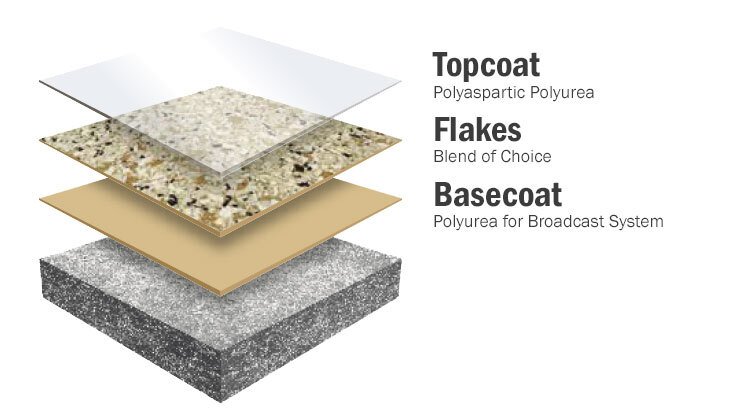
- Polyurea — extremely fast curing and highly flexible, often used as a base or hybrid layer under a polyaspartic topcoat for facilities needing maximum durability and minimal downtime.
- Urethane cement — the standout choice for facilities with heavy thermal cycling, heavy chemical exposure, or steam cleaning — common in food processing and some manufacturing environments where standard epoxy or polyaspartic systems aren’t rated for the conditions.
- Concrete sealers — a lighter-duty, lower-cost option that reduces dusting and adds some moisture resistance but doesn’t offer the durability or chemical resistance of a true coating system — appropriate for light-use storage areas, not active traffic zones.
- Concrete densifiers — chemically harden the surface of the slab itself rather than adding a film on top; often used in combination with a polish finish rather than as a standalone coating strategy.
- Acrylic coatings — economical and easy to apply, but with meaningfully shorter service life and lower chemical resistance than epoxy or polyaspartic — generally not our recommendation for active warehouse traffic.
- Hybrid systems — combining a polyurea or epoxy base coat with a polyaspartic topcoat, giving facilities the buildable thickness of one system with the UV stability and fast cure of the other.
Surface Preparation: The Step That Determines Everything
One of the most common problems we see in coating failures traces back to a single root cause: inadequate surface preparation. This is where cheap installers cut corners, and it’s the single biggest predictor of how long a coating will actually last.
- Grinding. Mechanical diamond grinding removes contamination, opens the concrete’s surface profile, and creates the mechanical bond a coating needs to adhere properly. We consider this the standard for warehouse floor prep — it’s more consistent and controllable than acid etching, and it doesn’t introduce the chemical residue and disposal concerns that come with etching.
- Shot blasting. An alternative mechanical prep method, particularly effective on larger open floor areas, that achieves a similar surface profile to grinding at high production speed.
- Crack repair. Active cracks need to be properly filled and, where structural, addressed before coating — coating over an unrepaired crack means the crack reflects right back through the new surface.
- Joint repair. Expansion and control joints deteriorate over time and need repair before coating; skipping this is one of the most common causes of early edge failure at joint lines.
- Moisture testing. This is the step most often skipped by inexperienced installers, and it’s one of the most consequential. Concrete slabs on grade in Florida frequently have moisture vapor moving up from the ground below, and installing a coating without testing for it is one of the leading causes of the bubbling and delamination failures we get called out to diagnose on floors coated by someone else.
- Cleaning and oil removal. Degreasing contaminated areas — common near equipment and forklift parking — is essential, since oil-saturated concrete simply won’t allow a coating to bond.
- Surface profiling. The finished texture from grinding or blasting needs to match the coating system’s specification — too smooth and adhesion suffers; the right profile is a technical spec, not a guess.
Pro Tip
Why grinding outperforms acid etching: grinding gives a consistent, mechanically verified surface profile every time, while acid etching’s result depends heavily on concrete composition and can vary significantly across the same floor. For a facility investing in a long-term coating system, that consistency is worth the difference.
Choosing the Right System for Your Facility Type
The right coating depends heavily on what the facility actually does, not just its square footage:
- Warehouses and distribution centers — generally best served by polyaspartic or a hybrid system in high-traffic and dock areas, with epoxy acceptable for lower-traffic storage zones
- Manufacturing plants — chemical and thermal exposure often calls for urethane cement or a heavy-duty epoxy system, selected based on the specific processes involved
- Retail storage areas — moderate traffic and budget sensitivity often make standard epoxy the practical choice
- Food processing facilities — urethane cement systems are frequently required given steam cleaning, thermal shock, and strict sanitation standards
- Automotive facilities — heavy chemical exposure from fluids and cleaners generally points toward a high-chemical-resistance epoxy or polyaspartic system
- Aircraft hangars and maintenance facilities — specialized coating systems rated for fuel and hydraulic fluid resistance are typically required
- Medical and cleanroom-adjacent facilities — seamless, easily sanitized coatings with minimal joints and strong chemical resistance are the standard
Slip Resistance and Warehouse Floor Safety
Floor coatings play a direct role in OSHA compliance and everyday employee safety, and this is an area where the wrong choice creates real liability:
- OSHA considerations. Walking-working surface requirements apply directly to warehouse floors, and slip-resistant additives in a coating system are a straightforward way to help meet that standard.
- Employee safety. A consistent, properly textured surface reduces slip-and-fall risk significantly compared to bare, worn, or unevenly sealed concrete.
- Forklift traction. The right surface texture also affects how well forklift tires grip during acceleration, braking, and turns — a factor that matters as much for equipment control as for pedestrian safety.
- Loading docks. High-traffic transition zones between interior floors and dock areas need particular attention to slip resistance, given the combination of moisture, debris, and heavy equipment movement.
- Wet environments. Food processing, wash-down areas, and any facility with regular water exposure need a coating system with slip-resistant texture built in, not added as an afterthought.
Safety Tip
Slip resistance and gloss level are often in tension — a high-gloss finish looks impressive but can be more slippery than a matte or satin finish with proper anti-slip additives. For active traffic areas, we generally recommend prioritizing texture and traction over showroom shine.
Warehouse Downtime: How Floor Coatings Are Installed Around Active Operations
Many warehouse owners wait too long to address a failing floor specifically because they assume the project means shutting down. It doesn’t have to.
Night work. For facilities that operate during the day, crews can install coatings overnight, with return-to-service timing planned around your opening hours the next morning — particularly practical with fast-curing polyaspartic systems.
Weekend work. For operations closed on weekends, this is often the simplest scheduling option, giving a full multi-day cure window with zero disruption to weekday production.
Phased installation. Rather than coating an entire facility at once, work proceeds zone by zone, allowing operations to continue in unaffected areas while each section is prepped, coated, and cured in sequence.
Return-to-service timelines. This is where the epoxy-versus-polyaspartic decision matters most for an active facility. Epoxy systems often need 24 to 72 hours before full traffic resumes; polyaspartic systems can frequently support foot traffic same-day and full vehicle traffic within a day or two, given the same conditions — a meaningful difference for a facility that can’t tolerate extended downtime.
How Long Do Warehouse Floor Coatings Last?
| Coating System | Typical Lifespan (moderate–heavy traffic) |
|---|---|
| Concrete sealer | 2–5 years |
| Acrylic coating | 3–5 years |
| Standard epoxy | 5–10 years |
| Polyaspartic | 10–15+ years |
| Urethane cement | 10–20 years in appropriate applications |
| Hybrid polyurea/polyaspartic system | 12–15+ years |
Factors that affect actual longevity: traffic volume and type (forklift turning zones wear faster than storage aisles by a wide margin), proper surface preparation, correct system selection for the environment, film thickness, and ongoing maintenance.
Maintenance schedule that extends lifespan:
| Frequency | Task |
|---|---|
| Daily/weekly | Sweep or dust mop to remove abrasive debris before it grinds into the surface under traffic |
| Weekly/monthly | Wet mop or auto-scrub with a pH-neutral cleaner; avoid harsh solvents on the coating surface |
| Quarterly | Inspect high-traffic zones and forklift turning areas for early wear |
| Annually | Full facility walk-through inspection; address chips or wear spots before they spread |
| As needed | Spot recoat high-wear zones between full recoating cycles |
Common Mistakes in Warehouse Floor Coating Projects
- Coating over contaminated concrete. Oil, grease, or residue left in the slab prevents proper adhesion no matter how good the coating product is — one of the most common problems we’re called in to diagnose after another installer’s work fails.
- Choosing the wrong system for the environment. A standard epoxy in a sunlit dock area, for example, is set up to yellow and degrade faster than the facility owner expects.
- Skipping moisture testing. As covered above, this is one of the single most common causes of coating bubbling and delamination on Florida slabs.
- Ignoring joint repair. Deteriorated joints left unaddressed become the first place a new coating fails at the edges.
- Choosing the cheapest coating available. Lower-cost, thinner-film products fail sooner under real warehouse traffic, often requiring a full redo well before a properly specified system would have needed attention.
- Poor surface preparation. The root cause behind the majority of early coating failures we’re asked to assess.
- Hiring inexperienced installers. Commercial and industrial floor coating work requires different equipment, technical knowledge, and quality control than residential concrete work — an inexperienced crew often looks capable right up until the coating starts failing months later.
Florida-Specific Considerations for Warehouse Floor Coatings
- Humidity. Persistent ambient humidity affects cure times and working conditions for coating application, particularly for products sensitive to temperature and moisture during installation.
- Moisture vapor transmission. Slabs on grade throughout Northeast Florida commonly show elevated moisture vapor readings, especially in older facilities — this is the single biggest reason we insist on moisture testing before any coating goes down.
- Summer heat. High ambient and slab surface temperatures affect working time and cure characteristics for certain coating chemistries, which is part of why scheduling and product selection go hand in hand.
- Hurricanes and storm water intrusion. Facilities in flood-prone areas or with a history of water intrusion during storms need this factored into coating and moisture-mitigation planning, not treated as a separate concern from the floor project.
- Condensation. Temperature differentials between conditioned interior space and Florida’s exterior humidity can create condensation on slab surfaces, particularly in facilities with inconsistent HVAC coverage.
- Coastal salt exposure. Facilities near the coast see salt-laden air infiltrate through dock doors and loading areas, which can affect metal fixtures embedded in or adjacent to the floor system over time.
- Industrial corrosion. The same humidity and salt factors that affect structural steel in a warehouse also affect any embedded metal elements in or around the floor system, worth considering as part of a full facility maintenance plan.
What Affects Warehouse Floor Coating Costs?
Costs vary too much facility-to-facility for a single number to be meaningful, but the consistent drivers are:
- Square footage — the most direct driver of material and labor cost
- Current floor condition — cracking, spalling, and existing coating failure all add repair scope before a new system can go down
- Repairs needed — crack and joint repair, and any structural concrete work identified during inspection
- Grinding and prep scope — the extent of mechanical preparation required based on the existing surface
- Coating system thickness — thicker, higher-build systems cost more but generally deliver longer service life
- Coating type — epoxy, polyaspartic, urethane cement, and hybrid systems carry different material costs
- Traffic requirements — heavier-duty specifications for forklift-heavy areas add cost relative to light-traffic storage zones
- Safety striping and color systems — aisle marking, hazard zones, and custom color-coding add scope beyond a single-color floor
Frequently Asked Questions
Which is better for a warehouse: epoxy or polyaspartic?
It depends on your priorities. Epoxy is a strong, cost-effective choice for shaded, moderate-traffic areas. Polyaspartic costs more but offers faster installation, better UV stability, and stronger performance for heavy forklift traffic and sunlit zones like dock areas.
How long does a warehouse floor coating last?
It ranges widely by system — 5 to 10 years for standard epoxy, 10 to 15+ years for polyaspartic and hybrid systems — with actual lifespan depending heavily on traffic volume and proper installation.
How much downtime does a floor coating project require?
With night, weekend, or phased scheduling, many facilities experience minimal to no operational disruption. Return-to-service time after application varies by system — polyaspartic often allows traffic within a day, while epoxy typically needs 24 to 72 hours.
Do I need moisture testing before coating my warehouse floor?
Yes, especially in Florida. Slab moisture vapor transmission is one of the leading causes of coating failure, and testing before installation is standard practice for any reputable commercial installer.
Can you coat over an existing failed coating?
Often yes, but the failed coating typically needs to be mechanically removed first — coating over a delaminating surface just guarantees the new system fails at the same points.
Is polyaspartic worth the extra cost over epoxy?
For heavy forklift traffic, sunlit areas, or facilities that can’t tolerate extended downtime, yes — the faster installation and longer service life often offset the higher material cost over the system’s lifespan.
How slip-resistant are these coatings?
Both epoxy and polyaspartic systems can include anti-slip additives broadcast into the surface, giving facility managers control over the traction level based on the specific area’s needs.
What causes a warehouse floor coating to fail early?
Most commonly: inadequate surface preparation, skipped moisture testing, coating over contamination, or an undersized system for the actual traffic level.
Can floor coatings handle forklift traffic?
Yes — properly specified epoxy and polyaspartic systems are designed for forklift traffic, though heavy turning zones benefit from thicker film builds or a hybrid system for maximum durability.
Do you offer color options and safety striping?
Yes — both systems support custom colors, aisle marking, and OSHA-compliant safety striping as part of the installation.
How often should warehouse floors be recoated?
This depends on the system and traffic level — anywhere from 5 years for standard epoxy under heavy use to 15+ years for a well-installed polyaspartic or hybrid system, with spot maintenance in between as needed.
Can you install floor coatings in cold storage or refrigerated facilities?
Yes, though cold storage environments require specific coating formulations suited to low temperatures and thermal cycling — this is addressed during facility assessment.
What’s the difference between grinding and acid etching for prep?
Grinding mechanically creates a consistent surface profile for coating adhesion. Acid etching uses a chemical process with more variable results depending on concrete composition, and it introduces disposal considerations grinding doesn’t.
Do you provide a warranty on floor coatings?
Yes — every commercial floor coating project is backed by a written workmanship warranty with clear terms.
What’s the ROI on a professional warehouse floor coating?
Beyond the direct cost of the coating itself, a quality system reduces ongoing maintenance costs, protects against far more expensive slab repair or replacement, reduces safety incidents, and extends the usable life of one of your facility’s largest physical assets.
Final Thoughts: Protecting One of Your Facility’s Biggest Assets
A warehouse floor takes more daily abuse than almost any other surface in a facility, and it’s easy to treat it as an afterthought until it’s visibly failing. The reality is that a properly specified, properly prepared coating system is one of the highest-ROI investments a facility can make — lower maintenance costs, reduced downtime from floor-related issues, improved safety, and a professional appearance that reflects well on the operation, all from a project that, done right, can be scheduled around your business rather than against it.
If you’re evaluating a floor coating project — whether you’re dealing with an aging, dusting slab or planning ahead for a new facility — we’re glad to walk your floor, test for moisture, and recommend the right system for your specific traffic and environment.
Why Facility Managers Choose A New Leaf Painting Contractors
A New Leaf Painting Contractors has served Northeast Florida since 2001 — licensed and insured, with 750+ verified five-star reviews and thousands of completed projects, including extensive commercial and industrial concrete coating work across Jacksonville. We install polyurea, polyaspartic, and epoxy systems using industrial diamond grinding for proper adhesion, not surface-level shortcuts.
Ready to talk through your facility’s floor coating needs? Schedule a free, no-pressure commercial estimate — we’ll assess your floor’s condition, test for moisture, and recommend the right system. Call 904-615-6599.