Last Updated: May 21, 2026 • Reviewed by: Thomas Drake, Owner, A New Leaf Painting Contractors • Serving Northeast Florida since 2001 | 750+ verified 5-star reviews
Warehouse Painting in Jacksonville, FL: The Complete Guide for Facility Managers
Painting a warehouse is a fundamentally different project than painting an office or a home. An office repaint may happen on nights or weekends around desks and employees. A warehouse repaint can happen around forklift traffic, active shipping schedules, inventory that can’t be exposed to dust or overspray, loading areas that need to remain accessible, and employees who need to keep working safely while a crew is thirty feet up on a lift painting walls, ceilings, structural steel, or bar joists. Our commercial painters in Jacksonville, FL understand that one of the biggest concerns facility managers have isn’t the paint itself — it’s whether the project can be completed safely and efficiently without unnecessarily disrupting operations.
After more than 25 years of commercial painting in Jacksonville, FL, we’ve learned that successful warehouse painting is as much about planning, access, scheduling, containment, equipment, communication, and coordination as it is about coatings. The right paint system matters, but so does understanding how the facility operates and developing a project plan around production schedules, employees, inventory, equipment, loading areas, and other active work zones.
This guide covers what an operations manager, facility manager, property manager, or business owner should know before painting a warehouse, distribution center, or industrial facility in Northeast Florida: why regular painting matters, what surfaces are actually involved, how proper preparation and coating systems work, how experienced crews coordinate painting around active operations, important safety considerations, common mistakes, realistic cost factors, and exactly what to ask before hiring a commercial painting contractor.
Facility Manager Tip
The single biggest predictor of a smooth warehouse painting project isn’t the paint brand — it’s whether the contractor has a documented plan for working around your operations before the first drop cloth goes down. Ask for that plan in writing before you sign anything.
Why Warehouses Need Regular Painting
Warehouse painting isn’t cosmetic maintenance — it protects the building, the equipment inside it, and the people working in it. We commonly see facility managers underestimate how many separate functions a coating system actually serves:
- Safety. OSHA-compliant floor striping, safety yellow on columns and equipment, and proper ceiling brightness all depend on paint being maintained, not just applied once at construction.
- Asset protection. Uncoated steel corrodes. Unprotected concrete pits and spalls. A quality coating system is the first line of defense against the deterioration that eventually requires far more expensive structural repair.
- Brand image. For distribution centers and manufacturing plants that host client visits, vendor tours, or audits, the visual condition of the facility reflects directly on how seriously visitors take the operation inside it.
- Maintenance and corrosion prevention. Steel columns, bar joists, and metal decking are constant corrosion risks in Florida’s humidity. A properly maintained coating system is meaningfully cheaper than steel repair or replacement.
- Employee morale. A clean, well-lit, well-maintained facility measurably affects how employees feel about where they work — a detail that’s easy to overlook until it’s pointed out, but one facility managers consistently mention once it’s raised.
- Customer and vendor visits. First impressions matter in B2B relationships just as much as in retail. A dated, dingy interior sends a signal about operational standards, whether that’s fair or not.
- OSHA visibility markings. Aisle striping, hazard marking, and safety color coding fade and wear under forklift traffic and foot traffic over time, and re-striping is a routine, necessary maintenance item — not an optional upgrade.
Types of Warehouse Painting Projects
Our crews regularly paint every major system in a warehouse or industrial facility, and most projects involve more than one of these at once:
- Interior wall painting — CMU block walls, drywall partitions, and demising walls between tenant spaces
- Exterior painting — metal panels, tilt-up concrete, exterior CMU, and trim
- Structural steel — columns, beams, bar joists, and metal decking, typically requiring corrosion-resistant primer systems
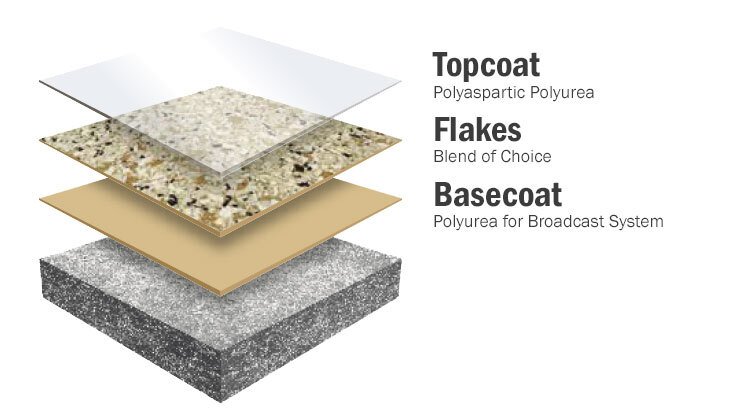
- Floor coatings — epoxy and polyurea/polyaspartic systems for warehouse floors, from light-duty office-adjacent areas to heavy forklift traffic zones
- Ceiling painting — dryfall systems that improve light reflectance and facility brightness without excessive overspray drift
- Dock areas — dock doors, dock levelers, bumper posts, and high-wear zones that take constant impact and traffic
- Warehouse offices — interior office and break room spaces built into the warehouse envelope, typically finished to a standard commercial interior spec
- Mechanical rooms and equipment areas — often requiring specific coatings for chemical resistance or fire-rated assemblies
- Storage racks — safety color coding and touch-up painting on racking systems that take regular impact
- Safety striping — aisle marking, hazard zones, and OSHA-compliant floor marking systems
Warehouse Surface Preparation
Preparation is where a professional warehouse painting job separates itself from a crew that just shows up with sprayers. During warehouse inspections, we typically find some combination of the following, and every one of them affects the prep scope:
- Cleaning and pressure washing — removing years of accumulated dust, dirt, and grime from walls, steel, and concrete before any coating goes on
- Degreasing — essential in manufacturing and distribution environments where equipment, forklifts, and material handling leave oil and grease residue on floors and lower walls
- Grinding — mechanical surface preparation on concrete floors, critical for proper coating adhesion, especially for epoxy and polyurea floor systems
- Rust removal — steel columns, bar joists, and structural elements often show corrosion that must be mechanically removed before priming, or the new coating simply fails over the rust
- Sanding — smoothing repaired areas and failing paint on walls and trim so new coatings bond properly
- Priming — corrosion-resistant primers on steel, appropriate primers on CMU and drywall, and moisture-mitigating primers on concrete where needed
- Repairs — patching CMU block, drywall damage, and concrete spalling before coating
- Caulking — sealing joints on exterior metal panels and around penetrations to prevent water intrusion
Pro Tip
Concrete floors need moisture testing before an epoxy or polyurea system goes down — slabs on grade in Florida frequently have moisture vapor transmission issues that, if ignored, cause coating failure within months regardless of how good the topcoat product is.
Choosing the Right Paint System
Product selection in a warehouse environment is a technical decision, not a color choice. We commonly recommend systems based on the specific surface and the demands it faces:
- Epoxy coatings — strong chemical and abrasion resistance for floors, commonly used in manufacturing and light-to-moderate traffic warehouse areas
- Urethane coatings — excellent UV stability and flexibility, often used as a topcoat over epoxy for floors that see sunlight through dock doors or skylights, where straight epoxy can yellow
- Sherwin-Williams industrial coatings — a full line of products engineered specifically for commercial and industrial environments, from wall systems to structural steel coatings
- Corrosion-resistant primers — essential on any structural steel, bar joists, or metal decking in Florida’s humidity, forming the actual barrier against rust rather than relying on the topcoat alone
- Concrete coatings — polyurea and polyaspartic systems for high-traffic warehouse floors, offering faster cure times and stronger abrasion resistance than standard epoxy in demanding environments
- Dryfall paint — formulated to dry into a powder-like state before reaching the floor, which is why it’s the standard choice for ceilings, bar joists, and overhead structural steel in an occupied warehouse — it dramatically reduces overspray landing on inventory, equipment, and floors below
- Low-VOC coatings — important in occupied facilities where employees are working during or shortly after application, reducing odor and air quality impact
Painting Without Shutting Down Operations
This is usually the deciding factor in which contractor gets hired, and it’s worth explaining in detail. We coordinate closely with facility managers to build a plan that keeps a warehouse painting project from ever becoming a production problem:
Night and weekend work. For facilities that can’t tolerate any daytime disruption, we schedule crews during off-hours, coordinating access, security, and any facility-specific protocols in advance.
Phased painting. Rather than shutting down an entire facility at once, work is broken into sections or zones, allowing operations to continue in unaffected areas while painting proceeds in a defined, contained zone.
Dust and overspray containment. Plastic sheeting, containment barriers, and dryfall products specifically chosen to minimize particulate drift protect inventory, equipment, and product from contamination during application.
Scheduling around production. We build the painting schedule around your production calendar, not the other way around — coordinating with shipping schedules, receiving windows, and any seasonal peak periods that simply aren’t available for disruption.
Communication. A single point of contact and a clear daily schedule means your team always knows exactly what areas are affected on a given day, rather than discovering wet paint or a containment barrier without warning.
Equipment and inventory protection. Racking, machinery, and stored product get covered and protected as part of the standard process — not as an afterthought once painting is already underway.
Warehouse Safety
Working in an active industrial facility carries safety obligations that go well beyond a standard residential or office job:
- OSHA considerations — our crews operate under standard OSHA safety protocols for industrial worksites, including proper signage and coordination with your facility’s existing safety program
- Lift certifications — scissor lifts and boom lifts used for high ceiling, bar joist, and structural steel work require certified operators
- Fall protection — proper harness and fall protection protocols on elevated work, consistent with OSHA requirements for the height and equipment involved
- PPE — respiratory protection, eye protection, and appropriate gear based on the coating systems and environment involved
- Fire exits and egress — maintaining clear access to exits and fire equipment throughout the project, never blocking required clearances even temporarily
- Ventilation — coordinating with facility HVAC and natural ventilation, particularly important with any coating that has notable VOC content
- Confined space awareness — mechanical rooms and equipment areas sometimes qualify as confined spaces, requiring specific protocols before work begins
- Traffic control — coordinating painting zones with active forklift and vehicle traffic patterns so crews and equipment never cross paths unsafely
Safety Tip
Before any contractor starts work in your facility, ask to see their written safety program and confirm their crews carry current lift certifications. This isn’t a formality — an uncertified lift operator working above active forklift traffic is a real liability exposure for your facility, not just the contractor.

Common Warehouse Painting Mistakes
One of the biggest mistakes we see is a facility hiring based on the lowest bid without checking whether the contractor has real commercial and industrial experience. Here’s what that mistake — and others like it — actually costs:
- Hiring residential painters for an industrial job. Residential painting and industrial/commercial painting require different equipment, different safety protocols, and different product knowledge. A crew skilled at repainting homes isn’t automatically equipped for structural steel or moisture-sensitive concrete.
- Skipping proper surface preparation. The most common cause of early coating failure in industrial settings — rushed prep to save time on a bid almost always shows up as peeling, delamination, or floor coating failure within a year.
- Choosing cheap coatings to save money upfront. Standard-grade paint on high-traffic industrial surfaces fails far sooner than an industrial-rated system, requiring a repeat project sooner than the cost savings justified.
- Ignoring corrosion on steel. Painting over active rust without proper treatment doesn’t stop it — it seals moisture against the steel and accelerates the problem underneath the new coating.
- Painting directly over rust. Related to the above — rust needs to be mechanically removed and properly primed with a corrosion-resistant system, not simply covered.
- Skipping moisture testing on concrete. A floor coating applied over a slab with unaddressed moisture vapor transmission issues frequently fails — bubbling, delaminating — regardless of the topcoat quality.
- Poor scheduling coordination. A contractor without a real operational plan can turn a two-day project into a week of disrupted production through poor sequencing and communication.
- Ignoring employee safety during the project. Blocked exits, uncontained overspray, or crews working without proper coordination with facility traffic patterns all create real liability exposure for the business.
How Often Should Warehouses Be Painted?
| Surface | Typical Repaint Interval |
|---|---|
| Interior walls (CMU/drywall) | 7–10 years, sooner in high-traffic or high-visibility areas |
| Exterior walls and metal panels | 8–12 years with a quality industrial coating system |
| Structural steel | 10–15 years, with periodic spot touch-up sooner if corrosion appears |
| Concrete floors (coated) | 5–10 years depending on traffic volume and coating system |
| Loading dock areas | 3–5 years, given constant impact and traffic |
| Safety striping / floor marking | 1–3 years, or as soon as visibility noticeably fades |
What Affects Warehouse Painting Costs?
Costs vary too much facility-to-facility for a single number to be meaningful, but the drivers are consistent across nearly every commercial and industrial project:
- Square footage and ceiling height — larger facilities and taller structures both add material and labor, with height also driving lift equipment requirements
- Lift and equipment requirements — scissor lifts, boom lifts, and specialized access equipment for high bar joists and structural steel add cost relative to ground-level work
- Production schedule constraints — night, weekend, or heavily phased work generally costs more than straightforward daytime access, reflecting the added coordination and labor timing
- Repair scope — corrosion remediation, concrete repair, and drywall or CMU patching found during inspection add labor beyond a standard paint application
- Coating system selection — industrial-grade and specialty coatings (moisture-mitigating primers, high-build epoxy, polyurea/polyaspartic) cost more per unit than standard commercial paint, but typically deliver a longer service life
- Surface condition — the extent of existing corrosion, prior coating failure, or floor damage significantly affects total preparation time
- Accessibility — congested facilities with limited staging area, active racking, or tight clearances take longer to work around than an open, unobstructed space
Money Saving Tip
Addressing steel corrosion and concrete moisture issues proactively, before they’ve spread, is consistently cheaper than waiting until a coating has already failed. A facility that budgets for periodic spot maintenance almost always spends less over a ten-year period than one that waits for a full emergency repaint.
Florida-Specific Considerations for Warehouse Painting
Northeast Florida’s climate adds real, specific challenges to industrial coatings that don’t apply in most other parts of the country:
- Humidity. Persistent humidity slows proper cure time on many coating systems and creates ideal conditions for corrosion on unprotected steel.
- Salt air. Facilities closer to the coast or the Intracoastal face accelerated corrosion on structural steel and exterior metal panels, making corrosion-resistant primer systems even more important than at inland locations.
- Corrosion. Between humidity and salt exposure, Florida industrial facilities generally see faster steel corrosion than facilities in drier climates, which is why proactive coating maintenance matters more here.
- Heat. High ambient and surface temperatures affect coating application windows and cure times, particularly for exterior work during peak summer months.
- Condensation. Temperature differentials between conditioned interior space and Florida’s exterior humidity can create condensation issues on interior steel and concrete, another factor in proper coating selection.
- Mildew. Shaded, poorly ventilated exterior walls and loading dock areas are common mildew locations, requiring coatings with adequate mildew resistance.
- Storm exposure and hurricane preparation. Exterior coatings need to hold up to wind-driven rain during Florida’s storm season, and facilities in hurricane-prone areas benefit from confirming their exterior coating system and caulking are in good condition ahead of each season.
- Coastal industrial environments. Facilities near the coast face the combined effect of salt air and humidity, generally requiring more frequent inspection and maintenance than inland Northeast Florida facilities.

How to Choose the Right Warehouse Painting Contractor
This is the decision that determines whether everything above actually happens the way it’s supposed to. A few things separate a contractor genuinely equipped for industrial work from one that isn’t:
Real commercial and industrial experience — not just residential painting experience with a commercial page added to their website. Ask specifically about warehouse, distribution center, or manufacturing projects they’ve completed.
Proper licensing and insurance — including liability coverage appropriate for working in an active industrial facility, not just standard residential coverage.
A documented safety program — covering lift certification, fall protection, and coordination with your facility’s existing safety protocols.
A real operational plan — for how the project will proceed around your production schedule, not a vague promise to “work around you.”
References specific to commercial and industrial work — a long list of residential references doesn’t tell you how a contractor performs in your environment.
Clear communication and a single point of contact — critical for a multi-day or multi-week project happening inside an active facility.
A written warranty — covering both materials and workmanship, with clear terms for what’s covered and for how long.
Questions to Ask Before Hiring a Warehouse Painting Contractor
- What commercial and industrial liability coverage do you carry, and can you provide documentation?
- How many warehouse or industrial facility projects have you completed, and can you provide references specific to that work?
- What does your written safety program cover, and are your lift operators certified?
- What size crew will be on-site, and who is our single point of contact?
- Can you provide a detailed scheduling plan that accounts for our production hours and shipping/receiving windows?
- What warranty do you provide on materials and workmanship, and what are the specific terms?
- Can you provide references from other commercial or industrial clients in Northeast Florida?
Frequently Asked Questions
How long does a typical warehouse painting project take?
It depends heavily on facility size, the scope of surfaces involved, and whether work is phased around active operations. A single-zone project might take a few days; a full-facility repaint with structural steel and floor coatings can take several weeks, particularly when scheduled around production hours.
Can you paint a warehouse while it’s still operating?
Yes — this is the majority of what we do. Night work, weekend work, and phased scheduling by zone all allow painting to proceed while a facility stays operational.
What’s the difference between commercial and industrial painting?
Commercial painting generally covers office, retail, and general business spaces. Industrial painting involves additional technical considerations — structural steel coatings, corrosion resistance, specialized floor systems, and often more demanding safety and scheduling requirements around active operations.
Do you paint structural steel and bar joists?
Yes, including corrosion-resistant primer systems appropriate for Florida’s humidity and, where relevant, coastal salt air exposure.
What paint system is best for a warehouse floor?
It depends on traffic volume and use — epoxy works well for moderate traffic, while polyurea and polyaspartic systems handle heavier forklift traffic and offer faster cure times. A moisture test on the concrete slab should happen before any system is selected.
How do you control dust and overspray in an occupied facility?
Through containment barriers, plastic sheeting, and dryfall coating products specifically formulated to minimize particulate drift onto inventory, equipment, and floors.
Do you provide OSHA-compliant safety striping?
Yes — aisle marking, hazard striping, and floor safety marking are a standard part of our warehouse and industrial painting services.
Can you match our existing brand colors?
Yes — we work from your brand color specifications or existing color codes to maintain consistency across your facility.
What’s involved in preparing structural steel before painting?
Mechanical rust removal, cleaning, and application of a corrosion-resistant primer before the topcoat — skipping any of these steps significantly shortens how long the new coating lasts.
Do you offer night and weekend scheduling?
Yes — for facilities that need to avoid any disruption to daytime operations, we regularly schedule crews during off-hours.
How often should warehouse floor coatings be redone?
Typically every 5 to 10 years depending on traffic volume and the coating system originally installed, though heavy forklift traffic zones may need attention sooner.
Can you paint cold storage facilities?
Yes, though cold storage and refrigerated environments require specific coating systems suited to temperature and moisture conditions — this is assessed during inspection.
Do you carry commercial liability insurance?
Yes — we carry insurance appropriate for commercial and industrial work, and we’re glad to provide documentation before any project begins.
What’s the biggest cost driver on a warehouse painting project?
Surface condition and repair scope typically drive cost more than the paint itself — a facility with existing corrosion or concrete damage requires meaningfully more preparation labor than one in good condition.
Do you provide a warranty on warehouse painting projects?
Yes — every commercial and industrial project is backed by a written workmanship warranty with clear terms.
Final Thoughts
Every mistake covered in this guide — skipped prep, painting over rust, ignoring moisture in a concrete slab, hiring a crew without real industrial experience — leads to the same outcome: a coating system that fails early and a facility that ends up paying for the same project twice. Proper planning, done once, protects your facility, your equipment, and your employees for years, and it keeps operations running the entire time it happens.
If you’re evaluating a warehouse or industrial painting project, we’re glad to walk your facility, assess the specific surfaces and conditions involved, and build a scheduling plan around your actual operations — not a generic estimate.
Why Facility Managers Choose A New Leaf Painting Contractors
A New Leaf Painting Contractors has served Northeast Florida since 2001 — licensed and insured, with 750+ verified five-star reviews and thousands of completed projects across residential, commercial, and industrial properties. Our commercial and industrial painting experience spans distribution centers, manufacturing facilities, warehouses, and multi-tenant industrial buildings throughout Jacksonville and the surrounding region.
Facility managers choose us for real commercial and industrial experience, a documented safety program, scheduling built around active operations rather than against them, premium industrial coating systems matched to each surface’s specific demands, and clear communication through a single point of contact from the first walkthrough to final completion.
Ready to talk through your facility’s painting needs? Schedule a free, no-pressure commercial estimate and we’ll walk your facility with you. Call 904-615-6599.
Helpful Resources
- Commercial & Industrial Painting Services
- Concrete Floor Coatings
- Pressure Washing
- Wood Rot Repair
- Stucco Repair
- Preventative Maintenance for Warehouse Floors: The Benefits of Concrete Coatings
- Multi-Family & HOA Commercial Painting
- Apartment & Multi-Unit Commercial Painting
- Licensed and Insured Painting Contractors