
Garage Floor Coatings in Jacksonville: Epoxy, Polyurea & Polyaspartic Options
Most Jacksonville garages start the same way: bare concrete that dusts, stains and picks up every oil drip and tire mark it has ever seen. Homeowners coat that floor for different reasons — a workshop, a home gym, clean storage, a finished garage to match the rest of the house, or simply an end to sweeping concrete dust. Whatever the reason, the coating you choose and how the slab is prepared beforehand decide whether the floor still looks good in five years or peels in one. This guide explains the real differences between the systems used for professional concrete coatings, so you can judge a proposal on something other than the color chart.
Why Coat a Garage Floor?
Bare concrete is porous. It absorbs oil, brake fluid and whatever the lawn equipment leaks, and once those soak in they do not come out. A coating puts a continuous, non-porous film between your slab and everything you do on top of it.
- Cleaning gets easier. A coated floor sweeps and mops instead of requiring degreaser and a stiff brush.
- Staining is far less of a problem. Spills sit on the surface rather than wicking into the concrete, which gives you time to wipe them up.
- Dusting stops. Bare concrete sheds fine powder constantly. That dust ends up on tool chests, cars and anything stored in the garage.
- The space becomes usable for more than parking. A sealed, light-reflective floor makes a garage viable as a gym or shop in a way bare concrete does not.
- The slab gets a layer of protection. The coating takes the abrasion, chemical contact and moisture that would otherwise hit the concrete directly.
A well-finished garage shows better than a stained one, and buyers notice. We stop short of promising it raises your appraised value — that depends on your market, your house and your buyer.
Epoxy vs. Polyurea vs. Polyaspartic Garage Floor Coatings
These three names get used interchangeably in advertising, and they are not the same thing. One point of clarity first, because it explains a lot of the confusion: polyaspartic is a type of polyurea — specifically an aliphatic polyurea formulated with a slower, more workable cure. So “polyurea vs. polyaspartic” is less a rivalry than a family relationship.
| System | Character | Typical role | Watch for |
|---|---|---|---|
| Epoxy | Two-part thermoset. Builds thickness well, bonds tenaciously to properly prepared concrete, good chemical resistance. | Base coat, or a complete system in low-UV interior spaces. | Ambers and yellows with UV exposure. More brittle than the alternatives. Longer cure, and sensitive to moisture and temperature while curing. |
| Polyurea | Fast-setting, flexible, high abrasion resistance. Tolerates a wider application temperature range than epoxy. | Base coat in fast-turnaround systems. | Short working time demands an experienced installer. Aromatic versions are not UV stable; aliphatic versions are. |
| Polyaspartic | Aliphatic polyurea. Excellent UV stability, will not yellow, very good abrasion resistance, cures quickly. | Clear topcoat over a base and flake broadcast. | Thin film build per coat. Short pot life leaves little room for application error. |
| Hybrid systems | An epoxy or polyurea base, decorative flake, then a polyaspartic clear topcoat. | The most common approach on residential garages. | Performance depends on the whole assembly, not any single layer. |
There is no universally best answer. Epoxy is not obsolete, and polyaspartic is not automatically superior — each has properties that suit different conditions. What matters more than the chemistry on the label is whether the system was matched to your slab and installed correctly.
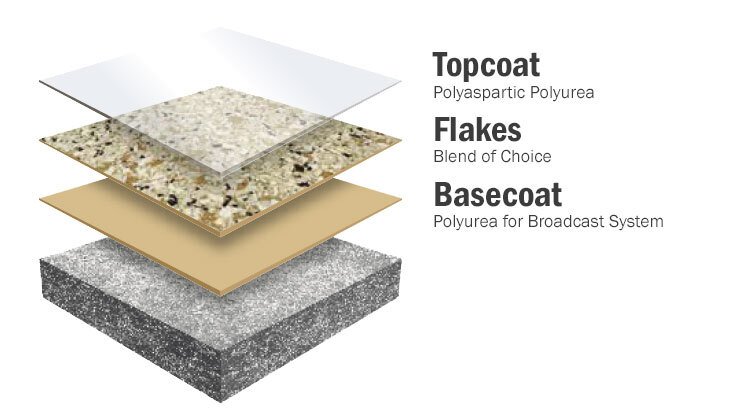
Why Surface Preparation Matters More Than the Brand Name
This is the part that decides everything, and it is the part that gets cut when a price looks too good.
Coatings rarely fail in the middle of the film. They fail at the bond line, where the coating meets the concrete. If that bond is compromised, the finest material available still peels — in sheets, taking the flake and topcoat with it.
- Mechanical grinding, not acid etching. Diamond grinding opens the concrete and creates a surface profile the coating can key into. It also removes the weak, dusty top layer left by the finishing process. Acid etching is a shortcut that produces a far less reliable bond.
- Removing contamination. Old sealers, curing compounds, paint, adhesive residue and soaked-in oil all have to come off. Deeply penetrated oil may need dedicated treatment first.
- Crack and spall repair. Cracks get chased out and filled with an appropriate repair material, and spalled or crumbling areas get rebuilt. A coating spans a crack briefly and then telegraphs it, so this happens first.
- Weak or damaged concrete. If the slab surface is soft or delaminating, coating over it just bonds the film to material that is already failing.
- Moisture. This is the one homeowners rarely hear about and the one that causes the most failures in Florida. Concrete slabs transmit water vapor from the ground upward. Older slabs poured without a vapor retarder underneath can push enough moisture through to lift a coating from below, no matter how well the surface was ground. Testing beforehand is what tells you whether a standard system will hold or whether a moisture-mitigating primer is needed.
A premium coating installed over poorly prepared concrete will still fail. If you are comparing quotes and one is dramatically cheaper, the difference is almost always in the preparation.
What Does a Professional Garage Floor Coating Process Look Like?
- Inspect the concrete. Age, condition, previous coatings, cracks, spalling, oil contamination and how the garage actually gets used.
- Check for damage and moisture concerns. Testing for moisture vapor transmission before committing to a system, rather than discovering the problem afterward.
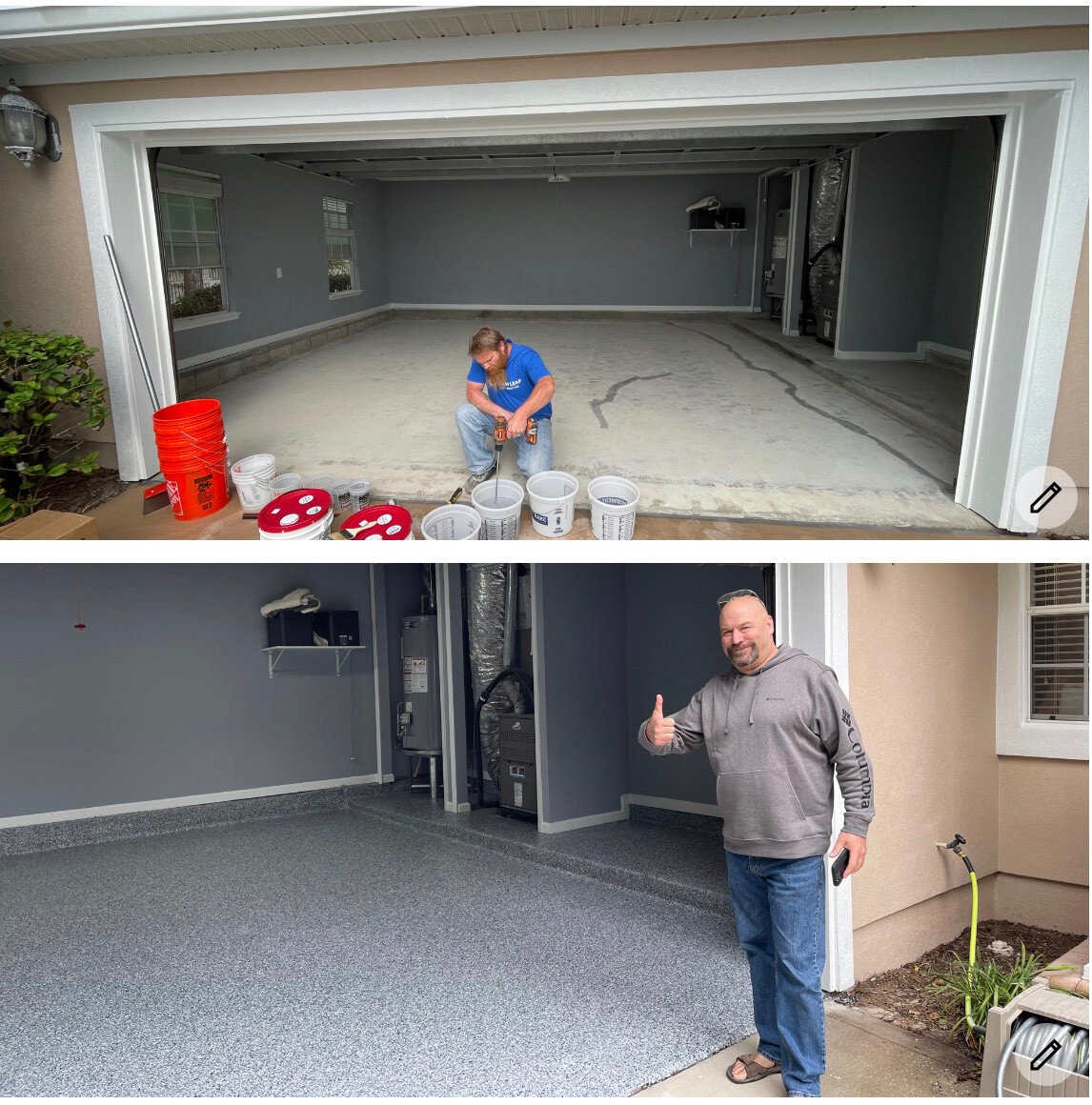
- Mechanically grind the surface. Diamond grinding across the full slab to remove contamination and create the profile the coating needs.
- Repair cracks and spalls. Filling, patching and rebuilding damaged areas so the finished floor is sound and level.
- Apply the base coat. Epoxy or polyurea, depending on the system specified for your slab and conditions.
- Broadcast decorative flake. If your finish includes flake, it is scattered into the wet base — to refusal for a full-flake look, or lighter for partial coverage.
- Scrape and prepare the flake surface. Excess flake is removed and the surface knocked down so the topcoat goes over an even profile rather than sharp edges.
- Apply the clear protective topcoat. Usually polyaspartic, and this is the layer doing most of the work against abrasion, UV and chemicals.
- Allow proper cure before use. Foot traffic and vehicle traffic have different requirements, and the manufacturer’s schedule governs both.
Timelines vary. Some systems can be completed in a single day under the right conditions, while others need a longer cure schedule between coats. Anyone who quotes the same turnaround before seeing your slab is quoting a process, not your floor.
Are One-Day Garage Floor Coatings Worth It?
They can be genuinely convenient. Fast-cure polyurea and polyaspartic systems allow grinding, base coat, flake and topcoat within one working day, which matters if you cannot lose the garage for most of a week.
But speed is a property of the chemistry, not a measure of quality. A one-day system is not automatically better than a multi-day one, and it is not automatically worse. What actually determines how the floor performs is the same list as always: how well the concrete was prepared, whether moisture was addressed, whether the system suits your conditions, and whether the installer respected the working time and cure requirements the manufacturer specifies.
The honest caution is this — fast-cure materials are less forgiving. Short pot life means an installer has limited time to get the material down correctly. Done well, the result is excellent. Done in a hurry by someone unfamiliar with the product, speed becomes the problem rather than the selling point.
Garage Floor Coating Colors and Finishes
Most residential garage floors land in one of a few categories:
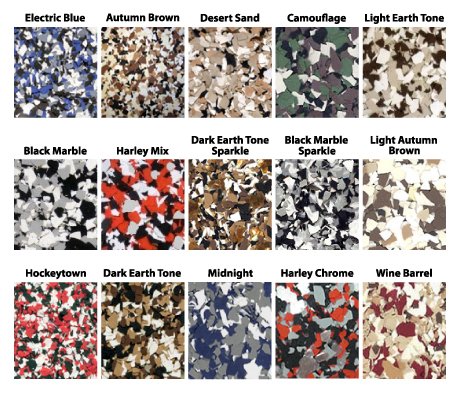
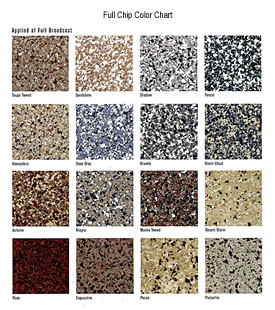
- Full flake. Flake broadcast to refusal, producing a dense, uniform granite-like surface. It hides dirt and imperfections better than anything else and adds surface texture.
- Partial flake. A lighter broadcast that lets the base color show through. Cleaner and more contemporary, though it shows dust more readily.
- Solid color. No flake, just a pigmented base and clear topcoat. The most modern look and the easiest to wipe down, but it also shows every mark.
- Metallic and decorative finishes. Pigments manipulated during application to create depth and movement. More common in showcase garages than working ones.
Gloss level is a separate decision from color. High gloss brightens the space dramatically and makes the floor easier to clean, but shows dust and tire marks sooner. A satin finish is more forgiving day to day.
Slip resistance is worth raising during your estimate rather than after installation. Additives broadcast into the topcoat increase traction, which matters most where a wet car pulls in from a Florida afternoon storm and water tracks across a glossy floor.
How Much Do Garage Floor Coatings Cost in Jacksonville?
Cost varies more here than homeowners expect, because so much of the price is what the slab needs before any coating goes down. Two identical two-car garages differ substantially if one has cracks, a failing coating and a moisture issue while the other is sound bare concrete.
The factors that move the number:
- Square footage, and how much cutting-in the layout requires
- Condition of the concrete — cracks, spalling, pitting, previous coatings to remove
- Extent of repair work needed before coating
- Which coating system is specified
- Finish choice — solid color, partial flake, full flake, metallic
- Number of coats and total film build
- Depth of surface preparation required
- Whether moisture mitigation is needed
For a breakdown of how these factors translate into a real number, see our guide to garage floor coating cost in Jacksonville. Any accurate figure for your garage comes from someone looking at your slab.
How to Maintain a Coated Garage Floor
- Sweep or vacuum regularly. Grit is abrasive, and dragging it under tires or a rolling tool chest is what dulls a finish over time.
- Mop with a mild cleaner. Warm water and a gentle detergent handle almost everything. Harsh or aggressive chemicals are rarely necessary and can dull the topcoat.
- Clean spills promptly. The coating buys you time, not immunity. Wipe up automotive fluids rather than leaving them to sit.
- Protect against heavy and sharp objects. Use pads or mats under jack stands, tool chests and workbench legs, and avoid dragging metal across the floor.
- Inspect occasionally. Look at high-traffic areas and the spot where your tires sit. Catching a small area of wear early is much easier than addressing a large one later.
When DIY Garage Floor Coating Makes Sense
A homeowner kit is a reasonable choice when the conditions line up:
- A small, single-bay garage
- Sound, clean concrete with no significant cracking or spalling
- No previous coating to remove
- No sign of moisture problems
- You are willing to rent a grinder and actually prepare the slab rather than etching it
- Realistic expectations about film thickness and lifespan compared with a professionally installed system
When Professional Installation Makes More Sense
- Two-car garages and larger, where working time becomes a real constraint
- Cracks, spalling or pitted concrete needing repair first
- An existing coating that has to come off
- Any suspicion of moisture coming up through the slab
- Heavy-use garages — workshops, lifts, frequent vehicle traffic
- Full-flake or metallic finishes, where the broadcast and knockdown steps are largely a matter of technique
- Shop, warehouse or multi-bay floors, which overlap with commercial painting and coating work
- You want the floor to hold up for the long term rather than the near term
If your garage falls into several of those categories, professional garage floor coating is generally the better use of the money — mostly because the grinding and moisture assessment are the parts that are hardest to replicate at home.
Garage Floor Coatings in Jacksonville and Northeast Florida
Northeast Florida garages deal with conditions that matter for this work. Humidity affects how coatings cure and makes application conditions worth planning around. Slabs in older neighborhoods were often poured without a vapor retarder, which is exactly the moisture scenario worth testing for. Closer to the water, salt exposure and sand tracked in from the beach add abrasion that inland garages do not see. And garages here tend to run hot, so hot-tire pickup — where warm tires lift a poorly bonded coating — is a real failure mode rather than a theoretical one.
A New Leaf Painting Contractors has worked on Northeast Florida homes since 2001 and installs garage floor and concrete coating systems throughout Jacksonville and nearby communities including Nocatee, Ponte Vedra Beach, Fleming Island and St. Augustine. If you would like someone to look at your slab and tell you what it actually needs, call 904-615-6599.