
By Thomas Drake, Owner — A New Leaf Painting Contractors
Founded 2001 · 5,000+ Projects · Jacksonville, FL
Here’s a question most Jacksonville homeowners have never been asked: do you know what type of stucco is on your home?
Most don’t. And it’s not their fault — the two types look nearly identical from the street. But under the surface, they’re fundamentally different systems with completely different painting requirements. Using the wrong approach on the wrong type can cause a paint job to fail in months — and in worse cases, cause moisture damage to the structure beneath.
The Two Types of Stucco on Jacksonville Homes
Traditional Stucco (Portland Cement Stucco)
Traditional stucco is a cementitious system applied in multiple coats directly over metal lath attached to the framing. The material is literally cement — Portland cement mixed with sand, water, and sometimes lime. When cured, it’s hard, dense, and heavy. It bonds directly to the substrate and becomes a rigid shell around the home.
- Hard and rigid when cured
- Dense — typically 7/8 inch or more in thickness for three-coat systems
- Breathable — moisture vapor can pass through
- Develops hairline cracking from thermal movement over time
- Repairable with standard stucco patching compounds
Synthetic Stucco (EIFS — Exterior Insulation and Finish System)
EIFS — pronounced “eefs” — is an entirely different product that looks similar to traditional stucco but works on completely different principles. An EIFS system consists of insulation board attached to the sheathing, a base coat with fiberglass mesh, and a thin textured acrylic finish coat.
- Soft — the foam beneath means the surface can be dented with finger pressure
- Thin finish coat over insulation board
- Designed to allow controlled vapor transmission through the system
- Does not develop the same crack patterns as traditional stucco
- Requires specific coatings that maintain vapor permeability
How to Tell Which Type You Have
The simplest test: press firmly on the stucco surface with your thumb. If there’s any give — any flex or softness beneath the surface — you likely have EIFS. Traditional stucco over concrete block or properly applied over metal lath is hard and unyielding.
- Age: Homes built in the 1990s and 2000s in St. Johns County communities are more likely to have EIFS. Older homes in established Jacksonville neighborhoods are more likely to have traditional stucco.
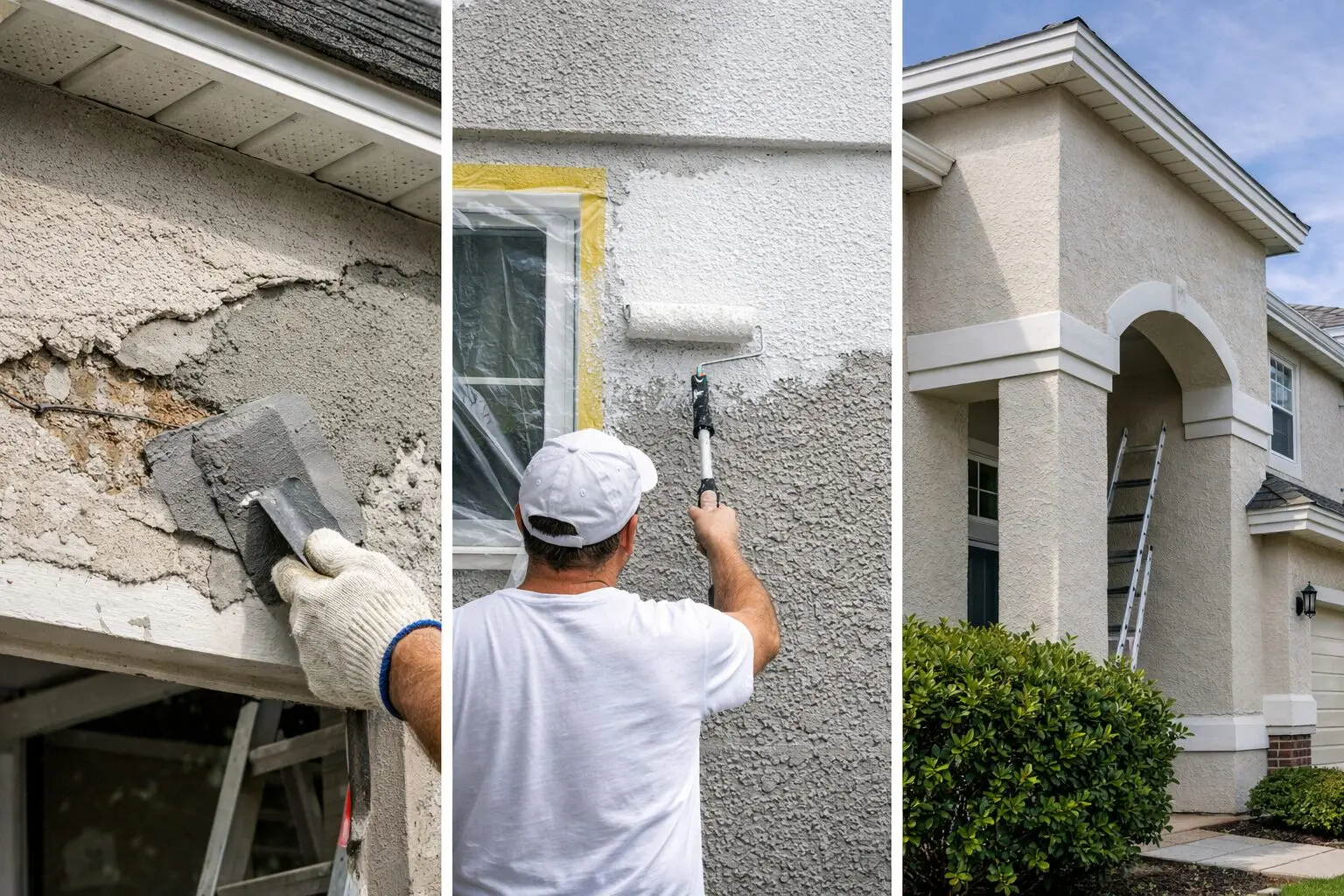
- Thickness: Traditional stucco shows a thick grey cementitious layer beneath damaged sections. EIFS shows a thin coat over white or grey foam board.
- Sound: Knock on the surface. Traditional stucco over block sounds solid and dense. EIFS over foam has a slightly hollow, softer sound.
Why the Painting Requirements Are Completely Different
Traditional Stucco: The Primary Goal Is Waterproofing
Traditional stucco is breathable — moisture vapor can pass through the cement system from inside to outside. The goal when painting is to add waterproofing protection against exterior moisture intrusion while maintaining vapor permeability. Elastomeric coatings excel here — they bridge hairline cracks, create a waterproof barrier, and remain permeable enough to allow vapor transmission.
Synthetic Stucco (EIFS): The Primary Goal Is Maintaining Vapor Permeability
EIFS systems are engineered with a specific moisture management approach. Moisture that gets behind the finish coat needs a path to escape. This is the critical difference. On traditional stucco, you want maximum waterproofing. On EIFS, you need waterproofing that still allows vapor transmission.
High-build elastomeric coatings can reduce vapor permeability to the point where moisture vapor from inside the wall assembly cannot escape — trapping humidity in the foam board and causing delamination of the entire system.
- Use acrylic coatings specifically rated for use on EIFS systems.
- Use products from the same manufacturer system when possible.
- Avoid standard high-build elastomeric coatings not rated for EIFS.
- Avoid aggressive power washing — EIFS is softer and can be damaged by high pressure.
What Every Jacksonville Homeowner Should Know
- If you have traditional stucco: Crack repair followed by elastomeric base coat and premium acrylic topcoat is the professional standard. Expect 10 to 15 years from a properly prepared surface.
- If you have EIFS: Confirm the coating products before any painting begins. The painter needs to specify EIFS-compatible products. Expect 8 to 12 years from a properly maintained system.
- If you’re not sure which you have: Ask. Any painting contractor who doesn’t ask which type of stucco you have — or can’t identify it themselves — lacks the specific knowledge to properly spec your job.
A New Leaf Painting: Stucco and EIFS Specialists in Jacksonville, FL
A New Leaf Painting has been working with both traditional stucco and EIFS systems across Jacksonville, Ponte Vedra Beach, Fleming Island, Amelia Island, and all of Northeast Florida since 2001. We identify the system before we quote, specify the appropriate products for each system, and apply them correctly.
Call (904) 615-6599 or visit anewleafpainting.com/contact-us for a free stucco assessment.
Thomas Drake founded A New Leaf Painting Contractors in Jacksonville, FL in 2001. The company has completed more than 5,000 interior and exterior painting projects across Northeast Florida and holds 750+ verified five-star reviews.