Why HOA Paint Colors Get Denied in Nocatee, Sawgrass & St. Johns County
If you live in Nocatee, Sawgrass, RiverTown, Palencia, or any of the master-planned communities across Northeast Florida, you already know the drill: before you can repaint your home, the Architectural Review Board (ARB) has to sign off. What most homeowners don’t know is that paint applications are often delayed or denied for the same handful of avoidable reasons — and almost all of them are fixable before you submit.
After painting hundreds of homes across St. Johns County and Northeast Florida, we’ve watched the same mistakes get applications denied over and over. Here’s what the boards are actually looking at, and how to give yourself the best shot at first-time approval.
Quick Answer
Why do HOA and ARB paint applications get denied?
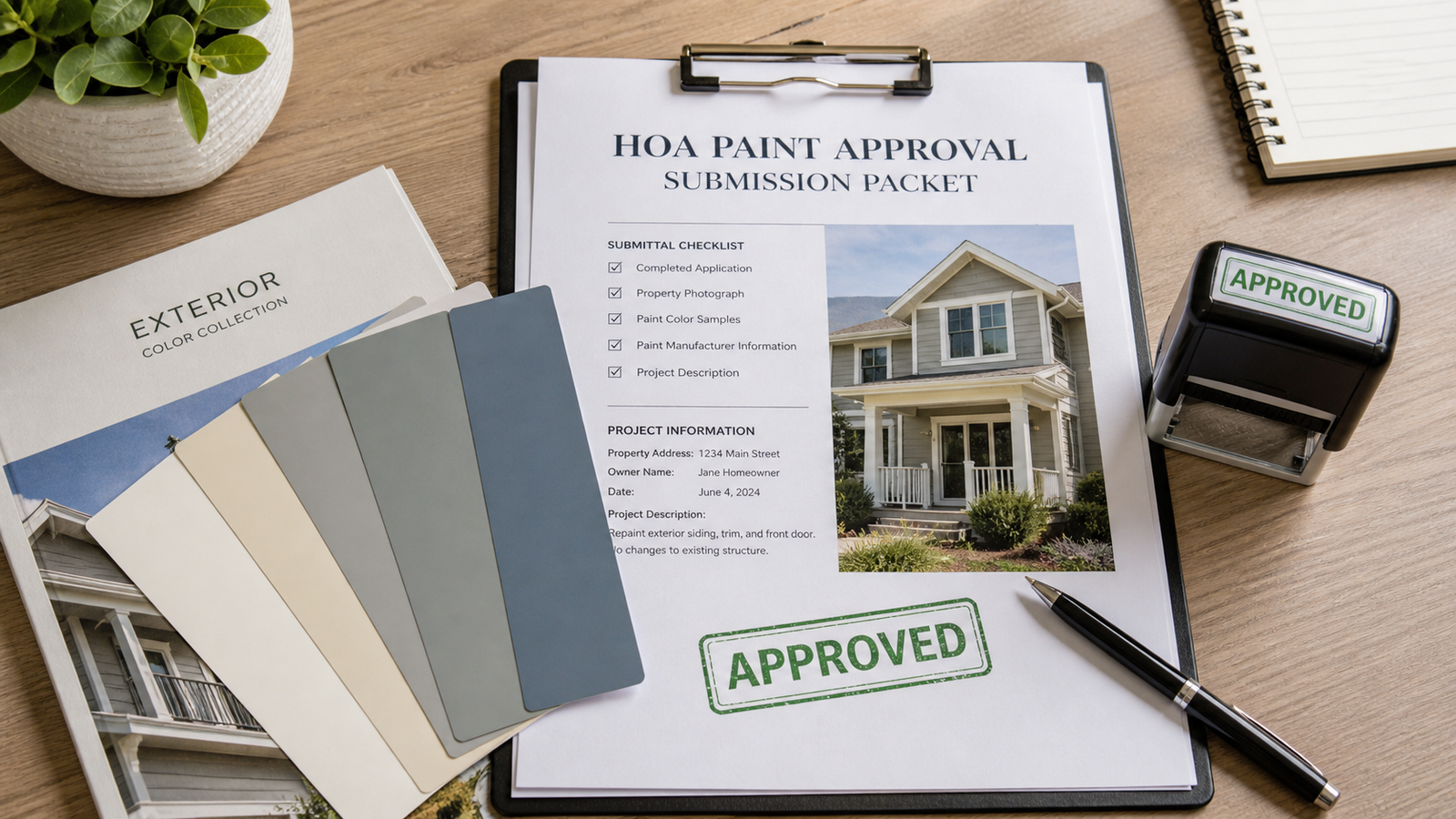
Most HOA and ARB paint color submissions get delayed or denied for the same preventable reasons: the application is missing details, the selected color is too close to a neighboring home, the color is not on the approved palette, manufacturer codes or sheen weren’t included, or the home shows surface conditions that raise prep concerns. In communities like Nocatee, Sawgrass, RiverTown, and Palencia, the safest path to first-time approval is submitting a complete packet with color names, codes, LRV when required, labeled photos, placement details, and contractor documentation — and waiting for written approval before painting begins.
The Non-Adjacency Rule That Gets “Approved” Colors Denied
Before you fall in love with a color, walk outside and look at the houses directly to your left, your right, and across the street. Many Jacksonville-area HOAs — Nocatee and RiverTown are among the strictest about this — enforce a Non-Adjacency rule. Even if a color is on the official approved list, the ARB can reject your application if a neighboring home already has it.
We check for this before we even write your estimate. It is one of the most common reasons a “safe” color choice gets denied, and it’s the most frustrating to discover after the fact. If your dream color is taken by your next-door neighbor, you need a Plan B before you submit anything.
Why “Same Color” Repaints Still Need HOA Approval
This one trips up sellers and long-time owners constantly. If you’re repainting in what you believe is the same color the house was originally painted, ask yourself a hard question: is the current paint 7+ years old?
Florida UV is brutal. It shifts pigment dramatically over time, especially in earth tones, deep blues, and any color with red oxide in it. If you put a fresh coat of the original color on a faded house without ARB approval, the finished home can read as a completely different shade than what your neighbors have grown used to seeing for the last decade. ARBs in many communities will treat this as an unauthorized color change — even though the name on the can never changed.
The fix is simple: submit the application anyway, even for a same-color repaint. It costs you nothing and it protects you.
The Stucco Condition That Can Raise ARB Questions
Walk to the side of your house that gets the most afternoon sun. Run your hand across the stucco. Is there a white, chalky powder on your palm?
That is chalking, and it is the sign of builder-grade paint disintegrating off your wall. ARBs in newer communities like Nocatee, eTown, and RiverTown are increasingly attentive to surface condition — if your home shows significant chalking, the board may push back on your application until you confirm proper surface prep is part of the project.
If a painter tells you they can just “paint over that,” walk away. That chalk has to be pressure washed off and then sealed with a specialized chalk-binding primer like Sherwin-Williams Loxon. Skip that step and your new paint job can start peeling within 24 months — and the warranty, if you have one, won’t cover it.
Why Dark Exterior Colors Get Extra Scrutiny in Florida
Charcoal, deep navy, and “moody” black exteriors are everywhere on Pinterest right now. Before you submit one to the ARB in Florida, check which way your home faces.
Dark exterior colors absorb significantly more solar heat than light or mid-tone colors, especially on south- and west-facing walls under the Florida summer sun. On stucco homes, that added heat can accelerate expansion, cracking, fading, and coating stress. Some ARBs in Ponte Vedra Beach and Sawgrass have started flagging dark color requests on south- and west-facing elevations for this reason — not to deny them outright, but to confirm the homeowner understands the trade-offs and is using a coating system designed for the thermal load.
If a homeowner wants a dark color, we look carefully at the surface, exposure, and product system before recommending it. That often means specifying premium exterior coatings like Sherwin-Williams Duration or Emerald, or Benjamin Moore Aura, rather than builder-grade paint — and having a realistic conversation about long-term performance before the application ever goes in front of the board. Dark colors aren’t impossible in Florida. They just need the right plan.
What ARBs Usually Check Before Approving Exterior Paint
Most ARB reviews come down to the same set of questions. Before you submit, work through this list:
- Is the color on the community’s current approved palette?
- Does an immediately adjacent or directly facing home already use the same color?
- Are the body, trim, door, garage, and shutter colors clearly labeled?
- Are manufacturer color names and codes included?
- Is sheen listed for each surface?
- Is LRV included if the community requires it?
- Are current photos of each elevation attached?
- Are painted sample boards required for your community?
- Does the home show chalking, peeling, mildew, or failed caulk that should be addressed first?
- Is contractor documentation on file (insurance, business information, registration where applicable)?
- Does the project timeline match what’s been submitted?
What ARBs Are Actually Trying to Prevent
It can feel personal when an application gets pushed back. It usually isn’t. ARBs are working from the same architectural guidelines they apply to every home in the community, and they’re trying to prevent a specific set of outcomes:
- Homes that clash with the established streetscape
- Identical or near-identical colors appearing side-by-side
- Extreme color contrasts between neighboring properties
- Poor surface prep that creates visible coating failure within 1–3 years
- Inconsistent placement of trim, door, and accent colors across the elevation
- Unapproved changes that generate neighbor complaints
- Paint systems that fail prematurely under Florida sun, salt air, and humidity
Understanding what the board is protecting against makes the approval process feel less like a gauntlet and more like a shared interest — yours and theirs — in the home aging well.
First-Time Approval Risk Levels
Where does your application sit before you submit it? Use this rough framework to assess your risk:
Likely First-Time Approval
Approved palette color, no matching adjacent neighbor, complete packet, clear labeled photos, neutral or mid-tone body color, documented surface prep, contractor information on file.
Expect Possible Questions
Same-color repaint without current written approval, darker accent color, missing LRV, uncertain match against immediate neighbors, sheen not specified, partial photo documentation.
Likely Delay or Denial
Dark body color on south/west elevation, color outside approved palette, no neighbor color check completed, missing product specs, visible chalking with no documented prep plan, painting started before written approval.
How to Improve Your Chance of First-Time Approval
If you want to give your application the best possible shot at sailing through on the first review:
- Start with your HOA’s current approved palette — not last year’s, not what your neighbor used five years ago
- Walk the street and check immediate neighbors’ colors
- Choose body, trim, door, garage, and shutter colors as one coordinated set
- Include manufacturer names and color codes (not “warm beige”)
- Add LRV values when your community requires them
- Attach labeled photos of each elevation
- Use painted sample boards if your community is strict about them
- Include product and prep details from your painter
- Submit before scheduling the crew
- Wait for written approval before any paint touches the wall
What Actually Gets Approved on the First Try
The applications that move quickly through Nocatee, Sawgrass, Palencia, and RiverTown ARBs share a few things in common.
A clean color submission with the actual manufacturer name and code — Sherwin-Williams Duration or Emerald, or Benjamin Moore Regal or Aura — all carry weight with reviewers who recognize the brands as legacy exterior products with proven UV protection and weather resistance.
Photographs of the body, trim, and accent placements clearly labeled.
Confirmation that no immediately adjacent neighbor has the same color — this alone gets you past one of the most common reasons for denial.
Contractor documentation on file. Some ARBs ask for proof of insurance, business information, workers’ compensation documentation, or registration information when applicable to the scope of work.
How A New Leaf Painting Helps Homeowners Prepare for ARB Approval
When we estimate a home in an ARB community, we walk the street, photograph the neighbors, pull the community’s current approved palette, and check it against what’s already on adjacent homes. We hand you a pre-vetted color package and the paint-related details your application is likely to request — color names, codes, sheen, LRV when needed, product specifications, and prep scope — before you ever submit.
It is one of the fastest ways we know to give your submission its best shot at first-time approval. We’ve been painting homes in Jacksonville since 2001, and we’ve seen the most common reasons ARBs delay, question, or deny paint submissions across every major HOA community in Northeast Florida.
Important
Every HOA, ARB, ARC, ACC, and management company has its own rules and review process. This guide is based on our painting experience across Northeast Florida and is for homeowner education — it does not replace your community’s covenants, architectural guidelines, or written HOA approval, and it is not legal advice. Always confirm requirements with your HOA, management company, or governing documents before painting.
Helpful Resources Before You Submit Your ARB Application
If you’re working through a paint color submission in Northeast Florida, these resources from our HOA cluster — and our broader service pages — will save you time and strengthen your application before it goes in front of the board.
Frequently Asked Questions
Do I need ARB approval to repaint the same color in Nocatee?
In most communities, yes. Even same-color repaints typically require written approval because fresh paint can look noticeably different from faded existing paint, and ARBs treat that visual difference as a color change. Submitting the application — even when you’re matching what’s already there — is the safest path.
Why would an approved color still get rejected?
Some communities enforce non-adjacency rules, meaning your home may not be allowed to match nearby homes even if the color is on the approved palette. Other reasons include incomplete documentation, unclear color placement, missing manufacturer codes, or surface conditions that the board wants addressed before painting begins.
Do ARBs care what paint product is used?
Some do, especially when the project involves stucco, dark colors, coastal exposure, or surfaces that need significant prep. Premium product lines like Sherwin-Williams Duration or Emerald and Benjamin Moore Regal or Aura tend to carry weight with reviewers who recognize them as legacy exterior systems built for long-term performance.
Should I submit paint chips or sample boards?
It depends on the community. Stricter HOAs may request physical painted sample boards rather than just digital color names, and some require samples mounted on the actual home for review. Always check your community’s current requirements before submitting.
Can A New Leaf Painting submit my ARB application for me?
The homeowner usually signs and submits the application, but A New Leaf Painting can help prepare the paint-related details your HOA may request — color names, codes, sheen, LRV, product specifications, surface prep scope, and contractor documentation. Final approval always comes from your HOA, ARB, ARC, or management company.
Before You Submit
Want a second look at your HOA paint colors before you submit?
Schedule a free exterior painting estimate with A New Leaf Painting. We’ll help review your color plan, identify potential HOA conflicts, and prepare the paint details your application is likely to request — before the first gallon is opened.